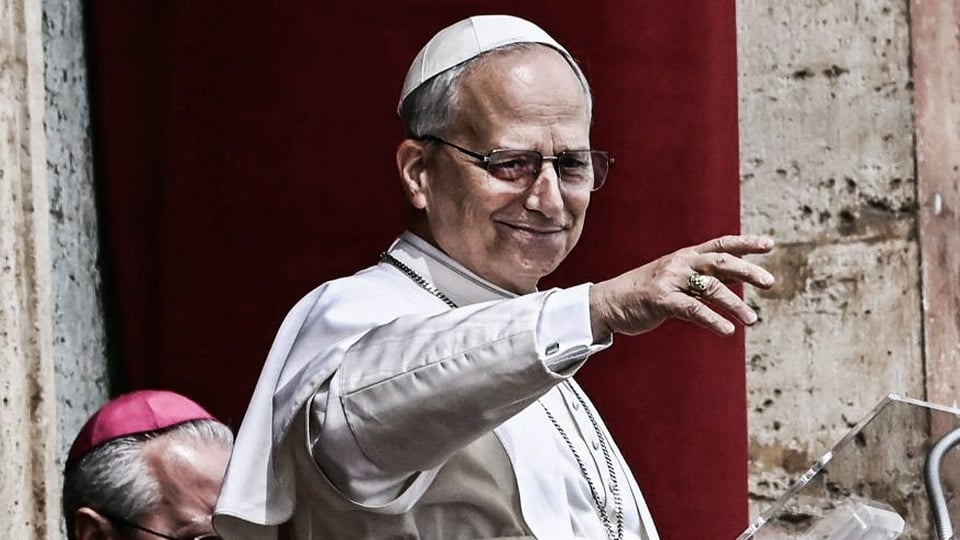

Almost a week after his acceptance, Pope Leo is inevitably already sparking discussions in media outlets around the world. Maintaining a balanced perspective, it is fair to say that it is still too early to offer a historical or even theological interpretation of his pontificate. However, we can gradually highlight some indicative details of his ecclesiastical leadership that have already emerged in these first few days.
Christ, the Pope, the Church
A small clarification: looking at a Pope’s past as a bishop and cardinal is certainly useful for understanding his thinking, but one must remember that such an analysis is always quite limiting.
This is true for two reasons—one natural and one supernatural, so to speak. The natural reason is that once a man becomes Pope—and thus becomes unjudgeable (according to the famous canonical formula: Prima Sedes a nemine judicatur nisi a Deo)—he might express positions that he had previously kept discreet or concealed, either to avoid pressure or marginalization by higher authorities.
The supernatural reason, on the other hand, is related to the grace of state.
The papacy is not primarily an honor, but a great cross. After all, the Pope is the Vicar of Christ, and in everything, he is called to share in the power of the Lord—including the cross. I believe Pope Leo is aware of this.
We must not forget that when a cardinal is elected Pope and he pronounces the famous word Accepto (“I accept”), he is sealing a marital and supernatural contract between himself and the Church. In this sense, the Pope is truly the Vicar of Christ, where “vicar” means the one who fully shares the power entrusted to him. Christ is the Supreme Pontiff of the Church, Christ is the Bridegroom of the Church, but in handing the keys of Heaven to Peter, He grants him His entire authority—without Peter being able to go “beyond” it. However, he also cannot diminish the power of the papacy.
Well, the grace of state of the papacy can truly transform the man designated for such a great ministry.
The Magisterium of Tears
Let us return for a moment to the day Pope Leo appeared on the Balcony of St. Peter’s Square. Few analysts have perhaps highlighted the tears that Prevost showed to the world. Those tears are not to be taken for granted, despite the fact that the place where the Pope prepares before making his first public appearance is called the “Room of Tears.” That emotion is the sign of that entirely human weakness that God can transform into strength.
The papacy is not primarily an honor, but a great cross. After all, the Pope is the Vicar of Christ, and in everything, he is called to share in the power of the Lord—including the cross. I believe Pope Leo is aware of this.
During the Missa pro Ecclesia (May 9, 2025), in his first homily as Pontiff, he explicitly said: “You have called me to carry that cross, and to be blessed with that mission.” Those tears are already a magisterial act, renewed last Sunday during Leo’s first Regina Coeli.
The new Pope is a mathematician, philosopher, theologian, and canonist. A man who is both a mathematician and a canonist inspires hope, not only for the rigor of method and a love for precision and order but also for his awareness of this specific aspect of the Church’s crisis—the crisis of right.
The Crisis of Law
There is another aspect I would like to highlight. In an article of mine published in The European Conservative on the eve of the 2025 Conclave, I wrote:
“One aspect that [Benedict XVI and Francis] neglected—albeit in very different ways—was the role of right in the life of the Church. Benedict XVI preferred to resort to legal mechanisms as little as possible, favoring a more spiritual rather than institutional leadership. Francis, on the other hand, has often circumvented or even bent the law to his own ends, using it selectively. […] Yet, this very “crisis of right”—marked by ignored norms, improvised procedures, and unjustified removals—remains one of the most serious and structural legacies left behind. It is unlikely, however, that the cardinals will recognize it as such. The dynamics at play are probably unfolding on other fronts: pastoral, geopolitical, media-related, and even economic. The risk, however, is that a problem undermining the Church’s cohesion and credibility from within and in the long term will continue to be overlooked.”
My concern has, to some extent, been acknowledged. The new Pope is a mathematician, philosopher, theologian, and canonist. Additionally, he is an Augustinian, and Saint Augustine himself stated that peace—one of the key words in his agenda—is “the tranquility of order” (cfr. De Civitate Dei XIX, 13.1).
A man who is both a mathematician and a canonist inspires hope, not only for the rigor of method and a love for precision and order but also for his awareness of this specific aspect of the Church’s crisis—the crisis of right. Moreover, it is highly reassuring to know that the newly elected Pope is open to the proposals and advice of two esteemed cardinals, both canonists and conservatives, such as the Hungarian Péter Erdő and the American Raymond Leo Burke—two Church figures who are undoubtedly conscious of the current crisis of right and law in the Catholic church.
The new pope is, however, also a philosopher and a theologian. This is not given for granted. Today, in fact, there is a tendency to study philosophy without theology, or theology without philosophy, but this is a modern and mistaken approach—counterproductive and harmful—because one cannot fully understand either without the other. Moreover, Robert Francis Prevost studied philosophy in the United States of America, at Villanova University (Pennsylvania). Why is this aspect so important? The answer is simple: philosophy is not studied in the same way throughout the world. Today, two major traditions of philosophical study exist globally: the continental model and the analytical model.
However, we must overcome the risk of confusing the unity of the Church—one of her four essential marks, founded on truth—with a confederation of diverse and even contradictory positions. I do not expect from this Pontiff a rapid or sudden solution to this grave problem of today’s Church. Nevertheless, it is certainly necessary for him to begin working in this direction.
The continental model developed mainly in Europe with thinkers such as Hegel, Heidegger, and Derrida. This model favors a holistic view of problems rather than their analysis, but above all it prefers the historical approach, often linked to subjective experience and the changing of social conditions. Continental philosophers tend to explore themes such as existence, consciousness, and society, using a more literary and less structured style compared to analytic philosophers. Joseph Ratzinger is an example of a continental theologian.
Analytic philosophers, on the other hand, seek to break down philosophical problems into simpler parts (analysis, precisely), using a rigorous, logical, and systematic method to reach precise and verifiable conclusions. This latter approach is much closer to medieval scholasticism, which was based on logical argumentation and a dialectical method to deepen theology and philosophy, and on the assumption that truth is objective. Prevost studied this kind of philosophy – I assume. I would like to emphasize how this aspect of Prevost’s formation is not marginal: I am writing this as a philosopher who studied under both models, in Italy (continental) and in Switzerland (analytic).
The Key Words of the Pontificate of Leo XIV
In the previous article introducing Leo XIV, I stated that there are three words that present his governing agenda. We await the publication of his first encyclical—which is usually also programmatic for the entire Pontificate—to confirm or correct the analysis. However, I believe I can already discern a very important fourth key word.
To recap: the words are ‘peace’ and ‘justice’ with regard to the Church’s external relations, toward the world; and ‘unity’ and ‘mission’ with regard to the Church’s internal relations, with her own children. These are undoubtedly four pressing needs of contemporary ecclesial life. Pope Leo’s official coat of arms itself bears as its motto a quotation from Saint Augustine: in illo uno unum, “in the one Christ we are one.” This motto is explanatory in this sense.
As I wrote elsewhere, however, we must overcome the risk of confusing the unity of the Church—one of her four essential marks, founded on truth—with a confederation of diverse and even contradictory positions. I do not expect from this Pontiff a rapid or sudden solution to this grave problem of today’s Church, because the pope must lead and govern Christ’s Institution with prudence and sound realism.
Nevertheless, it is certainly necessary for him to begin working in this direction. Here, then, is one of the great tasks of this Pope: to labor for the true unity of the Church.
As has been said, Pope Leo XIV was elected as a pope of convergence. He gathered the votes of those who loved Bergoglio, of those who have opposed him to varying degrees, of those who wanted to block Parolin, of those who simply let themselves be carried along, and of those who sincerely believed in the former Prefect of Bishops. In short, Prevost was the name that brought everyone together—but this is not enough to create the unity of Catholics.
True unity is communion, that is, to have together a munus, a divine gift, which is the Catholic Faith, that is, universal, destined for all men of good will.
Moreover, the Code of Canon Law devotes an entire section to the concept of the Synod of Bishops. No scandal, then, if Pope Leo says: “We want to be a synodal Church, a Church that walks” (May 8, 2025). Francis used synodality as a pretext, on the one hand, to expand the consultative power from the bishops to the laity, and even to non-believers and enemies of the Church, in order to democratize the definitions of faith and morals; Leo could use the same synodality to restore the consultative role of bishops and cardinals and the subsidiarity of the Church.
The fourth key word to highlight is “mission.” Over the past twelve years, Pope Bergoglio—very astutely, rhetorically speaking—has continually repeated that there is a substantial difference between proselytism and mission, and that Catholics should be missionaries without seeking to make proselytes.
An artificial distinction, not immediately clear, and evidently of Rahnerian origin: according to the Jesuit Karl Rahner, in fact, it would not be necessary to speak of Jesus Christ in order to be missionaries. He spoke of “anonymous Christianity,” a concept still very popular among Jesuits today.
According to this idea, even those who are not formally Christian can live according to Christian values and thus be saved by God’s grace. Rahner held that God works in every person, regardless of their religion, and that those who live with “love and justice”, even without knowing Christianity, can be considered “anonymous Christians.” The necessity of sacramental grace, therefore, is not just relegated to second place—it is removed.
For Francis, similarly, “mission” would mean announcing the Gospel through works of love (read: philanthropy), without inviting anyone to conversion. Proselytism, on the other hand, would be an aggressive attempt to convince others to change religion, often with insistence or pressure.
As is evident, there is no middle ground between these two poles. The authentically Catholic sense of mission has always been another: to show others, through the example of life and the teaching of doctrine, the necessity of becoming Christians in order to attain eternal salvation.
Pope Leo seems to have taken up again the centrality of Christ and the necessity of having Christ as the sole point of reference for bringing man back to God. This aspect prompts us to reflect on another important dimension of the new Leonine pontificate.
Pope Prevost, regardless of his actual opinion of Bergoglio’s pontificate, is well aware of the damage caused by his predecessor and, to some extent, I believe, will seek to remedy it.
A Pope Who Will “Convert” Bergoglio’s Lexicon?
Whoever expects Prevost to erase or take a clear and strong stance against Bergoglio’s Magisterium is not only thinking very naively, but also forgetting that the Church has always been governed according to a criterion of prudence and with an eye to the long term.
Those who read my writings will have noticed that I often like to recall the ancient Roman adage that represents the modus operandi of the Roman Catholic Church: cunctando regitur mundum, “one governs the world by delaying.” This criterion is fundamental, and is well known and applied even by revolutionaries, because it is the only effective one.
Francis too, as a good Jesuit, knew and applied this principle. In this sense, we must understand another recurring and apparently cryptic phrase of Bergoglio: “Time is greater than space.” The precise interpretation of these words was given to us at the time by the ultra-Bergoglian cardinal Víctor Manuel Fernández, who, in an interview on May 10, 2015, with the Italian newspaper Il Corriere della Sera, said:
“The Pope moves slowly because he wants to be sure that the changes have a deep impact. Slowness is necessary for their effectiveness. He knows that there are some who hope that with the next Pope everything will go back to the way it was. If one goes slowly, it’s harder to go back. He makes this clear when he says that time is greater than space. (…) One must understand that he aims for irreversible reforms. If one day he senses that he has little time left, and not enough to do what the Spirit is asking of him, you can be sure he will speed up.”
This is exactly what happened. Francis accelerated during the final period of his reign, fearing he would not have enough time to lay all the revolutionary premises, which—like noxious weeds—will continue to sprout and infest the good field even after his death, unless someone takes action to uproot them.
Pope Prevost, regardless of his actual opinion of Bergoglio’s pontificate, is well aware of the damage caused by his predecessor and, to some extent, I believe, will seek to remedy it.
One of the methods he will adopt—so as not to scandalize the vast multitude of Catholics who are, in fact, unaware of what really happened in recent decades—will consist in a gradual “conversion” of the many concepts introduced by Francis. After all, we must not forget that the constant strategy of the neomodernists is a terminological one: it does not so much consist in coining new words, as in using the vocabulary of Catholic tradition, emptying it of its original meaning, and filling it with revolutionary content.
What Pope Prevost can (and must) do is to take these same words and refill them with their authentic meaning. The word ‘mission’, for example, can once again become Christocentric.
However, to discern the actual direction of this pontificate, it will be decisive to observe to whom Leo XIV will entrust the leadership of the Roman dicasteries: a choice that could either confirm or contradict the initial direction.
Likewise, the word ‘synodality’ may undergo the same healthy restoration. After all, the concept of ‘synod’ is authentically Catholic. It refers to the entire college of bishops assembled to discuss matters pertaining to faith, morals, and pastoral care. The term comes from the Greek synodos, meaning “walking together,” but it refers to the consultative dimension of the episcopate—not to a democratic transformation of the Catholic Church.
The Pope, in fact, has never been a monad. While he holds primacy over all the bishops of the world and is the source of the power of jurisdiction, it is fitting and prudent for him to listen to the needs, requests, and appeals of the People of God, through the mediation of the “overseers”—the bishops themselves—who are called throughout the world to nourish Christians with the bread of the Word and the Eucharist.
Pope Leo XIV could restore the proper weight and role to the cardinals who, according to Canon Law, “assist the Roman Pontiff, acting collegially when they are summoned together to consider matters of greatest importance, and individually, through the various offices they fulfill in aiding him especially in the daily care of the universal Church” (can. 349); and likewise to the bishops.
Let us remember that “it is [exclusively] the prerogative of the Roman Pontiff, according to the needs of the Church, to determine and promote the ways in which the College of Bishops may exercise its office collegially for the universal Church” (can. 336 §3).
Moreover, the Code of Canon Law devotes an entire section to the concept of the Synod of Bishops. There we read:
“The synod is a group of bishops who have been chosen from different regions of the world and meet together at fixed times to foster closer unity between the Roman Pontiff and bishops, to assist the Roman Pontiff with their counsel in the preservation and growth of faith and morals and in the observance and strengthening of ecclesiastical discipline, and to consider questions pertaining to the activity of the Church in the world.” (Can. 342)
No scandal, then, if Pope Leo says: “We want to be a synodal Church, a Church that walks” (May 8, 2025). Francis used synodality as a pretext, on the one hand, to expand the consultative power from the bishops to the laity, and even to non-believers and enemies of the Church, in order to democratize the definitions of faith and morals; and, on the other hand, to centralize the governance of the Church in his hands.
Leo could use the same synodality to restore the consultative role of bishops and cardinals and the subsidiarity of the Church, according to which the pope is responsible for resolving disputes of common interest, while the bishops handle local issues due to their greater proximity to them.
Also regarding synodality, it is appropriate to remember what Robert F. Prevost said in Chiclayo, Peru, on March 14, 2023. It was the day when the Augustinian monk, until then the bishop of Chiclayo, bid farewell to his diocese because he had been appointed by Francis as Prefect of the Dicastery for Bishops and President of the Pontifical Commission for Latin America:
“Yesterday marked ten years since the election of Pope Francis. I knew Jorge Mario Bergoglio, Archbishop of Buenos Aires. At the time, I was the General of the Augustinians. I had met him several times, and when he was elected, I said to some of my confreres: ‘Well, this is a very good thing: thank God I will never become a bishop.’ I will not tell you the reason, but let’s just say that not all encounters with Cardinal Bergoglio were always in full agreement, let’s say, between the two of us, not always with mutual consent.”
Some Concluding Considerations
The symbolic gesture of Leo XIV establishing himself in the Apostolic Palace, breaking with the anomaly introduced by Francis, marks a visible return to the solemnity of the papacy and its universal role, not reducible to that of a mere Bishop of Rome.
In continuity with this choice, the sincere Marian devotion manifested by the new Pontiff — as shown by his visit to the Shrine of Our Lady of Good Counsel in Genazzano and the spontaneous singing of the Regina Coeli during his first occasion — reveals a heart deeply anchored in Catholic spirituality, where Mary is the principle of every authentic ecclesial renewal.
However, to discern the actual direction of this pontificate, it will be decisive to observe to whom Leo XIV will entrust the leadership of the Roman dicasteries: a choice that could either confirm or contradict the initial direction.
The fundamental question remains — though never too far in the background — will he be a Pope in fullness, or will he limit himself to being the Bishop of Rome? For it is the crisis of the Papacy and the Magisterium, and not anything else, that is at the root of the crisis of the priesthood, the liturgy, and the faith itself. Only an authentic restoration of doctrinal authority can fully reopen the paths of Grace within the ecclesial body.