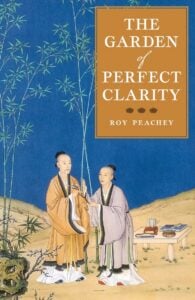
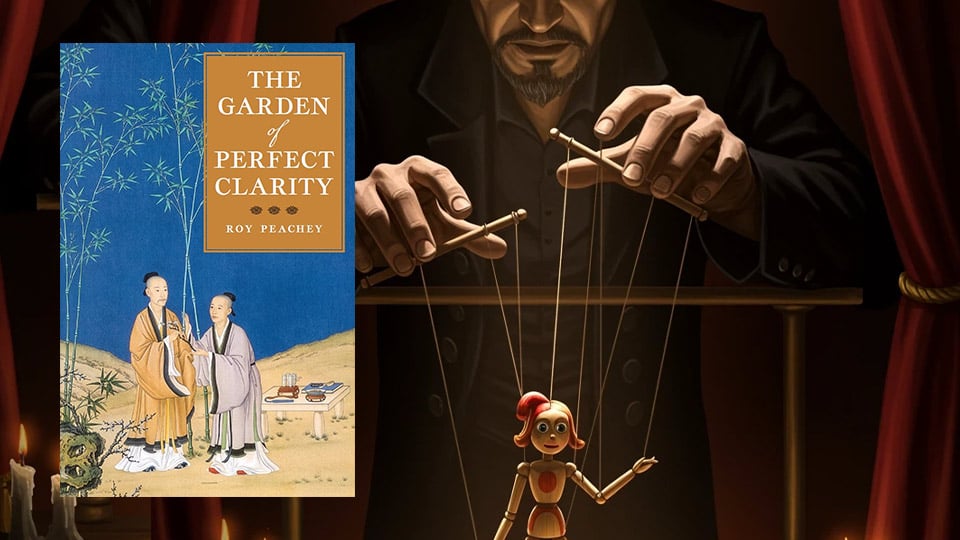
I seldom write about personal experiences but will do so briefly here, in this reflection on Roy Peachey’s newly released book, The Garden of Perfect Clarity. On the basis of stellar endorsements from (among others) Fr. Armand de Malleray (FSSP), and Professors Anthony Esolen, Joseph Pearce, and Peter Kwasniewski, I purchased a Kindle version of the book and started reading it that evening. After the first few pages, I realized that Mr. Peachey happens to be an extraordinary writer; and by the third chapter it was clear that he was writing from a genuinely Catholic perspective. Owing to my need to stay up later than usual to monitor a tornado warning in my area, I sat at the foot of my stairs and kept reading, amazed both by the book and the trees swaying violently outside. Then I made it to the beginning of chapter nineteen, in which the book’s narrator, Acheson, says:
“I was mopping the stairs the day the red boat came.”
At some point during the course of that chapter introducing the red boat and the puppet masters it carried to Acheson’s city, we lost power. As the following chapters would reveal, the red boats brought spiritual darkness to the city that was infinitely more harmful than the darkness that the storm had brought to my house.
The red boats bring more than political upheaval; they bring a spiritual darkness that Catholics will immediately recognize.
The lack of power gave me time to finish the book, which is excellent, and see the light eventually overcome the darkness, at least partially. Even so, as nightfall returned to my still powerless house, I pondered the meaning of the puppet masters and the evils they had brought with them. Shortly after midnight, I awoke with what seemed like an epiphany: the city’s eager welcome of those masters of unreality was like a curse. A few seconds later the power came back on (as did the bright lights). In the book, as in my weekend of reading it, the puppet masters brought darkness; and that darkness remained for so long as the puppet masters were not seen for what they are.
Acheson hails from England, but through a heart-rending episode, this child ends up on a ship bound for China. He probably should have lost his life on that voyage, but he instead survives through the help of a Catholic priest, Jacobus. In scenes which are too beautiful to spoil, Acheson learns a few things from this priest, including the language of his destination and a piece of advice that he will soon need, which he recalls after having been thrown off his ship once it arrived in China:
“The mocking laughter of my fellow sailors swirled after me as I looked back at the ship which had become my home. I had heard the same stories of strangulation and flaying, the same gruesome tales of cages set up in town squares and prisoners being paraded in cangues, as had the captain, and I was almost as fearful of my fate as he was certain of it. Almost but not entirely, because Jacobus had roundly denounced such tales on the only occasion I had dared mention them to him. ‘There is cruelty in every land,’ he said, ‘because there are men in every land, but it is a gross calumny to claim that my country is notable for such tortures. I do not say it lightly, for I have gained much from my journey to the west, but I would suggest that those who speak such nonsense look first at the motes in their own eyes.’ I held onto these words as firmly as a drowning man holds onto scraps of driftwood and, shaking myself free of the sea and the distant taunts, started the long trudge inland towards whatever end might await me, armed only with the language Jacobus had taught me and the brittle adaptability of youth.”
From that moment until the introduction of the red boats, Mr. Peachey treats his readers to Acheson’s adventures in confronting the ordinary cruelties of his new city with the “brittle adaptability of his youth.” It ends up being very easy to root for Acheson.
This is not merely historical fiction. It is a warning for our own time.
And then the red boats appear with their puppet masters. From that point on, it is no longer simply a contest of natural virtues versus natural cruelties and vices — the red boats bring a real spiritual darkness and distortion of reality to the story, which the Catholic reader will likely come to see as part of a battle that has raged since the fall of Satan. Mr. Peachey might have conveyed the same dramatic action by simply echoing the horrors of the Cultural Revolution, but his stunning portrayal of the puppet masters helps us to see the book’s revolution in light of the first revolution, in which God tasked St. Michael with intervening.
During that period of darkness, Acheson has a series of falls, many of which he regrets deeply. At every step, though, his sins stop short of the wickedness of so many around him. His unwillingness to fully imbibe the revolutionary spirit ultimately allows him to choose sacrifice over cowardice, though he does not get the decision right until after learning from his failures.
In addition to rooting for the young Acheson, most readers will come to admire the aged Acheson we find at the end of the book. Mr. Peachey gives us just enough Catholic influence in the book, especially through Jacobus, to allow us to see the crucial role of grace in getting Acheson to the point at which we have some hope that he could eventually find God’s truth. In an even more tangible way, the mother-figure in Acheson’s life, Xiaomei, shines as the real beauty of the book. Together, Jacobus and Xiaomei are able to overcome the darkness of the puppet masters to lead Acheson to a place at which he can appreciate some light and thirst for still more.
When the truths of the Catholic Church are obscured, the lies of the puppet masters rush in to fill the void.
Catholic lessons abound in this book for those who are inclined to seek them. Most of those lessons are evident with attentive reading, but there is one insight from Mr. Peachey’s “Author’s Note” at the end of the book that could be worthwhile for those wanting a head start in appreciating the Catholic ideas in The Garden of Perfect Clarity:
“Much of what Europeans knew about China in the eighteenth century came, directly or indirectly, from the Jesuit missionaries who had established themselves in the Chinese court from the early seventeenth century. For almost 150 years, they had been the trusted advisors to the Qing emperors. They had also converted thousands of people across the country, as Liam Matthew Brockey shows in his definitive account, Journey to the East: The Jesuit Mission to China, 1579–1724. Of their many achievements, it is worth highlighting just two. First, Jesuit artists and architects designed and built a series of European pavilions in the Qianlong emperor’s summer palace, the Yuanmingyuan or Garden of Perfect Clarity. This Garden was an extraordinary place. In the words of Richard E. Strassberg, it was an intricately structured, man-made landscape of hills, ponds, watercourses, islets, terraces, groves, flowering plants, rocks, and a full array of garden architecture, from corridors and gazebos to halls and temples. It contained more than 650 individually named structures and some 130 formal views. The Garden of Perfect Clarity was both Chinese and Western, both familiar and strange. It was solidly there and it pointed beyond itself.”
When Acheson arrives in China, this Jesuit influence has already dissipated to a large extent, but it is not entirely lost. These remnants of Catholicism, coupled with the natural virtues exhibited by Xiaomei, and the spiritual intercession of Jacobus, are what overcome the darkness of the puppet masters, at least in Acheson’s life.
But not everyone overcomes the darkness. The loss of true Catholic influence, and the accompanying disdain for reality, ultimately pave the way for darkness to prevail over many. One of the clearest harbingers of this comes shortly before the horrors of the revolution are fully developed, as the supposed intellectual authority of the city, Tangren, has opened the doors of his House of Learning for the public to ask him questions. One exchange shows why Acheson’s city had become such fertile ground for the evils the puppet masters would soon harvest:
“Some of the older scholars joined him in shouting insults. The old man bowed and took his seat. ‘Master, which is stronger: the dark or the light?’ a third man asked. ‘Coming as brightness, I hit the brightness. Coming as darkness, I hit the darkness,’ Tangren replied. ‘That is the only answer you need to know.’”
Instead of truth, the “master” offers only insults and nonsense. Distressingly, those who lack understanding lap it up, as though it were truth and goodness. All too often we see the same dynamic from the leaders not only of our nations but also the Catholic Church.
Authentic Catholicism is not an ornament to civilization—it is often the only thing standing between light and darkness.
Our fallen human nature stands no match against the darkness without God’s truth and grace. When the truths of the Catholic Church are lost or obscured, the wickedness and lies of the puppet masters stand ready to fill the void. Through repentance and sacrifice, Acheson eventually shuts the door to this darkness, but Mr. Peachey leaves us with a real sense that this was only possible through the intercession of an authentic Catholicism that many no longer find today, one that is ready to give everything to honor God and save souls. When that is missing, the darkness spreads with little opposition. But if, by the grace of God, souls can follow Acheson in recognizing the unholy darkness as a curse, they can repent and begin to give room in their lives for the light that Our Lord died to give us.
Mr. Peachey has a rare talent, but what makes The Garden of Perfect Clarity such a treasure is something that need not be all that rare: a view of reality from a truly Catholic perspective. For this, we must learn again to trust our eyes, unwaveringly follow our consciences, and firmly reject those who seek to deceive us. Immaculate Heart of Mary, pray for us!