

“Because men have rejected reason and, above all, revelation, they are vulnerable to occult forces. For a religion of modern secular humanism is powerless intellectually to stem the rush to the coves of occultism. Indeed, secular humanism is one of the primary causes of the revival of the religion of Satanism.”1
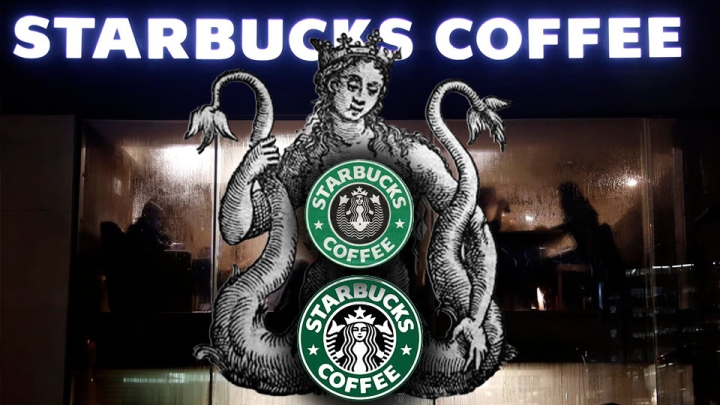
Now that Christmas is over and Starbucks will be putting away the pumpkin-spice lattés till next fall, it is time to think of other matters having to do with Starbucks—namely its use of the strange-looking image on its logo…
Catholic Geraldine Cominsky writes: “More than 140 of these gargoyle-like images have been found in the British Isles, the vast majority in Ireland, most of them appearing in the stonework of Early Christian churches.”
After looking at the stone image she was referring to, it dawned on me the similarity to a very common image that is saturated all across the land. In fact, the icon she was referring to is called Sile na Gig, and is the iconic business dispensing refreshments under the brand name of the coffee company called Starbucks.
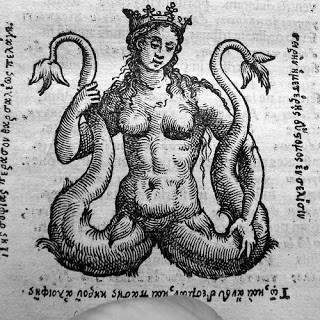
However, the dirty little secret is that the logo has metamorphosed over the years to hide the original look of the bare breasts and vulva depicted in the original version—but it is still the same Sile na Gig. So I conducted my own research online and found out the symbol was adapted from a split-tailed mermaid sometimes called a Melusine, which is a symbol of fertility linked to the Dionysus cults of ancient Greece; e.g. the symbol is commonly found—among others—in medieval Romanesque churches in Tuscany (Italy), dating up to XI century D.C. She dates as far back as 2000 BC, and her image is found in ancient Sumerian tablets.
I won’t go into the entire history of the Starbucks logo, but suffice to say that there have been many cosmetic changes over the years, as one blogger says, “Obviously, the bare-breasted look [and exposed vulva] wouldn’t play in Peoria, so they covered her up.”

Here is the official history of the Starbucks logo, according to the FAQ on the Starbucks webpage: “When we were originally looking for a logo for Starbucks in 1971, we wanted to capture the seafaring tradition of early coffee traders. […] We pored over old marine books until we came up with a logo based on an old sixteenth-century Norse woodcut: a two-tailed mermaid encircled by the store’s original name, Starbucks Coffee, Tea, and Spice.”
Catholic blogger Scott Smith has extensively researched the Starbucks logo. He has noted some similarities with a figure referred to as Lilith as she is usually depicted as a beautiful woman from the waist up and as serpentine from the waist down. Smith has previously written about Lilith, and the appropriation of her name and likeness by radical feminists and pro-abortion groups, such as the Lilith Fund, which raised money for so-called emergency abortions in the wake of Hurricane Harvey in 2017.
Smith relates:
Lilith has been called “the goddess of a thousand faces,” but she’s no goddess. Sometimes described as Adam’s first wife among her promoters, she is typically described in literature as the devil’s own wife and a “child eater.” Lilith is actually an entire category of demons. The Lilith is a sexually wanton demon that comes in the night and steals newborn babies. There are ancient Sumerian prayers for women and newborns that call for protection from the lilith. She even appears in Scripture.
Getting back to Starbucks, an Ohio woman noticed the following atheistic message stamped on the side of her coffee cup: “Why in moments of crisis do we ask God for strength and help? As cognitive beings, why would we ask something that may well be a figment of our imaginations for guidance? Why not search inside ourselves for the power to overcome? After all, we are strong enough to cause most of the catastrophes we need to endure.”
The thing is though: does the demon logo mean anything to the owners’ of Starbucks beyond just an attractive image? What I mean is that—is there an occultic ritual that goes with it that might explain the success of Starbucks?
Not only that, but according to 2nd Vote that’s just the beginning of Starbucks’ list of offenses:
(1) Starbucks not only supports same-sex marriage, but even signed an amicus brief asking the Supreme Court to overturn state marriage laws in Obergefell v. Hodges (2015);
(2) Starbucks contributes to Girls Inc., another pro-abortion organization; and
(3) Starbucks received a score of 100 on the Human Rights Campaign’s (HRC’s) Corporate Equality Index. The HRC is the standard-bearer for the liberal LGBTQ political agenda, which also opposed religious freedom.
The thing that irks me the most about the Starbucks logo is that the owners could have changed the look to get rid of the privates entirely. And yet, in the latest incarnation they are still incorporating the split tail—although conveniently hidden. In fact, this to me is a sign that the owners are, more likely than not, mocking and ridiculing the many Christians who frequent their establishments. After all, what better way to say “IN YOUR FACE!” then to have a demonic, immodest image displayed on the coffee cup in the hands of the very people who are known for wholesomeness and proper morals?
You can hardly go anywhere without seeing one. They are in nearly all the grocery stores, and many department stores. The thing is though: does the demon logo mean anything to the owners’ of Starbucks beyond just an attractive image? What I mean is that—is there an occultic ritual that goes with it that might explain the success of Starbucks? Unfortunately, I cannot answer that question.
However, maybe the late Fr. Miceli can give us a clue:
What explains the current revival of occultism and witchcraft? It is my strong conviction that the decline of Christian faith has led to the decline of man’s confidence in the powers of human reason and truth. Man has concluded today that all truth is relative. There is no real standard nor universally accepted method for its verification. Thus, epistemological relativism allows man to access truth on his own personal experiences, no longer on the endless chain of coherent, logical reasoning. But since reason can no longer support itself, it is not surprising that it no longer can support revelation. Thus, faith, too, has come to increasingly rely upon personal dogmatic assertion and experience. In rejecting the permanent authority of truth as founded by God in reality, reason and revelation, man set himself up as the autonomous source of all truth. Yet man is to himself an insoluble dilemma. He admits that some phenomena of experience give him much factual truth. He can even give a certain order to these facts with his intellect, but he cannot explain their existence nor their intelligibility. Moreover, man must admit that there remain many phenomena which his autonomous intellect cannot explain. This is the realm of mystery, the area of the “not yet known nor experienced.” Despairing of his reason or of revelation to make this realm intelligible to him, man has convinced himself that he can get in contact with the mysterious, with the unknown, by means of his emotions and his will. To aid himself in making this contact man has consulted the seer, the fortune teller, the prophet, the sorcerer, the medium. Hence man is no longer a philosopher nor a believer; he has become the atheistic scientist who has gone on a ghost hunt. For without the God of reason and of revelation, man is condemned to dabble at diabolism. This to explain the many phenomena that escape rational laws, man has recourse to table tapping, to spiritualists, witches, séance people, yoga people, the Mystical Church of Cosmic Vibrations people. He has become in large numbers the only too willing victim of the swamis, gurus, mahatmas, healers, mumblers and holy men, many of whom claim they have been chosen by God in miraculous visions granted them on trips made to heroin heaven. 2
I believe I can provide an example of where the occult most likely did provide a measure of success for the British blues rock band Fleetwood Mac that was started back in 1967 by singer and guitarist, Peter Green. The band went through a number of incarnations over the year, but had never attained any serious recognition or fame. By the end of 1974, four original members had departed, which left the band without a guitarist and male vocalist. This came about with the addition of Lindsey Buckingham and his girlfriend, Stevie Nicks. The duo had tried to make it on their own—with no real success. However, as if they were anointed, Fleetwood Mac’s next album topped the Billboard 200. The album was a breakthrough for the band and became a huge hit, reaching No. 1 in the US, selling over 7 million copies. The next one, Rumours, reached No. 1 one in multiple countries around the world and won the Grammy Award for Album of the Year in 1978, becoming one of the biggest selling rock albums of all time, generating four top-ten singles.
What could have accounted for such startlingly dramatic success? Well, it might have something to do with the fact that Fleetwood Mac’s singer, Stevie Nicks, was deeply involved in witchcraft.
What could have accounted for such startlingly dramatic success? Well, it might have something to do with the fact that Fleetwood Mac’s singer, Stevie Nicks, was deeply involved in witchcraft. Rolling Stone called her “Fleetwood Mac’s blond priestess of the occult” (Sept. 17, 1981, p. 57). She has dressed as a witch on some of her solo album covers. Her music was published under the name “Welch Witch Music.” She said her song “Rhiannon” is about a Welsh witch. She incorporated crystal balls into her album covers. The promotional booklet for her 1983 Wild Heart Tour says: “She believes in angels, witches and magic wands.”
However, Satan plays for keeps! and ultimately demands your soul—but he is willing to wait. The devil does not give out fame and riches without expecting something in return; the band experienced marriage breakups, infidelities, drug addiction, and at least four abortions that we know of by Stevie Nicks.
But you see, there was a really good reason for the first abortion, as she says, “If I had not had that abortion, I’m pretty sure there would have been no Fleetwood Mac.” She further added that, “There’s just no way that I could have had a child then, working as hard as we worked constantly.” Nicks also said of her role in Fleetwood Mac: “I would have had to walk away, and I knew that the music we were going to bring to the world was going to heal so many people’s hearts and make people so happy.”
So, there you have it—Nick’s abortion was “needed” in order to heal so many, and to make them happy. A wise priest one said that man is incapable of evil; instead, he or she has to generalize it to the supposed good that will come from it.
So, getting back to Starbucks: maybe there is something more to the use of a demon prominently displayed on their logo? Whether it is or isn’t, should we really give them the benefit of the doubt? Think of it: what if they are using your money to do more than the despicable things listed previously? Couldn’t there be better places to spend or donate your hard-earned money?
References:
- The Antichrist, Fr. Vincent Miceli, 1981, p 241
- Ibid. p 241
