
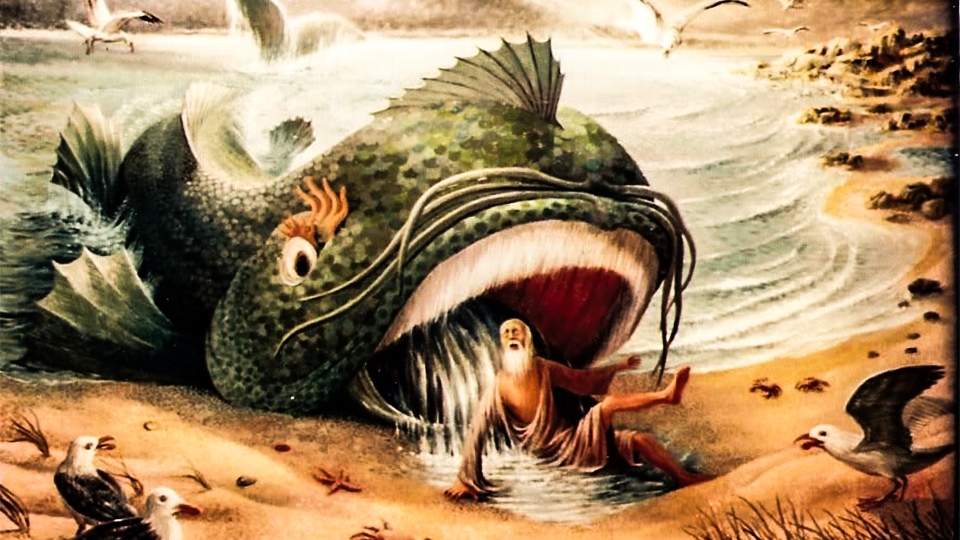

One of the most fascinating stories in the Old Testament is that of Jonah the wandering prophet. Called by God and sent to deliver a warning to the inhabitants of the city of Nineveh, he seeks to escape such a mission, which he considered impossible:
“And Jonas rose up to flee into Tharsis from the face of the Lord, and he went down to Joppe, and found a ship going to Tharsis: and he paid the fare thereof, and went down into it, to go with them to Tharsis from the face of the Lord” (Jonah 1:3).
Jonah’s flight from before the face of God astonishes us. Is that not what sinners do? Do they not—beginning with Adam and Eve—seek to hide from the Most High? Do they not constantly build towers (like Babel) through which they wish to make a name for themselves, forgetting or ignoring that “every best gift, and every perfect gift, is from above, coming down from the Father of lights, with whom there is no change, nor shadow of alteration” (James 1:17)? But if sinners act this way, why did Jonah flee—a prophet to whom God spoke directly? Here is a question that suggests the presence of a mystery whose depths are not easily explored. That is precisely why we must seek the necessary clues in the sacred text itself.
Saint Maximus uses the prophet’s experience to illustrate a true and complete immersion of fallen human nature. This immersion refers to the descent into the abyss of death associated with ignorance of the supreme Cause of all creation: God.
In the fourth and final chapter of Jonah’s story, we find a possible explanation for the prophet’s “desertion:” he is angered by the mercy he anticipated God would show to the pagan inhabitants of the great city of Nineveh. For instead of punishing them for their countless sins, the Creator and King of the universe spares them, accepting their repentance. Yet Jonah, zealous like the apostles who wished to call down fire from heaven upon the Samaritans who asked the Lord Jesus Christ to leave their land (Luke 9:54), desires the punishment of the wicked. Then God gives him one final lesson—valid for all who are quick to anger and slow to mercy: after “the Lord God prepared an ivy, and it came up over the head of Jonas, to be a shadow over his head, and to cover him (for he was fatigued),” He sends a worm that “struck the ivy and it withered” (Jonah 4:6–7).
In this context of a profound divine lesson—from which we learn that God does not wish to destroy or punish souls, but to save them (Luke 9:56)—the episode of the prophet being swallowed by a great fish always leaves us stupefied. As I have said in other articles, God is the greatest writer imaginable. The stories of Holy Scripture, on the one hand filled with deep meanings like a well whose bottom cannot be reached, are on the other hand truly spectacular. The Book of Jonah even inspired the famous fairy tale The Adventures of Pinocchio (1883), written by the Italian Carlo Collodi (1826–1890). But the extraordinary events found in biblical stories are not meant merely to astonish us—they are meant to teach us, to convey a divine message. Therefore, it is entirely natural to ask what profound meaning might be hidden in Jonah’s immersion—his being hidden in the belly of the colossal fish. Here, we are helped by the most brilliant master of sacred text interpretation, Saint Maximus the Confessor (c. 580–662).
First of all, he presents the meanings of names based on their etymologies. Thus, Joppa “signified virtue when it is translated as ‘wondrous beauty,’ knowledge when it is taken as ‘watchtower of joy,’ and wisdom when it signifies ‘powerful joy’.”[i] Essentially, all these etymologies—based both on the original Hebrew terms and their Greek translation in the Septuagint—indicate the symbolic meaning of the city of Joppa, which represents Paradise itself. But if this is the case regarding the name of the city where Jonah’s adventure begins, then the prophet symbolizes human nature which, as the text of Genesis tells us, “falls” from Paradise as a result of the original sin committed by Adam and Eve:
“We observe the nature of human beings perpetually fleeing from Joppa, like Adam from paradise on account of his disobedience, fleeing, that is, from the stable habit of virtue and knowledge and the wisdom associated with them. This is because the human mind is intensely fixated on evil things and is voluntarily dragged away to the sea, by which I mean the brine of sin, in the same way that our forefather Adam slipped and fell from paradise into this world.”[ii]
Delving deeper into this interpretation, Saint Maximus describes the fall of the foreparents and their expulsion from Paradise in terms of drowning. Specifically, it is as if Adam and Eve had fallen into a tumultuous sea, sinking into the abyss.
The most interesting part comes only after the symbolic analogy between Jonah and universal human nature has been firmly established. Delving deeper into this interpretation, Saint Maximus describes the fall of the foreparents and their expulsion from Paradise in terms of drowning. Specifically, it is as if Adam and Eve had fallen into a tumultuous sea, sinking into the abyss. The description is extraordinarily vivid and expressive:
“The prophet Jonah, then, signifies Adam, that is, the common nature of human beings, and in himself he mystically figures our nature, which slipped away from the good things of God, as if from Joppa, and descended, as though into the sea, into the misery of this present life. Our nature, I say, which was submerged in the chaotic and roaring ocean of material attachments; which was swallowed by the whale, that intelligible and insatiable beast, the devil; and which was inundated by water on all sides, taking on, up to its very soul, the water of temptations to evil, so that human life was submerged in temptations; and which was encompassed by the final abyss, that is, imprisoned by the complete ignorance of the intellect, and overwhelmed by the great weight of evil pressing down on its power of reason.”[iii]
The Fall and expulsion from Paradise are synonymous with a descent into the depths of matter and the enslavement of human souls, whose intellectual light—unsupported by the light of supernatural grace—has become darkness (Matthew 6:23). Jonah’s being swallowed by the great fish symbolizes the engulfing of fallen human nature by the devil. For, if we recall traditional theological teaching, we know that original sin not only brings death upon human nature, but also subjects it to the slavery of the devil, who manipulates all humanity through the fear of death.
If we view the ritual of Holy Baptism through this perspective opened by Saint Maximus’s interpretation, we can understand all its key elements: the immersion and raising of the neophyte from the water (seen most clearly in baptism by immersion) point to that very act which our Lord Jesus Christ taught—He being the only master capable of such a teaching—to the apostles: walking on water. As we know from the Gospel of Matthew, Peter was the “pioneer” of this extraordinary act (Matthew 14:25–32). The Savior Jesus Christ encouraged him and supported him above the waters, showing us by his example that all who are baptized must remain upright, above the tumultuous “waters” of this fallen world.
It is hard to find a more fitting description of the disintegration of knowledge in fallen man, a disintegration reflected in the countless false religions, forms of idolatry and superstition, and, in the Christian era, the innumerable heresies with which the Church has been confronted through the centuries.
Not by chance, the Book of Revelation contains the strongest image of this kind, presenting those who “had overcome the beast, and his image, and the number of his name, standing on the sea of glass” (Revelation 15:2). This perfectly corresponds with the symbolic image of the Church as a ship floating above the abyss. Therefore, take heed: it is not by our own power that we can walk on water, but through the graces God imparts to us through His Church. Only through these graces do we receive the power to overcome the fallen world. In turn, the exorcisms performed during baptism indicate the liberation of human nature from the devil’s power. And it is not only the one to be baptized who is exorcised: the salt and water used in the ritual are also exorcised. This shows that both human nature and the nature of creation must be delivered from the devil’s evil influence. Leaving the discussion of such aspects to other articles, let us now return to the symbolism of the life of those who have fallen into the watery abyss.
In the case of Jonah, who was swallowed by the gigantic fish, he remained in the darkness of its stomach until God commanded the sea monster to “vomit” him out onto the shore. Saint Maximus uses the prophet’s experience to illustrate a true and complete immersion of fallen human nature. This immersion refers to the descent into the abyss of death associated with ignorance of the supreme Cause of all creation: God.
For Saint Maximus, the opening of the bodily eyes (Genesis 3:7) is, as for Saint Hildegard of Bingen (c.1098–1179), an act that occurs simultaneously with the closing of the eyes of the mind, which once allowed contemplation of the divine world. Thus, through original sin, man lost that form of knowledge which enabled a relationship with God that is unimaginable to us in our fallen state. This is the result of a profound alteration of the cognitive and epistemological faculties of the human soul.
To describe this transformation, one of the most fitting metaphors is that of submersion. Anyone who has dived underwater and tried to see with their eyes wide open knows how distorted everything appears: practically, we can barely distinguish anything without diving equipment (at the very least, proper goggles). This experience points to the captivity in which the intellect of fallen man – the “head” of our soul, as Saint Maximus says – “was locked away, as if in the clefts of dark mountains, by the designs of evil powers, and divided into multiple opinions and false imaginings.”[iv]
It is hard to find a more fitting description of the disintegration of knowledge in fallen man, a disintegration reflected in the countless false religions, forms of idolatry and superstition, and, in the Christian era, the innumerable heresies with which the Church has been confronted through the centuries. Without acknowledging this terrible weakness of our cognitive faculties, a proper remedy is impossible. On the one hand, no doctor can treat a blind person as if he were healthy; on the other hand, the goal of healing must be the recovery of that state of the soul which becomes once again capable of what Dante and the medieval theologians called the “beatific vision.” However, this presupposes surfacing from the tumultuous ocean of the fallen world. And this, of course, can only begin with Jonah’s prayer:
“When my soul was in distress within me, I remembered the Lord: that my prayer may come to thee, unto thy holy temple. They that are vain observe vanities, forsake their own mercy. But I with the voice of praise will sacrifice to thee: I will pay whatsoever I have vowed for my salvation to the Lord” (Jonah 2:8-10).
[i] Saint Maximus the Confessor, On Difficulties in Sacred Scripture: The Responses to Thalassios, Translated by Fr. Maximos Constas, Catholic University of America Press, 2018, p. 488.
[ii] Saint Maximus the Confessor, Op. Cit., p. 489.
[iii] Saint Maximus the Confessor, Op. Cit., pp. 489-490.
[iv] Saint Maximus the Confessor, Ibidem.
