
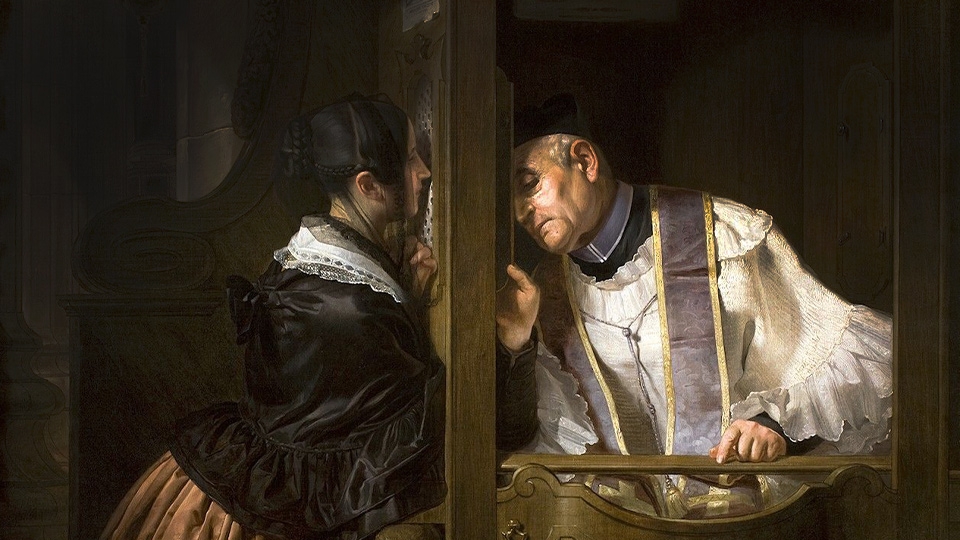

Being in the season of Lent, nothing is more fitting than meditations on the Holy Sacraments—especially Penance and Communion. By associating them with key verses from Holy Scripture, unexpected insights guide our understanding.
Although the essence of the Holy Sacraments consists in what the Roman Catechism (1566)—using Thomistic categories—calls their “matter” and “form” (for example, in the case of Baptism, the water + the words “I baptize thee in the name of the Father, and of the Son, and of the Holy Spirit”), they are nonetheless accompanied by numerous other elements with a pronounced pedagogical character. In other words, gestures, symbols, prayers (i.e., sacred words)—in short, everything—is meant to shape our minds and hearts in order to strive for a deeper union with God.
As the Catechism states, through these elements, “the faithful can contemplate with a pious and attentive mind the meaning of those things which they hear and at the same time see it illustrated by the sacred ceremonies.”[1] And yet, over the years, I have encountered many (especially Novus Ordo) Catholics who not only were unfamiliar with the sacred ceremonies but were also unaware of what is essential in the Holy Sacraments. Once again, the absence of traditional catechesis has devastating consequences.
“I am living for ever and ever, and have the keys of death and of hell” (Apocalypse 1: 18)
For atheists, agnostics, and so-called “non-practicing Catholics,” the greatest danger lies in the complete absence of the sacraments from their lives. In contrast, for the faithful (or “practicing” Catholics), the temptation of ritualism can be present, though difficult to perceive. By “ritualism,” I mean the practice of the sacraments without adequate catechetical knowledge, as well as without meditation and understanding.
If the Church offers us so many symbolic elements that accompany the sacraments their purpose is to elevate our minds, through an understanding sustained by grace, to the divine meanings of these sacraments. As I have shown in other articles,[2] mystagogical catechesis has always been the primary means of providing the foundation for such an understanding. But, like any form of catechesis, it is not a completed process.
No one can claim to know everything or, more importantly, to fully grasp the profound meanings of the Church’s Holy Mysteries. However, when there is a fundamental attitude of abandoning any form of reflection on the sacraments, the danger of ritualism threatens everyone.
If the sacred Traditional rituals themselves can offer us many opportunities for meditation, Holy Scripture can also be of great help. I realized this a few days ago while rereading the Book of Apocalypse for a series of articles dedicated to the seven Churches. A particular verse from the first chapter, accompanied by the commentary of Saint Bede the Venerable, revealed to me the crucial value of the Sacrament of Penance.
Here is, first, the verse from the inspired text written by God through His faithful servant, Saint John:
“I am living for ever and ever, and have the keys of death and of hell” (Apocalypse 1: 18).[3]
“Not only, He says, have I conquered death by Resurrection, but also I have dominion over death itself. And this He also bestowed upon the Church by breathing upon it the Holy Spirit, saying, ‘Whose sins you shall forgive, they are forgiven them; and whose sins you shall retain, they are retained’.”
The one speaking is none other than God the Son, the Risen Christ the Savior. Although we may suspect what kind of keys are being referred to, Saint Bede’s commentary provides all the necessary explanations:
“Not only, He says, have I conquered death by Resurrection, but also I have dominion over death itself. And this He also bestowed upon the Church by breathing upon it the Holy Spirit, saying, ‘Whose sins you shall forgive, they are forgiven them; and whose sins you shall retain, they are retained’.”[4]
The association between the words by which Christ the Savior instituted the Sacrament of Penance (John 20: 22-23 and Matthew 16: 18-19) and “the keys of death and of hell” was, for me, both astonishing and unexpected. Why? Because, like most of you, I had always remembered the words of the Gospels according to Matthew and John, which present—so to speak—the bright side of things.
In both texts, the keys are called—as seen most clearly in Matthew’s Gospel—“the keys of the kingdom of heaven” (Matthew 16: 19). Thus, they serve to open the gates of the heavenly Jerusalem. However, in the text of the Apocalypse, they are called “the keys of death and of hell.” Here, then, the darker side of things is emphasized—hell itself. What is being indicated is the consequence of the gates of Heaven being closed, that is, the failure to use these keys: the opening of the gates of Hell, on which Dante wrote,
“Lasciate ogne speranza, voi ch’intrate” (“Abandon all hope, ye who enter here” – Divina Commedia, Canto III).
Saint Bede the Venerable’s commentary gave me much to think about. I spent an entire afternoon reflecting on the connection between the keys and the Sacrament of Penance. The first thought that came to my mind was the recipients of these words: absolutely and categorically, it is about us, the Christians of the Apostolic (i.e., Catholic) Church. For, as we all know, no one can have access to any sacrament without first passing through the gate that grants us access to them: Holy Baptism. And whoever is baptized, that is, “born again of water and the Holy Ghost” (John 3: 5), is a Christian. Only in this way can one have access to all the other sacraments—including Penance.
The two titles given to the Sacrament of Penance—“keys of the kingdom of heaven,” and “keys of death and of hell”.
Reading Holy Scripture and discovering the two titles given to the Sacrament of Penance—“keys of the kingdom of heaven,” and “keys of death and of hell”—clearly reveals to us divine pedagogy. This pedagogy, especially in recent decades, has been systematically ignored, hidden, forgotten, and even denied by those liturgical revolutionaries who have altered all the sacraments as well as all prayers (especially the Psalms and Exorcisms) so that we might no longer hear anything about hell, punishment, God’s wrath, or His hatred of sin and obstinate sinners.
Holy Scripture does not at all follow this logic of a mercy without justice, without punishment, without judgment. On the contrary, the texts written by God constantly remind us of all the consequences of our actions. Thus, we can go to Confession—preparing ourselves as best as possible and doing so with true humility—obtaining for our souls the opening of the gates of Paradise. Or, on the other hand, we can either refuse to confess or, even worse, confess sacrilegiously. This is exactly what all those “Catholics” do who never confess in the confessional the sins of contraception or abortion—yet do not hesitate to receive Communion as if nothing could happen to them. This not only adds to their sins the sin of scandal, but it is also one of the gravest reasons for the terrible crisis the Church is experiencing today.
To the ears of the penitent, the words “Ego te absolvo” are the whisper of Paradise, the diaphanous sound of the gates of Heaven opening.
As for us, those who are aware of these things, we must, first and foremost, do everything in our power to preserve all the holy, apostolic teachings in our souls, minds, and hearts. Then, we must order them well within our own families, encouraging good preparation for confession (without an excess of scrupulosity!) and a grave seriousness regarding sin. We must also know precisely what constitutes the valid “form” of the Sacrament of Penance (or, if the right form is missing, its invalidity). The Roman Catechism tells us clearly:
“Now the form is: I absolve thee, as may be inferred not only from the words, ‘whatsoever you shall bind upon earth, shall be bound also in heaven’ (Matthew 18: 18), but also from the teaching of Christ our Lord, handed down to us by the Apostles.”[5]
To the ears of the penitent, the words “Ego te absolvo” are the whisper of Paradise, the diaphanous sound of the gates of Heaven opening. To leave things unsaid would be an injustice, so let us recall that the “matter” of the sacrament “is the acts of the penitent,—namely, contrition, confession and satisfaction—, as has been declared by the Council of Trent.”[6]
Reflecting, supported by the biblical texts, that Confession can be, depending on how it is approached, the keys of the Kingdom of Heaven or the keys of death and of hell, let us pray to our Queen, the Holy Virgin Mary, to help us obtain the former: Santa Maria, auxilium Christianorum, ora pro nobis!
[1] Although it refers strictly to Baptism, this statement can of course be applied to all the Sacraments: Catechism of the Council of Trent for Parish Priests, Issued by order of Pope Pius V, Translated into English with notes by John A. McHugh, O.P., and Charles J. Callan, O.P., Tenth Printing 1947, New York-London, p. 162.
[2] See, for example, “The Replacement of the Traditional Roman Catholic Mass and the Need for Mystagogical Catechesis:” https://www.remnantnewspaper.com/articles/item/6714-the-replacement-of-the-traditional-roman-catholic-mass-and-the-need-for-mystagogical-catechesis [Accessed: 12 Mach 2025].
[3] I strongly emphasize that I consider all the books of the Biblical Canon, from the first to the last, written by Traditional authors under the direct influence of the Holy Spirit (therefore, inspired). So, the book of Revelation was written, categorically, by the Holy Apostle John. Any exegesis or “textual criticism” that would tell us otherwise must be rejected without hesitation and thrown into the dustbin of history.
[4] With minor improvements, I quote the text provided online here: https://www.ecatholic2000.com/bede/untitled-06.shtml#_Toc385608314 [Accessed: 11 March 2025].
[5] Catechism of the Council of Trent for Parish Priests, the edition quoted above (note 1), p. 268.
[6] Ibidem.
