
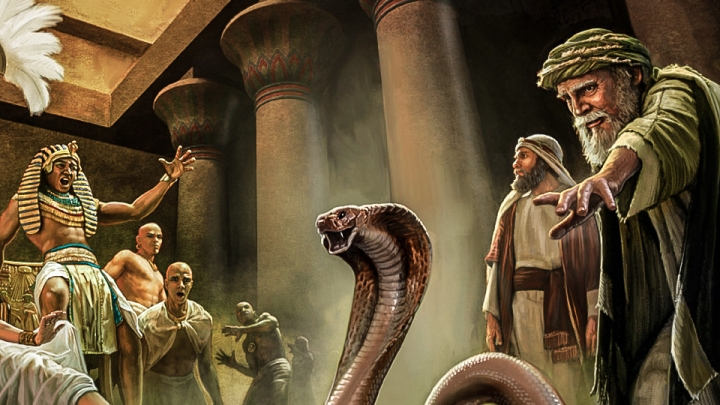

As noted by His Eminence, the French Cardinal Guillaume-René Meignan (1817–1896), an apologist and exegete of the sacred texts of the Bible, what we witness here is a battle between God and the demons disguised as the Egyptian idols—a battle fought on the field of miracles and magic:
“Pharaoh had disdainfully rejected the divine command that Moses brought to him. The Almighty will make Himself known to this proud monarch through the powerful language of miraculous deeds. A sort of combat begins between Moses and Pharaoh, between Jehovah and the gods of Egypt. It is on the field of miracles that the struggle will be fought—a field on which the Egyptians, a people skilled in magic, believed themselves all-powerful.”[i]
Beginning with verse 9 of chapter 7 in the Book of Exodus, we witness the dramatic confrontation between God—represented by Moses—and Pharaoh’s magicians.
“Faced with this astonishing testimony of the biblical text, we may naturally ask: were the magicians’ feats real or mere deception?”
Thus, in verses 9 and 10 of chapter 7, Moses’ staff turns into a serpent. Then something surprising happens—something no reader could overlook. Unimpressed by the divine power, Pharaoh summons the wise men and the magicians, who perform the same wondrous transformation (verses 11–12). Yet the serpent-staff of Moses devours those of the Egyptians.
A more spectacular “sign” follows: the corruption of the waters and their transformation into blood (Exodus 7:15–21). Once again, to our astonishment, Pharaoh’s magicians do the same with their occult powers (Exodus 7:22). Considered the first plague inflicted by God’s power upon Egypt, the transformation of the staff into a serpent and of the waters into blood is followed in chapter 8 by the next three plagues: the multiplication of frogs (verses 1–11), the invasion of gnats (verses 12–15), and the multiplication of flies (verses 16–28). Of these three, the magicians manage to reproduce only the first. The biblical text explicitly states that they could not “produce” gnats, and regarding the flies, the text does not even mention whether they tried.
The same pattern continues with the remaining plagues: the Pestilence (9:1–7), the Boils (9:8–12), the Hail (9:13–35), the Locusts (10:1–20), the terrible Darkness (10:21–29), and finally, the most dreadful of all—the Death of the Firstborn (chapter 11). Thus, Pharaoh’s magicians succeeded in reproducing, through their magic, only the first two miracles (“signs”) performed by Moses.
Faced with this astonishing testimony of the biblical text, we may naturally ask: were the magicians’ feats real or mere deception? Though often hesitant, many Jewish commentators as well as Church Fathers have confronted this daring question.
Among those who frequently returned to the confrontation between Moses and Pharaoh was Saint Augustine. Initially, as shown in his Letter 137, he explains that Moses defeated “their trickery” through invoking God. From this, it seems Saint Augustine first leaned toward the illusionist interpretation: Pharaoh’s magicians were nothing more than clever conjurers who deceived the senses of onlookers with well-crafted tricks. However, this explanation did not satisfy him. As he did with many difficult subjects, the Doctor of Hippo revisited the magicians’ miracles several times.
“Pharaoh’s magicians performed their miracles first “by the magical arts” and second “by the incantations to which the evil spirits or demons are addicted.”
In De civitate Dei (The City of God), he offers a new interpretation—one that, this time, does not exclude demonic intervention:
“How striking also were the wonders done by Moses to rescue God’s people from the yoke of slavery in Egypt, when the magi of the Pharaoh, that is, the king of Egypt, who tyrannized over this people, were suffered to do some wonderful things that they might be vanquished all the more signally! They did these things by the magical arts and incantations to which the evil spirits or demons are addicted; while Moses, having as much greater power as he had right on his side, and having the aid of angels, easily conquered them in the name of the Lord who made heaven and earth.”[ii]
Thus, Pharaoh’s magicians performed their miracles first “by the magical arts” and second “by the incantations to which the evil spirits or demons are addicted.” In other words, they used both natural magic and demonic magic—commonly called “black magic.” But if God allowed the Egyptian magicians to perform miracles that rivaled those of Moses, then much broader explanations are needed to clarify such divine permission. Saint Augustine provides them in a lengthy answer to the question:
“Why did Pharao’s magicians perform certain miracles in the manner of Moses the servant of God?”[iii]
Here, he explains in detail, first, why God permits pseudo-miracles performed with demonic involvement, and second, why fallen angels consent to be “conjured” by those—like Pharaoh’s magicians—who seek to compel them for personal gain. Both explanations serve as grave warnings to anyone tempted by magic, sorcery, or other such “arts” strictly forbidden by both the Old Testament and the Christian (i.e., Catholic) Church.
The first part of the explanation, concerning God’s forbearance, has as its axiom a verse from the Epistle to the Romans of Saint Paul the Apostle (1:26):
“God has given them over to the desires of their hearts.”
Yet this divine apparent tolerance toward those who practice magic, Augustine shows, is nothing more than a punishment for previously committed sins, since “the opportunity to commit certain sins is a punishment for other preceding sins.” The famous doctrine which states that permission to do evil is the result of earlier sins appears in the writings of many saints and doctors of the Church, among whom perhaps the most significant is Pope Gregory the Great (c.540–604) in his extraordinary treatise Moralia in Job (Morals in Job).
“Saint Augustine must now explain why angels allow themselves to respond to the invocations of sorcerers. Briefly and clearly, the answer is terrifying: in order to enslave those who invoke them.”
Admitting, therefore, the possibility of miracles performed by Pharaoh’s priests with the help of demons, Saint Augustine must now explain why angels allow themselves to respond to the invocations of sorcerers. Briefly and clearly, the answer is terrifying: in order to enslave those who invoke them. Here are Augustine’s own words:
“However, in magical imprecation, in order to make the deception attractive so as to subjugate to themselves those [magicians] to whom they grant such things, [the lowest powers] give effect to their prayers and rituals.”
Evidently, anyone can understand the gravity of the statements above. As we know from the famous Faust cycle of novels, the sorcerer who believes he can control the powers of darkness always ends up becoming their slave, not their master.
Once the extreme danger of the dark arts has been established, there still remains the difficult question of distinguishing between magicians and saints. For, as seen in the confrontation between Moses and Pharaoh’s priests, their acts sometimes appear, outwardly, identical. Saint Augustine penetrates the depths of their souls to explain the fundamental difference:
“When, therefore, magicians do things of a kind which the saints sometimes do, indeed their deeds appear to the eye to be alike, but they are done both for a different purpose and under a different law. For the former act seeking their own glory; the latter, the glory of God. Again, the former act through certain things granted to the powers in their own sphere, as if through business arrangements and magic arts of a private nature; but the latter, by a public administration at the command of him to whom the entire creation is subject.”
The reading of biblical texts should be sufficient to establish the differences between Moses and Pharaoh’s magicians. The former acts in the service of God, after long hesitating to accept a mission which, humanly speaking, surpasses him. After the Creator instructs him and endows him with the gift of miracles, Moses accepts. In Pharaoh’s case, only the preservation of his own superstitions and deceitful religion motivates his and his servants’ actions. What the Pharaoh is counting on is the protection of the institutionalization of evil, in the form of the false, idolatrous, and superstitious religion he governed. (Thinking about what we know from the political life of recent centuries — does that sound familiar?) As Saint Maximus the Confessor says, the impurities of superstition and witchcraft are what decisively contribute to the hardening of Pharaoh’s heart, which cannot humbly receive the graces that transform Moses’ heart into that of a true servant.
“Why did God allow such displays of power based on demonic influence? Solely to show their limits and emptiness—just as when our Lord Jesus Christ allowed Himself to be tempted by the devil in the wilderness.”
And if God, at least in the beginning, allowed the Egyptian magicians to duplicate the first two miracles of Moses, this had a double purpose. The first, according to Saint Augustine, was to reveal—through contrast—the greatness of the true miracles performed by Moses through divine power. The second was to warn us about the deceptive capacities of the servants of darkness: just as Satan can transform himself into an angel of light (2 Corinthians 11:14), so too can false prophets and wonder-workers magically simulate true miracles.
For those unable to discern the true nature of such deeds, the danger is very great. Returning to the question of the veracity of the “miracles” performed by magicians, Saint Augustine’s interpretation became somewhat canonical. We find it in numerous authors, including one already cited: Cardinal Guillaume-René Meignan.
Rejecting the opinions of “rationalists” who denied the possibility of magic, the French author shows that, closely linked to the existence of demons, magic is indeed possible. Yes, Egyptian magic existed. Moreover, this “art,” he adds, can be found among all pre-Christian nations. What is it, then? He answers:
“Magic is, in the opinion of those who practice it, the mysterious art of commanding the forces of nature and the power of demons.”
Thus we find the famous distinction between “natural magic” (which, under certain circumstances, may be lawful) and “demonic magic,” which is absolutely and always illicit. When discussing how the Egyptian priests transformed their staffs into serpents, he indirectly presents Saint Augustine’s doctrine:
“The staff of the Egyptian priests changed into a serpent seems to us to have only distant similarity to the extraordinary feats attributed to the psylles, a kind of guild of enchanters who play with snakes and can suddenly render them stiff like wood. It seems probable to us that the Egyptian priests resorted both to trickery and to demons.”
But why did God allow such displays of power based on demonic influence? Solely to show their limits and emptiness—just as when our Lord Jesus Christ allowed Himself to be tempted by the devil in the wilderness:
“There is nothing impossible in the power granted here to the demon, since this power must turn to his shame: such was the power granted to Satan when he tempted Jesus Christ.”
“Considering that the serpents of the Egyptians were ultimately devoured by Moses’ serpent, the lesson is clear. And if Pharaoh chose to follow false miracles and refused to listen to God’s messenger, Moses, this was due to the sealing of his heart with the infamous mark of idolatry.”
Evidently, considering that the serpents of the Egyptians were ultimately devoured by Moses’ serpent, the lesson is clear. And if Pharaoh chose to follow false miracles and refused to listen to God’s messenger, Moses, this was due to the sealing of his heart with the infamous mark of idolatry. The predisposition to accept false miracles is therefore linked to idolatry—that is, to the worship not of God, but of His creatures. Hidden here is a lesson that concerns not only Old Testament history and spiritual theology, but the very end of history—the “end times.”
Then, as the Book of Revelation of Saint John the Theologian tells us, the inhabitants of those unfortunate times will worship “the beast that came up out of the sea” (Revelation 13:8). The second beast, however, which came up out of the earth, “did great signs, so that he made also fire to come down from heaven unto the earth in the sight of men. And he seduced them that dwell on the earth, for the signs, which were given him to do in the sight of the beast” (Revelation 13:13–14).
According to the interpretation of certain Church Fathers and Doctors, what we see in the Book of Revelation was already prefigured in the actions of Pharaoh’s magicians. This is why understanding the nature of their “sorceries,” as well as the conditions that can prevent their deadly effects, is crucial. Because it is precisely the power that the last Christians—the Remnant—will confront during the time of the Antichrist, which will precede the second coming of our Lord Jesus Christ.
