

The history of the world before the incarnation of the Second Person of the Holy Trinity, our Lord Jesus Christ, is divided into the time preceding the Flood and the period following that great punishment. These are, therefore, the two epochs of the Old Testament era. If the first began with Adam and Eve and their descendants, the second begins anew—just like the first—with a single couple, Noah and his wife, and their descendants. They stand at the origin of the uninterrupted history of humanity, the one that unfolds from Noah to the end of the world.
Chapter 10 of the Book of Genesis written by Moses contains a clear exposition of the genealogical branches that arose from Noah’s three sons: Shem, Ham, and Japheth. It also repeatedly mentions, in anticipation, the division according to languages, families, and nations (verses 5, 20, 31, and 32). In each of these four verses, the first entity that serves as the defining marker is the language. This is perfectly clear to all of us: nations can only be spoken of in relation to the existence of different languages—languages which, in turn, are the result of a punitive divine intervention.
The next chapter of Genesis, chapter 11, begins by mentioning the state of things before the flood as well as immediately after the deluge:
“And the earth was of one tongue, and of the same speech” (“Erat autem terra labii unius, et sermonum eorumdem” – Genesis 11:1).
Anticipated in chapter 10 by the description of the genealogical tree whose root is Noah and his wife, the linguistic division is therefore explained in the following chapter. Everything is contained between verses 2 and 9. The story is too well known to reproduce the key passage here. We shall establish only the main landmarks mentioned in the biblical text.
First, the “slipping” or movement from the east toward the plain of Shinar. Some patristic commentators see in this movement away from the place where the sun rises a distancing from God and from the paradisiacal origins of the human race. If Adam and Eve were placed near Eden, from which they were exiled, the descendants of Noah move ever farther from the garden of youth without aging and life without death. The distancing is, however, not physical but spiritual. It is accompanied by increasingly deep moral corruption, dominated and generated by the sin of pride.
Examining the megalithic construction they had begun, God immediately perceives the boundless pride animating their cyclopean project. Thus He decides to interrupt it in a way perhaps unexpected: by “mixing” the languages of the builders.
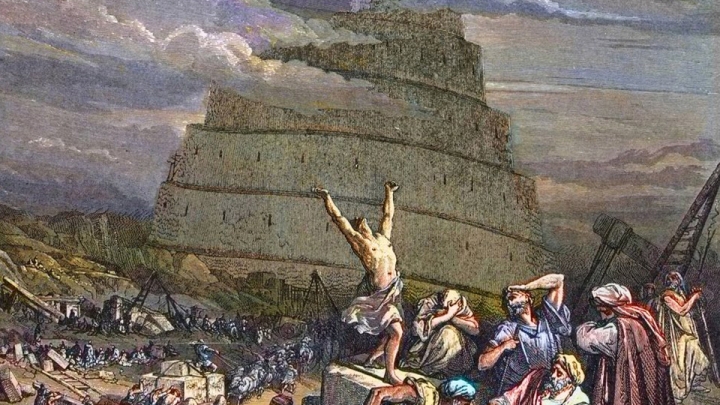
Those settled in the plain of Shinar propose to build, simultaneously, a city and a tower. The project is generated by the most terrible sin: hybris. For what normal man would propose, as they did, to build a tower that reaches the heavens? The goal is fame—or, as we might say today, celebrity. We might almost say they succeeded! But they became famous not for the tower, but for their resounding failure.
Examining the megalithic construction they had begun, God immediately perceives the boundless pride animating their cyclopean project. Thus He decides to interrupt it in a way perhaps unexpected: by “mixing” the languages of the builders. And this is precisely what happened, putting an end to that great but foolish attempt. Scattered across the face of the whole earth, the builders of the Tower of Babel stand at the origin of the various nations and their subsequent branches. The name of the city Babylon, in which the tower stood, would become in the Book of Revelation synonymous with the organization of those who conspire against God and His chosen ones, forming an alternative city dominated by “the great harlot” (Revelation 17:1).
Before any attempt to interpret the deeper meaning of the tower and the city, many Jewish and Christian commentators asked how the languages were “confused.” Was this punishment physiological in nature? Was the hearing of the builders altered so that they no longer understood or correctly perceived the spoken words? Or perhaps even the phonatory apparatus and vocal cords were modified so that faulty and inconsistent pronunciation made the proper reception of others’ speech impossible? So, in short, what happened so that people came to be separated from one another by the famous “language barrier” of their own tongues?
This question is not only for philologists. One of the classic Jewish thinkers who tried to unravel the mystery is Josephus Flavius (c.AD 37–c.100), author of the extraordinary history of the war between the Jews and the Romans that led to the destruction of Jerusalem and the Temple.
In another major work of his, Antiquities of the Jews, he reveals his conviction—based on certain apocryphal traditions—that the descendants of Noah began to see God not as the source of their prosperity and happiness but as a tyrant:
“They, imagining the prosperity they enjoyed was not derived from the favor of God, but supposing that their own power was the proper cause of the plentiful condition they were in, did not obey him. Nay, they added to this their disobedience to the Divine will, the suspicion that they were therefore ordered to send out separate colonies, that, being divided asunder, they might the more easily be Oppressed.”[i]
The one who allegedly led them in their rebellion was Noah’s grandson, Nimrod, who taught them that they were the sole source of their own happiness rather than God. Also, the construction they intended to begin was meant to protect them, through its height, from another flood—something that disregarded God’s promise that “all flesh shall be no more destroyed with the waters of a flood, neither shall there be from henceforth a flood to waste the earth” (Genesis 9:11). Indeed, what Nimrod gradually achieved, Josephus tells us, was to turn himself into a tyrant who convinced his subjects to work on “a tower too high for the waters to be able to reach and that he would avenge himself on God for destroying their forefathers.”
Thus what caused the separation of the builders was the diminution of the capacity for understanding, so that each person joined the group whose words were intelligible to him.
Beyond the details he adds in strictly historical and contextual explanation of the episode of the Tower of Babel, Josephus does not answer the questions raised by the mixing of languages. How did this happen? The Holy Fathers have left us answers to almost all the questions that may arise from reading Holy Scripture. Among them, one of the most brilliant commentators was Saint Augustine (354–430). His monumental work, On the City of God Against the Pagans (De civitate Dei Contra Paganos), contains a brief but idea-filled discussion of the significance and manner in which the mixing of languages occurred.
Like Josephus Flavius—perhaps even influenced by him—Augustine states that the one who initiated the building of the sacrilegious tower was Nimrod. But in addition to the Jewish author, he affirms that Noah’s great-grandson was a giant. The logic is clear: a gigantic, hubristic project devised by a giant. How else?
What interests us especially in Saint Augustine’s interpretation is the manner in which the confusion of languages took place. Here is his comment concerning the deeds of Nimrod and of those who followed him in that reckless project:
“He and his people therefore, erected this tower against the Lord, and so gave expression to their impious pride; and justly was their wicked intention punished by God, even though it was unsuccessful. But what was the nature of the punishment? As the tongue is the instrument of domination, in it pride was punished; so that man, who would not understand God when He issued His commands, should be misunderstood when he himself gave orders. Thus was that conspiracy disbanded, for each man retired from those he could not understand, and associated with those whose speech was intelligible; and the nations were divided according to their languages, and scattered over the earth as seemed good to God, who accomplished this in ways hidden from and incomprehensible to us.”[ii]
At first glance, the text does not seem to solve the most difficult problem: how the confusion of languages occurred. Nevertheless, toward the end Augustine mentions that the conspiracy animated by pride was destroyed through the dissolution of the capacity for understanding:
“For each man retired from those he could not understand, and associated with those whose speech was intelligible.”
Thus what caused the separation of the builders was the diminution of the capacity for understanding, so that each person joined the group whose words were intelligible to him. What Augustine therefore affirms is that the phenomenon of linguistic separation is based, in fact, on an alteration of the capacity for understanding—that is, of the minds of those punished by God for their boldness.
Here, then, is the answer to the question concerning the phenomenon that occurred during the building of the Tower of Babel—a phenomenon that generated the birth of the different language families and the nations grouped according to them. It was not an alteration of hearing or of the ability to articulate words but an alteration of the descendants of Noah’s capacity for understanding.
Moreover, if we think carefully about our own experiences, we will easily recognize that the problem of not understanding the content of others’ thinking—that is, their ideas—is the greatest problem we often encounter. The chaos of the mass media and especially of political life shows clearly that the Babylonian confusion has remained one of the most serious problems of people in all periods of post-diluvian history. Only once in history did God show us the solution, one that only He can bring: on the day of Pentecost, when the Holy Spirit entered history “as a mighty wind coming” (Acts 2:2).
