
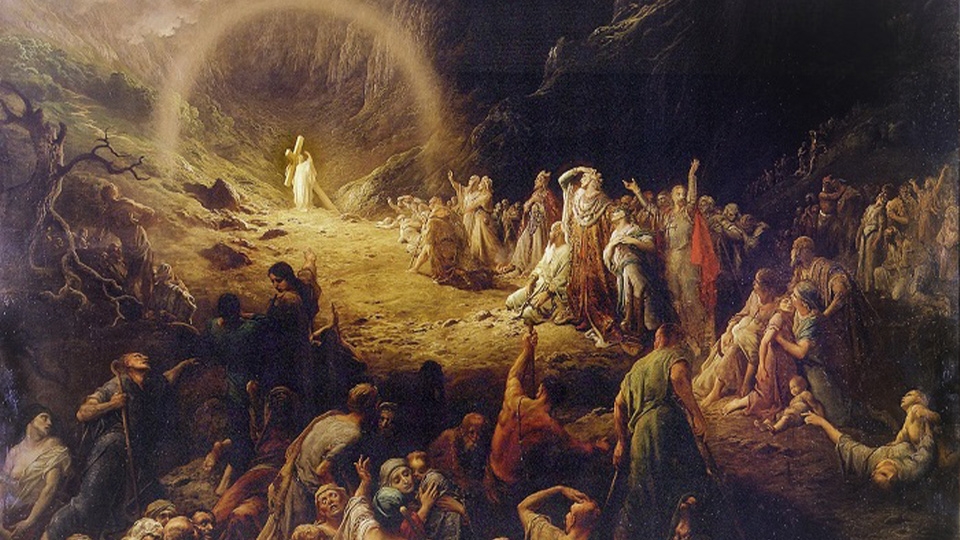

“And Jesus again crying with a loud voice, yielded up the ghost” (Matthew 27: 50). With these austere and precise words, Saint Apostle Matthew described the most terrible moment in the history of all humanity: God made man had died. The enemies of Jesus of Nazareth—who cried out before Pilate, “Crucify Him, crucify Him!”—wished this to be the end. Their unbelief had blinded them, rendering them incapable of understanding Who was the One who stood in their midst. What followed proved how gravely they had erred: “And the graves were opened: and many bodies of the saints that had slept arose, and coming out of the tombs after his resurrection, came into the holy city, and appeared to many” (Matthew 27: 52–53).
The text of the Gospel according to Matthew lists four signs that accompanied the death of our Lord Jesus Christ. The first is also mentioned by Mark and Luke: “the veil of the temple was rent in two from the top even to the bottom” (Matthew 27:51). The next two signs—the earthquake and the splitting of the rocks—are mentioned only by Matthew, as is the resurrection of some of the dead, the fourth sign:
“And the graves were opened: and many bodies of the saints that had slept arose, and coming out of the tombs after his resurrection, came into the holy city, and appeared to many” (Matthew 27: 52–53).
The evangelist’s text clearly states that we are dealing with an event that took place on the Sunday of the Resurrection and in the days that followed. At first glance, it seems to be a miraculous event of the same nature as the resurrection of Lazarus. But if that were the case, such an extraordinary occurrence would surely have been mentioned even by non-Christian witnesses—such as the famous author of The Jewish War, Flavius Josephus (c.37–c.100). However, that would have been possible, I repeat, only if we were dealing with an event similar to the resurrection of Lazarus, the brother of Martha and Mary. The only difference would have been the number: instead of a single person being brought back to life, it would have been several dead people from the vicinity of Jerusalem. Of course, not just any of the deceased, but only the “saints”—meaning those who, like the patriarchs and prophets of the Old Testament, had died at peace with God.
Anticipating the argument of my article, I will already emphasize that this was not the case. On the contrary, following the interpretations of several of the great Saints and Doctors of the Church, we will see that, in fact, the Evangelist Matthew is speaking of something that the resurrection of Lazarus merely foreshadowed: the true and definitive resurrection from the dead of those who had died in the Old Testament era.
According to Saint Jerome, this was not the general resurrection—which will take place only once, at the end of history—but rather a special resurrection, accessible only to those worthy of beholding it.
The Interpretation of the Holy Fathers and Doctors
Reflecting on this unprecedented event in the entire history of humanity, Saint Thomas Aquinas asks—just as some of the Holy Fathers of the Church did before him—whether, like Lazarus, all these resurrected individuals died again. In other words, he questions whether it was a temporary resurrection, lasting only for a limited time, or not. Saint Jerome had already mentioned two possible interpretations:
“As Lazarus rose from the dead, so also did many bodies of the Saints rise again to shew forth the Lord’s resurrection; yet notwithstanding that the graves were opened, they did not rise again before the Lord rose, that He might be the first-born of the resurrection from the dead. The holy city in which they were seen after they had risen may be understood to mean either the heavenly Jerusalem, or this earthly, which once had been holy. For the city of Jerusalem was called Holy on account of the Temple and the Holy of Holies, and to distinguish it from other cities in which idols were worshipped. When it is said, ‘And appeared unto many,’ it is signified that this was not a general resurrection which all should see, but special, seen only by such as were worthy to see it.”[i]
So, according to Saint Jerome, this was not the general resurrection—which will take place only once, at the end of history—but rather a special resurrection, accessible only to those worthy of beholding it. Referring to the interpretation of the translator of the Vulgate, the Angelic Doctor follows the same line of interpretation. Here is his full commentary:
“There is usually a question about these people, whether they rose again and died again, or did not die. It is agreed that some have arisen and later died, like Lazarus. But one can say about these people that they rose and did not die again, because they rose for the manifestation of Christ’s resurrection, and it is certain that Christ rising again from the dead, dies now no more (Romans 6: 9). Also, if they had risen only to die again, it would not have been a kindness shown them but rather an injury; therefore they rose to enter into heaven with Christ. And coming out of the tombs after his resurrection, came into the holy city. And one should note that although this was said in the description of Christ’s death, yet one should understand that it was said by way of anticipation, because it was done after the resurrection; for Christ is the first begotten of the dead (Revelation 1: 5). And they came into the holy city, not because it was holy now, but because it had been before; how is the faithful city, that was full of judgment, become a harlot? (Isaiah 1: 21). Or, it is called holy because holy things were done there. Or, following Jerome, into the holy city, namely the heavenly city, because they went with Christ into glory. And appered to many. For just as Christ has the power of manifesting himself to whom he wishes, so it should be understood with glorified bodies.”[ii]
“With glorified bodies,” is significant. For this expression shows us that it was not a matter of the dead being raised, like Lazarus, with mortal bodies. On the contrary, it refers to those who, once resurrected with bodies full of glory, did not die again but entered the Kingdom of Heaven alongside the King of the Universe, Jesus Christ.
The detail found at the very end of the above commentary, which tells us that it was the resurrection of the saints “with glorified bodies,” that is significant. For this expression shows us that it was not a matter of the dead being raised, like Lazarus, with mortal bodies. On the contrary, it refers to those who, once resurrected with bodies full of glory, did not die again but entered the Kingdom of Heaven alongside the King of the Universe, Jesus Christ.
Saint Remigius’s interpretation, the holy bishop who baptized King Clovis I of the Franks, points in exactly the same direction. He categorically rejects the mistaken understanding that it was the resurrection of mortal bodies—thus, like Lazarus—of some dead from the vicinity of earthly Jerusalem. On the contrary, it can only refer to the heavenly Jerusalem. Here is Remigius’s commentary:
“Some have said that they died again, and were turned to dust, as Lazarus and the rest whom the Lord raised. But we must by no means give credit to these men’s sayings, since if they were to die again, it would be greater torment to them, than if they had not risen again. We ought therefore to believe without hesitation that they who rose from the dead at the Lord’s resurrection, ascended also into heaven together with Him.”
Nothing in Holy Scripture is accidental. Being a work whose author is God Himself, every detail conveys not just a meaning, but often multiple ones—each accessible according to the spiritual maturity of the reader. Thus, the mention of tombs and of bodies rising is, in itself, a message full of profound teachings.
Saint Thomas begins with the significance of the tombs, which are “enclosures for dead bodies.” His interpretation likely follows that of Pope Leo the Great (c.400–461), who spoke of “these sepulchres of mortality” from which, by the burning away of the bonds that held them captive, the saints were set free. Saint Thomas affirms the same idea:
“And the graves were opened. Graves are enclosures for dead bodies. Hence it signifies that he burst the bonds of death; O death, I will be your death; O hell, I will be your bite (Hosea 13: 14). Likewise, death is swallowed up in victory (1 Corinthians 15: 54).”
That being said, before returning to the question of the identity of those who were resurrected, I will summarize the unanimous interpretation of the Saints and Doctors of the Church. Far from being a mere “appearance” (as Saint John Chrysostom emphasizes), the resurrection from the tombs of the saints who “came into the holy city, and appeared to many” represents a true resurrection from the dead—a definitive one—with glorified bodies (according to Saint Thomas).
Specifically, by His divine power, the Savior Christ accomplished—unlike the resurrection of Lazarus, which was only temporary (since Lazarus died again after a time)—the ultimate miracle: He conquered death not only through His own resurrection but also through the resurrection of His saints. These saints appeared, selectively, to those inhabitants of Jerusalem who were already on the path of faith: just as Christ came among the apostles, passing through walls (Luke 24: 36) to speak with them after His Resurrection, so too did the resurrected saints appear to those who needed the strengthening of their faith.
And thus we arrive at the crucial question posed in the title of this article: Who were the saints released from the tombs?
Those who were raised immediately after the glorious final victory of our Lord Jesus Christ appeared to some members of the first Christian community, or to others who, like “doubting” Thomas, needed one last proof in order to convert.
The Final Victory
All of human history in general, and of religions in particular, shows that no issue has been more pressing than death. In every imaginable way—often superstitious and even ridiculous —people have tried to confront death in hopes of reclaiming the immortality of Eden. The resounding failure of all such attempts shows us that we are dealing with our most formidable adversary. Furthermore, careful reflection on historical and religious sources from various eras and cultures ultimately reveals that a problem of such magnitude cannot be solved by man.
Only God can defeat death. The essence of the Christian faith lies in the following truth: fully human and fully divine, Jesus of Nazareth is the one who has conquered death for all of us—definitively and irrevocably. To prove this and to strengthen supernatural faith in His Resurrection, Jesus Christ first appeared to many of His disciples. But He did not stop there. By His divine power, He also caused the saints whom He had raised from the dead to appear to those who were already on the path of faith.
I dare to add that this did not happen only then, immediately after Jesus Christ’s Resurrection. The lives of the saints throughout the centuries bear witness to encounters of the faithful with the resurrected—those who came from beyond to strengthen them. Remaining, however, within the scope of the Gospel of Matthew, where we read about the appearance of the resurrected in Jerusalem, we ask: Who were they? The answer, of course, is found in Christian Tradition.
Cornelius a Lapide (1567–1637), one of the last great commentators on Holy Scripture, offers the most probable explanations after acknowledging that “it is not clear who these saints were.” And yet, he tells us that those who were resurrected were:
“Probably those, in the first place, who were specially connected with Christ, either by kindred, or promise, or type and figure, or by faith and hope, or else by chastity and holiness; as Adam, Abraham, Isaac, Melchisedek, David, who wished to be buried in the promised land, and thus be partakers of Christ s resurrection. Job, also, and Jonah, as types of the resurrection; Moses, Joshua, Samuel, Isaiah, and the other Prophets. Daniel, also, and his three companions (though their bodies are at Rome). Eve, also (some suppose), as well as Adam, though Lorinus considers that the Blessed Virgin was the first woman raised from the grave, as Christ Himself was the first-fruits among men. Those, also, who died but recently; as Zacharias, Simeon, Saint John the Baptist.”[iii]
So then, here is who, very likely, were the ones who—raised immediately after the glorious final victory of our Lord Jesus Christ—appeared to some members of the first Christian community, or to others who, like “doubting” Thomas, needed one last proof in order to convert. Amazed by such testimonies, let us continue to reflect on the mystery of the Original Sin, Fall and of death—definitively conquered through the glorious Resurrection of the God-Man, Jesus Christ.
Resurrexit sicut dixit, Alleluia!
Latest at RTV — Pope Leo on Women Priests and Synodality
[i] All the quotations from the Fathers of the Church are from Catena Aurea: https://www.ecatholic2000.com/catena/untitled-34.shtml [Accessed: 17 Aprilie 2025].
[ii] The text of Saint Thomas Aquinas’ comment can be read online here: https://aquinas.cc/la/en/~Matt.C27.L2.n2396 [Accessed: 17 Aprilie 2025].
[iii] Cornelius a Lapide, The Great Commentary, Vol. III: S. Matthew’s Gospel, Chaps XXII to XXVIII, S. Mark’s Gospel-Complete, Translated by Thomas W. Mossman, London: John Hodges, 1891, pp. 313-314.
