
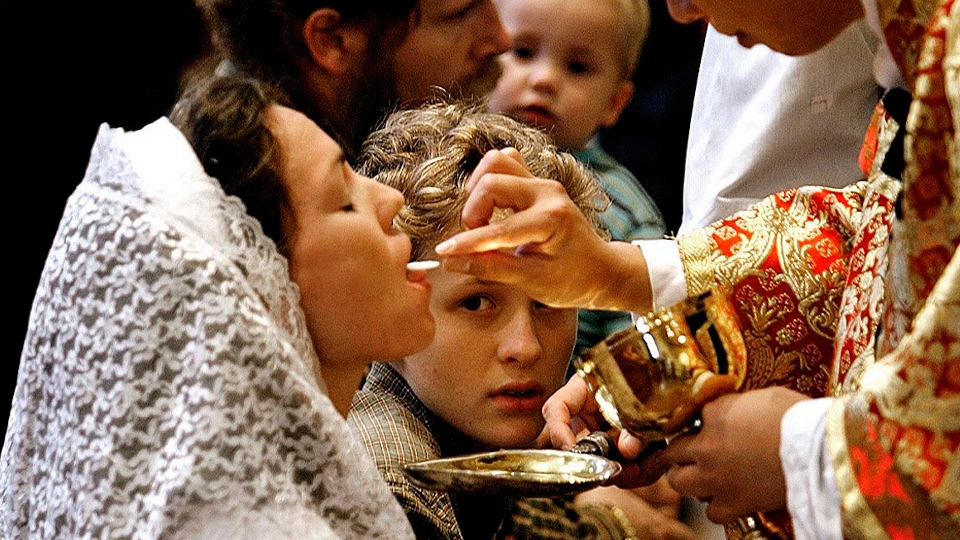

The Holy Eucharist seems like an accessible mystery. I say this because I have met people who, even though they were not Catholic, had seen that the faithful attending a Mass in the Netherlands were receiving “a kind of biscuit.” Indeed, this is what a non-Catholic told me, someone who had attended the Holy Liturgy out of curiosity. Despite such unintentional trivializations, there is no mystery as simple and complex, as profound and complete, as the Holy Eucharist.
Created human nature, united with the uncreated nature of God in the Person of our Lord Jesus Christ, is contained in the Holy Eucharist, in which the Divine Logos offers Himself to Christians in a surprising mystical act. It is not by chance, then, that the monumental Roman Catechism (1566) speaks of “the three mysteries of the Holy Eucharist.”[i]
Before presenting these mysteries, however, the catechism issues serious warnings regarding the absolute necessity for all believers to contemplate the real presence of Christ the Savior—a presence hidden from our senses but accessible to our minds. Here are the words of the Catechism:
“We must now return to an explanation of those truths concerning the Eucharist about which the faithful are on no account to be left in ignorance. Pastors, aware of the warning of the Apostle that those who discern not the body of the Lord are guilty of a most grave crime (1 Corinthians 11:29), should first of all impress on the minds of the faithful the necessity of detaching, as much as possible, their mind and understanding from the dominion of the senses; for if they believe that this Sacrament contains only what the senses disclose, they will of necessity fall into enormous impiety. Consulting the sight, the touch, the smell, the taste and finding nothing but the appearances of bread and wine, they will naturally judge that this Sacrament contains nothing more than bread and wine. Their minds, therefore, are as much as possible to be withdrawn from subjection to the senses and excited to the contemplation of the stupendous might and power of God.”
That “most grave crime” mentioned by the Roman Catechism refers to verse 29 of the first epistle to the Corinthians of the Holy Apostle Paul, where he states the following:
“He that eateth and drinketh unworthily, eateth and drinketh judgment to himself, not discerning the body of the Lord.”
This, then, is why the Church’s teaching considers the discernment of the Lord’s body an absolutely necessary act. The priest, who must be the principal catechist of his own faithful, is urged to explain the contemplative act that helps them to discern the presence hidden from bodily eyes by the visible accidents that remain after transubstantiation. To avoid an “enormous impiety,” each of those who receive Communion must be fully aware that the reality is not found in what is perceived by the senses.
The true body of Christ the Lord, the same that was born of the Virgin, and is now seated at the right hand of the Father in heaven, is contained in this Sacrament.” Reading the words above, one gets the impression that everything pertaining to the physical world fades away to the point of disappearing.
The danger of reducing existence and reality solely to what is perceived through the senses is one that perpetually accompanies the condition of fallen humanity. Starting with Pythagoras, Socrates, and Plato, the true philosophers of ancient Greece always warned against this error that stems from the deficiency of our knowledge based on the perceptions of the five senses. For example, a later author, Proclus (412–485), criticized those who, believing that “only material things exist,” claimed that the invisible essences (or ideas) of living beings and created things “lack reality.”[ii]
Just as with grave moral errors that result from confusing happiness with bodily pleasures, confusing the visible, material world with what is truly real is one of the most common errors brought about by the limits and deficiencies of our postlapsarian knowledge. Immersed in the world of matter and becoming, we tend to reduce the “real” to what is accessible to the senses. Christian teaching rejects this view. The world “of the seen and visible things” is not synonymous with reality.
On the contrary, only the world “of the unseen,” where God is directly present—where the angels and saints of the heavenly hierarchies live in eternal joy—can truly be considered “real.” Why? Because only that world possesses the attribute of eternity. Only that world is imperishable; there is no sickness, aging, or death—in a word, there is no destruction.
Our fallen world, by contrast, is rather “unreal” in the sense that, despite appearances, it is moving toward an end. Moreover, the decay and dissolution present everywhere transform it into something volatile, a phantom-like pseudo-reality destined to perish. Even the most solid granite rocks eventually erode and disintegrate over time, don’t they? The lesson proposed by the Roman Catechism, then, is about the distinction between what is truly “real” and what is “unreal” (or “pseudo-real”).
As we will soon see, what we perceive through the senses when we are before the mystery of mysteries—the Holy Sacrament—is more or less “unreal,” being miraculously preserved in existence by God, who takes into account the limits and weaknesses of our current knowledge.
(Of course, the only exception is the awe-inspiring Eucharistic miracles, so numerous in the past, meant to constantly remind us that, indeed, what we receive in Holy Communion is the real Body and Blood of our Lord and Savior Jesus Christ.)
The accidents that remain perceptible to our senses after transubstantiation exist in a mysterious, ineffable way that belongs to the realm of miracle. It is a wonderful existence. And, I would add, a truly miraculous one.
That said, I must quickly emphasize that the “unreal” mentioned above does not mean “non-existent.” Rather, it refers to a diminished, transitory, accidental, and fleeting existence—just as “unreal” as everything that passes in this world. But in contrast with the hidden presence of the Lord Jesus Christ in the Holy Eucharist, this diminished reality of appearances is a mere shadow—as insubstantial as the shadow that follows us on this earth. Let us now look at the “three mysteries” spoken of in the Catechism.
“The first is that the true body of Christ the Lord, the same that was born of the Virgin, and is now seated at the right hand of the Father in heaven, is contained in this Sacrament.”
Reading the words above, one gets the impression that everything pertaining to the physical world fades away to the point of disappearing. History, even time itself, becomes relative. For the Holy Eucharist makes us contemporaries not only with the birth of our Lord from the Holy Virgin Mary but also with His death, resurrection, and ascension. Moreover, we cannot help but be amazed by the ubiquity of the One who, although He is in Heaven—“at the right hand of the Father”—is also on earth, right next to us who participate in the Holy Liturgy. Of course, if Saint Padre Pio (like other Saints) received the gift of bi- or multi-location, we should not be surprised that the One who granted him that gift—God Himself—can be present everywhere at once. Let us now move on to the second mystery:
“The second, however repugnant it may appear to the senses, is that none of the substance of the elements remains in the Sacrament.”
Here we need a bit of scholastic philosophy.
Inspired by Platonic-Aristotelian language, the distinction between “matter” and “form” was assimilated into Catholic theology through the contribution of Saint Thomas Aquinas. Specifically, this distinction tells us that every object in the sensible, physical, material world “hides” within it an invisible essence that belongs to the unseen, intelligible world—accessible only to our minds. There is, therefore, an “essence” (or “form,” as Saint Thomas would say) of bread, just as there is one of wine. Without these essences (i.e., “forms”), neither bread nor wine could exist.
The concrete existence of all the different kinds of bread and wine, despite there being only one essence of bread and one of wine, results from the intervention of “accidents” that give a concrete, particular “identity” to each piece of bread and each type of wine. For example, colors—white, yellow, red—already differentiate types of wine. Any other details we add, such as weight, specific aromas, etc., only describe the “accidents” that individualize the concrete things we perceive with our senses. However, what is truly decisive for all these concrete particularities to exist is the presence of the “essences” (i.e., “substances”) of bread and wine: without them, we would have no kind of bread or wine at all.
Let us remember, then, that appearances are absolutely insignificant in relation to what is unseen—the essences. For what is seen is fleeting, transitory, mortal, volatile, illusory. That is how our bodies are. What is truly essential in man is, of course, the soul—which, though invisible to our senses, is immortal.
When, during the Holy Liturgy, the miracle of transubstantiation takes place, the essences of the bread and wine are literally completely replaced with the Body and Blood of our Lord Jesus Christ, present in every particle of the Eucharist with His Body, Blood, Soul, and Divinity—truly, really, and substantially. Thus, as the Catechism says, nothing of the “substance” (i.e., “essence”) of the bread and wine remains “behind” the appearances. The notion of “transubstantiation” refers precisely to this change of the substances of bread and wine into the Body and Blood of the Lord Jesus Christ. Finally, the third mystery results from the first two:
“The third, which may be deduced from the two preceding, although the words of consecration themselves clearly express it, is that the accidents which present themselves to the eyes or other senses exist in a wonderful and ineffable manner without a subject. All the accidents of bread and wine we can see, but they inhere in no substance, and exist independently of any; for the substance of the bread and wine is so changed into the body and blood of our Lord that they altogether cease to be the substance of bread and wine.”
As we see, the accidents that remain perceptible to our senses after transubstantiation exist in a mysterious, ineffable way that belongs to the realm of miracle. It is, as the quote above says, a wonderful existence. And, I would add, a truly miraculous one.
The point I wanted to emphasize in this article concerns especially what is real and what is un-real. Let us remember, then, that appearances are absolutely insignificant in relation to what is unseen—the essences. For what is seen is fleeting, transitory, mortal, volatile, illusory. That is how our bodies are. What is truly essential in man is, of course, the soul—which, though invisible to our senses, is immortal. I could continue giving examples endlessly. The main idea is this: what is unseen is truly important. For what is not seen is eternal and imperishable. This faith inspired the following exhortation of Saint Paul:
“All things are for your sakes; that the grace abounding through many, may abound in thanksgiving unto the glory of God. For which cause we faint not; but though our outward man is corrupted, yet the inward man is renewed day by day. For that which is at present momentary and light of our tribulation, worketh for us above measure exceedingly an eternal weight of glory. While we look not at the things which are seen, but at the things which are not seen. For the things which are seen, are temporal; but the things which are not seen, are eternal. (1 Corinthians 4:15-18).
[i] Catechism of the Council of Trent for parish priests, Issued by order of Pope Pius V, Translated into English with notes, by John A. McHugh, O.P., and Charles J. Callan, O.P., Tenth Printing, 1947, pp. 228-229.
[ii] Here is the full quote from Proclus, A Commentary on the First Book of Euclid’s Elements, Translated with Introduction and Notes by Glenn A. Morrow, Princeton University Press, 1970, p. 112: “Rather we shall posit that the causes mentioned are subservient to others in the process of generation and affirm that the end is defined for them by other and precedent causes. Neither is it true, as some say, that immaterial figures lack reality and only material things exist; nor true what still others Soy, that they exist indeed apart from matter, but only in thought and by abstraction.”
