
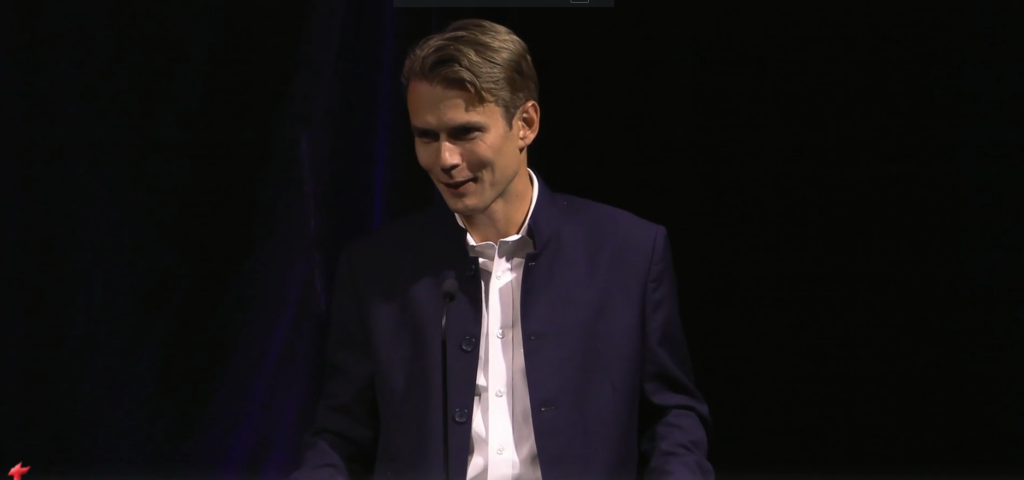

Below is the text of George Farmer’s talk:
SPEAKING AT THE Catholic Identity Conference this year came about more by accident than design. Whilst Michael and I shared coffee in Rome during the papal conclave, the topic of the conference came up, and before I knew it, a speaking slot was developed. My usual rebuttal to being asked to speak is that my perspective is normally better elucidated by more intelligent, more erudite or more holy men than me. However, on the topic that I was given this year, my thoughts are that actually the more erudite, holy or intelligent you are, the less likely you are to be able to talk about it. Perhaps this is why I’m here, because I have a long way to go in all three fields.
My topic this year is “anti-Christendom.” But what does that even mean? Christendom as a concept is considered by many to be something of the past. The geographical and socio-political bounds of “Christendom” have really been torn down in the last couple of hundred years. Ever since the time of the Reformation and the shattering of the beautiful Catholic unity that had pre-existed, with an objective moral standard that was shared by all of Europe, the concept of Christendom has been in retreat; and since this talk is not a lookback at what historically opposed Christendom in the medieval period, don’t we face a sort of dead end in even attempting to examine “anti-Christendom”?
Well, the one-word answer is no. Whilst we are correct to say that Christendom as a political and geographical concept—apart from perhaps in some very isolated social microcosms—is dead, the pendulum against Christendom and against what it stood for has been picking up speed for centuries. If we want to talk of the several hundred years during which Christendom was established, built up, and was the dominant cultural-political force, we can now see the mirror image occurring in the forces of anti-Christendom.
Having battled against the dominant Christian worldview as a starter force, the forces of anti-Christendom then found intellectual footing in the “enlightenment” of the 18th and 19th centuries, perfecting themselves in the Satanic century, aka the 20th Century, when the human mind, truly unfettered from all moral standards, went mad and brought death, destruction and genocide on a level that had previously been unthinkable.
But now, as Christ-consciousness awakens again and people realize that the religion of the Antichrist is all around us, what are we to be aware of? Where is the religion of the Antichrist present? How can we guard against it?
And I don’t mean simply the obvious examples of the wars and their associated horrors. I also mean the modernist sexual revolution that eats humanity from the inside and corrupts the inner fabric of the soul; I mean the neoliberal gospel of libertarian capitalism that commoditizes human beings into profit/loss statements; I mean the resurrection of the creed of Pontius Pilate, the first true postmodernist, who first posited the question “Quod est Veritas? [What is Truth?]”
In these three examples alone, we see the philosophical (postmodernism), the intellectual (the sexual revolution) and the practical (libertarian capitalism) assault themselves on the historic territory of Christendom. The forces of anti-Christendom are therefore aping the historic trajectory of Christendom: they emerge, engage in a battle for the mind, soul and body, and then establish dominance. In this sense—and this corresponds to what we all know to be true—we Christians have been fighting a rearguard action for centuries. We have been defending traditional morality against the vanguard assault of Satan, who has been ratcheting up his attacks ever since Catholic universalism was shattered.
I say we all know this to be true because we do. The numbers speak to it. Our society speaks to it. Christianity in the West is retreating to the Apostolic Church that Pope Benedict spoke of. Globally, the 20th Century saw the highest number of Christians killed both on an absolute basis and on a proportionate basis to global population in history. We don’t need to look far to see the religion of the Antichrist on full display. What we have been fighting is actually the modernist infiltration of the one organization that is supposed to stand against the Antichrist, namely the Church. Despite the onslaught of anti-Christendom forces in the last few hundred years, it was not until almost all the kinetic wars had stopped in the second half of the 20th Century that Satan realized that destroying the Church from within would be just as, if not more, profitable than the untold misery caused by bombs and bullets.
In times of struggle, people look more to God, not less, and so after years of struggle, humanity became ensnared by the easy living and cheap morals that have become so rampant since the 1960s. Anti-Christendom actually reached its apogee in the 20th Century, which is why at the end of the cold war, the end of religion—indeed the end of history—was touted. Christianity was doomed to irrelevancy as the collapse of competing global ideologies made us all the neoliberal individualists we are now. The Catholic Church, with its outdated morals, beliefs, traditions and structures, was destined for the dustbin of history. But even now, 30 years after “the end of history” that Fukuyama predicted, the relentless assault of sexual laxity, cheap money and convenience that the Antichrist has been using to try and displace the Church is failing.
No doubt everyone in this room saw the widespread reports over the past year about steady increases in converts to the Church, record numbers of adult baptisms and catechumens being taken under instruction. The trends of converts do not displace the widespread numbers of lapsed Catholics leaving the Church; but they do represent a significant uptick and reversal of decline in conversions. In the face of a never-ending onslaught of modernism, the message of the Gospel will prevail in the face of the gates of Hell.
But now, as Christ-consciousness awakens again and people realize that the religion of the Antichrist is all around us, what are we to be aware of? Where is the religion of the Antichrist present? How can we guard against it? These are the questions I want to pose and answer today. As the Church emerges again after being, at best, asleep for sixty years, what do we need to watch for, fight against and then build anew to remake the true Christendom that was lost so many years ago?
I also want to say one more thing as a prelude: it is better to be fighting than to be conquered. Even if that fight is a rebellion; even if that fight is guerilla warfare; even if you’re the last militia in the mountains, it is better to live for the freedom that Christ has set us free for, than to be enslaved to sin and death. I know many of you in this room, not least our esteemed conference organizer, have been fighting for decades; but I can only imagine the sense of isolation you felt in the 1980s and 1990s. It must be so encouraging to those of you who lived through those years to see the proverbial phoenix rising from the ashes in 2025.
In light of this, I would say that my message today is cautious hope, because the thing that is reviving the Church is not a new pope, or an old pope; it’s not any one of the weak bishops’ conferences; it’s not a coalition of priests, no matter how holy they are, nor is it the emergence of a new religious order. It’s the Holy Spirit moving through the laity. The revival we are witnessing in the traditional Church is tens of thousands of mainly young people being immersed in the faith of our grandfathers. This movement is so powerful that the enemy is now hellbent on stopping it, even attempting to weaponize the US federal government to crack down on it during the last administration.
People often ask me: what is the solution to our problems? How do we win back culture, our society, our civilization? My answer, aside from total trust and devotion to God, is to “build local.” Build a local community, build a local Church, a local market, local friendships and networks and build thousands of them across the country. Because that is how minds are changed—not from top-down edicts signed on the resolute desk.
So this religion of the Antichrist—what are we looking at and how is it manifesting itself? There is really one answer to this that I want to focus on today. The antichrist has brought one huge weapon into the 21st century that we, as the Church, have to wage a battle for. It is so pervasive and totalitarian that we have been completely overwhelmed and caught napping. That weapon is technology.
Technology, and the industry, the hardware, the software, and the philosophy that surrounds it, has completely infected the mind of man. We have lost ourselves to the god of the black mirror. Every week when I get my screen time number from my phone, I think, “If only I had spent that much time each day in prayer, rather than looking at my phone.” And bear in mind, I have no social media, so I can only imagine what that number would be if I did.
But before we even get to the hardware, we need to understand the enemy that we’re dealing with; we need to understand the dominant philosophy that guides it. What is the dominant philosophy behind the tech industry? What is the theology of tech? Well, I don’t think the industry is monolithic enough to legitimize a single answer, but I do think that there are a few key threads that we can pull on and consequently be aware of when framing the fight against the Church.
As usual with the work of Satan, we are dealing with something that is marketed to us as good, which it can be, but that left to the excesses of the human mind, becomes bad. Behind the tech industry in 2025 lie the words “convenience,” “freedom,” “efficiency,” “social” media, “democratization” and other leitmotifs that have become catchphrases for the West. Yet all of these ideas were sprung onto humanity so aggressively, in such a short space of time, that the ability of the human mind to comprehensively prepare for the assault was bypassed. We were told by technologists that the age of the internet, the cellphone and now AI would herald new dawns for humanity, because the efficiency and convenience of being able to work anywhere would change the way go to the office. Social media would connect us all, the world would become local, and totalitarian regimes would tumble with the advent of the internet. And whilst some of this is true, the price we paid was social isolation, spiking teenage suicide rates, porn addiction, 24/7 work hours, collapse in human interactions, and now the threat of total global digital surveillance through a non-human system of intelligence. Was this a price worth paying?
Well as usual, Satan didn’t explain the cost before we signed the contract. As with all things that the Prince of this world starts selling, the lie is actually the half-truth. There’s a reason Satan quotes scripture to our Lord. He weaponizes something that is true to convince us that he’s right, without showing the total calculation. There is truth in the efficiency and convenience of technology; there is truth in the social aspect of social media; it is true that technology can make us better people, but to the soul that isn’t steeped in the virtues of Jesus, it’s as dangerous as walking onto a battlefield fully exposed.
Humanity has been sold a half-truth by the Antichrist, and through it we have philosophically caved to these arguments. We’ve completely forgotten the correct order of existence: to love God, and then to love our neighbor as ourself. If we’re putting our own convenience or phone-based entertainment first, we’re neglecting our neighbor, our family, even ourselves to some extent. The theology of technology, not fundamentally based on God, has therefore corrupted the way we should be thinking. It’s taught us to look inwards, to centre ourselves around our own gratification.
And how has it done this? It’s done through a small black-screened computer that we all slip into our pockets every day. An innately harmless set of chips, plastics and metals that, combined, have probably been the portal to more sin than any other single invention in history. The black mirror that we all stare into everyday has become a portal to hell for so many. This small portable computer is so easy, convenient, and useful that we’ve become addicted to it. I wonder whether Our Lord speaking in 2025 would tell us to pluck out our phone from our pocket and throw it into the fire, alongside telling us to take out our eye or hand rather than falling into sin.
For those of us who thought that the war of the Antichrist would be fought with armies clashing in some titanic battle, perhaps the first step before that is for us to win the titanic battle that humanity hasn’t even begun fighting with the devices in their own pockets. Satan didn’t need to mount some full-frontal assault on morality in the public sphere; he just convinced us all that we needed to buy a small device to have on us at all times, in all places, recording everything we do, giving us access to everything, which now we can wear on our wrists, or on our eyes; that we can’t navigate without; that we have forgotten how to write without; that we’ve rewired our brains to think in 30 seconds because of; that now 21% of Gen Z wish had never been invented. … What have we done? The devil must be laughing, because it was just so easy to win.
The Christian fight of the 21st century will be against the theology of technology. We are battling an enemy that is so engrained, entrenched and pervasive that people don’t even know it is an enemy. Sometimes now when I’m walking through airports or large public spaces I take time to just observe how many people are on their phones. Next time do it for yourself. Those who are stationary, I would say the number is at north of 80%, sometimes its 100. In some cities around the world, they now broadcast the Walk / Don’t walk signs onto the sidewalks beside the lights because heaven forbid people have to break eye contact with their device to look up for 3 seconds. The hardware of tech has become symbiotically engrained into human existence. We design cars, houses and bedrooms around it. We don’t sleep without our phone next to our bed. The phone screen is literally the last thing that people look at in the evening and the first thing they look at when they wake up in the morning. Satan has found a way into our homes that we all voluntarily brought in, and through the little portals into another dimension that we have opted into, keeps us isolated, addicted and depressed.
What do I mean by this? Well this is the software layer. I’m using software in the broadest possible sense here to encompass apps and sites that we all have become daily users of. Social media that is purposefully built to keep the doom loop scroll, replicated on the slot machine pull down function from a casino, endlessly going so that you will become divorced from real existence and real communication. And the reason you keep scrolling is because you see the custom filtered perfect beach sunset that your friend from 15 years ago randomly posted on a Tuesday afternoon making you envious of how did they achieve so much and you didn’t. So you keep hitting refresh to see if the notification your dopamine receptor is now attuned to flashes. But once you’ve exhausted one platform, you jump to another where your brain, now adroitly reorganized around a maximum attention span of 30 seconds, watches a few videos you will have forgotten by tomorrow. In the meantime, you post a picture of some food you ate yesterday and then spend 35 minutes prepping for a funny video which everyone will give you credit for, before they forget about it. In case you hadn’t realized, this is enslavement. Karl Marx referred to religion as opium of the masses, but he couldn’t, as usual, have been more wrong. Jesus Christ is the salvation of man and the masses. The modern opium of the masses, keeping us all fat, sedated and braindead is the technological revolution we have handed our lives over to.
And of course this doesn’t even begin to tackle artificial intelligence. AI has already changed the way we live, work and even socialize, and candidly we haven’t even begun with AI. If this is where we are after just a few years, imagine where will be in twenty years. I was listening to a podcast with a well-known former policy adviser to the White House the other day where he suggested that within a few years there will be options to ‘upgrade’ yourself, using chips and implants, which in turn means you would be effectively download AI into you. This is no longer some science fiction narrative, humanity is here. We have arrived. The question of non-human sentient life being found on other planets is just a Hollywood fantasy when compared to the intelligent systems that we are building right in front of us. Questions of so called AI alignment, effectively AI safety, have been cast aside in a race between corporates and nations to dominate the sector. We’ve already had our first suicide driven by AI. In simulated military testing, AI decided that it was more efficient to kill its own operator, who was preventing it from carrying out mission-critical steps, than to obey instructions. It will only be so long before we have our first mass shooter whose manifesto is written by ChatGPT. Leading groups of technologists have even warned that AI is a species-level threat that we should treat the same as nuclear war. It’s ironic therefore that Peter Thiel the other day said that control of AI could lead to the advent of the Antichrist through the form of one-world government, although to many it seemed like he was just speaking his own book by saying AI should just be an unregulated free for all where the richest profit.
I could go on. As I said, it’s not just AI, it’s the very way we have rebuilt the fabric of our lives around technology. We have became slaves to our own creation.
But I’m not standing here advocating for some 21st-century luddism or for us to retreat from the world. I’m saying that we, as the Church, need to have our eyes open to the threat right in front of us. Instead of building our lives around technology, we need to build our lives around God, and make technology subservient to our faith. Technology, like all human creations, needs to point towards the Creator if it is to be used to its proper purpose. This is the only true “alignment” that is needed. I say all of this as someone who is both deeply involved in the technology industry and who has, in many ways, had his life shaped by its advent. I also say this as someone who has a deep love for technology.
As I said, I am not here to preach some version of the 2025 burning of the cotton mills. I did most of my school homework on Microsoft word, I enjoyed the scrollable wheel on the very first iPod, and I remember my life changing as WhatsApp became the default method of communication whilst I was at college. In the last fifteen years I’ve invested in, started, run and sat on boards of technology companies. I’ve witnessed, like many others, the advent of technology that would have seemed like a pipe dream not so long ago. I am a technology evangelist. But just like the polemics of those outside the Church looking in carry less weight than those inside, true awareness of the need for right-ordering our relationship with technology can only come from those who are aware of its pervasive impact. As somebody who would count themselves on the inside of the technological tent, I would argue I’m well placed to preach on how technology is and will be the most powerful weapon used by the Antichrist to establish control of the world.
Now some of you in this room may be the truly virtuous who can say these issues don’t apply to you. Maybe you are the exception that proves the rule. Your screen time is 30 minutes a day; you’re better known for forgetting your phone or ignoring it than being glued to it; you have no social media, and you casually ignore the notifications on your home screen by leaving your device on “do not disturb” for 90% of the time. To those people I say well done, you have resisted the broad, easy path that leads to destruction. But let me assure you, those around you and those in your family may not have such an easy time. As parents to the next generation, or as members of the generation growing up now, the battle against the false idol of technology will become harder and harder, not easier. As technology becomes more entrenched and omnipresent, unconscious resistance to it will be harder.
So how do we fight back? Here’s a non-exhaustive list of things that we as Catholics should embrace.
Firstly, acknowledge the enemy in our midst. Do not assume technology is just an inanimate bystander with no agenda. Remind yourself daily that this industry was conceived, created, designed and built to hook you and to inculcate daily habits that will change the way you think, the way you act, the way you build your life. Acknowledge that OpenAI, Google, Meta, X or any other platform or service you use is built and made by people who do not have a love of Jesus at their heart. We cannot fight an enemy if we do not think it is an enemy, if we think technology is our friend we will continue to treat it as such. Be tech-aware.
Secondly, start your day with God before you start your day with tech. A few years ago, I moved charging my phone overnight from beside my bed to a different room. Now when I get up in the morning, I try to avoid looking at my device or even engaging with technology in any form until I have completed my morning offering or spent time with God. Likewise in the evenings, which I find harder. Put down your phone at least 30 minutes before you go to bed. Turn off the TV. Divorce yourself from technology for those first 30 and last 30 minutes of the day. Instead begin and end with God.
Thirdly, bring God into your technological life. Build a virtuous tech existence centered on goodness, truth, and beauty. Since integrating technology is almost an inevitable part of our existence, make sure your tech existence reflects who you both are and aspire to be. I know for me this is the hardest thing on the list. It is incredibly easy to lose oneself in the proverbial rabbit hole of your phone. It is the extreme ease and convenience of our devices that allows us to slip so easily from goodness into darkness. In the space of 20 seconds, we can post, view, or engage with something that can destroy our souls.
Fourth, be founder-focused. What do all the founders of all the major tech companies in the world have in common? That’s right. None of them are Catholic. If these men—and they are all men—aren’t Catholic, then why on earth would they align themselves with Catholic teaching? Several of them are homosexual; most of them are “nones,” that is to say they have no religion whatsoever; barely any of them are even “conservative” in a political sense. So I ask again, why would any of their products or ideas reflect our worldview? I’m not saying don’t use them, I’m just saying, remember that these products are created, designed and built by people who do not share our worldview.
Fifth, live local, not mobile. As I said at the beginning, the most effective instrument for change in society, beyond prayer, is to build our own. Don’t be a citizen of the world living through a phone portal. Be a real citizen in your town, city, and country, living locally. Know more about the people who go to Church with you than the people who live on the other side of your screen.
Sixth: look up, not down. One of the things that bothers me the most about our phone-oriented existence is the fact that it encourages us to look downwards the whole time. Not that I put much store by “studies,” but there are plenty, and indeed in this case backed up by our own experience, which tell us that your posture and line of visible sight reflect your mood and outlook. So you can imagine what kind of mood and outlook we might be susceptible to if we are constantly staring down, hunched over, being pulled inwards. Instead of raising our eyes heavenwards, observing the natural beauty that speaks to the glory of God, we are sucked inwards to a world of digital darkness
And seven: only humans are made in the image and likeness of God. Christ did not come to save the machine. ChatGPT doesn’t have a guardian angel. There won’t be a Saint Optimus from the Tesla production line in heaven. The Church has been extremely clear on ethical issues such as cloning, IVF, embryo research and other areas of biotechnology. Often the statements and views of the Church that fundamentally uphold human life run counter to the views and ideas of the world, but that doesn’t matter, because we are defending eternal truth that comes from God and not from man. In this vein, we must also uphold and defend human sanctity when it comes to technology. Both upholding the primacy of man versus machine in regards to intelligence, but also upholding the sanctity of human life without alteration. Do not chip your kids, or be tempted to do so. Do not chip yourself! I have big reservations around wearable tech, not because I dispute its usefulness or practicality, but because it further blurs the line between human and cyborg. We need to maintain the anthropocentric view of existence, and not the blurred existence that Satan would love to promote where man, machine, creation, family are all blended into one.
These ideas are just mine; they can be built upon, added to, or amended to fit our personal circumstances, but the key theme of making technology subservient to God is really what I want to drive home. Most of humanity has become enslaved to the device. They have embraced the new idolatry. The graven image stares back at them with their own reflection. Satan now has an easy and convenient portal located on all of us. If we stare into the blackness long enough, eventually it will consume us.
Realign your technological life to be under God. Deus ex machina should remain a plot device in literature and not the way we increasingly live our lives.
George Farmer is a UK businessman, entrepreneur, political advocate, former CEO of Parler, and husband to US media personality and commentator Candace Owens.
