
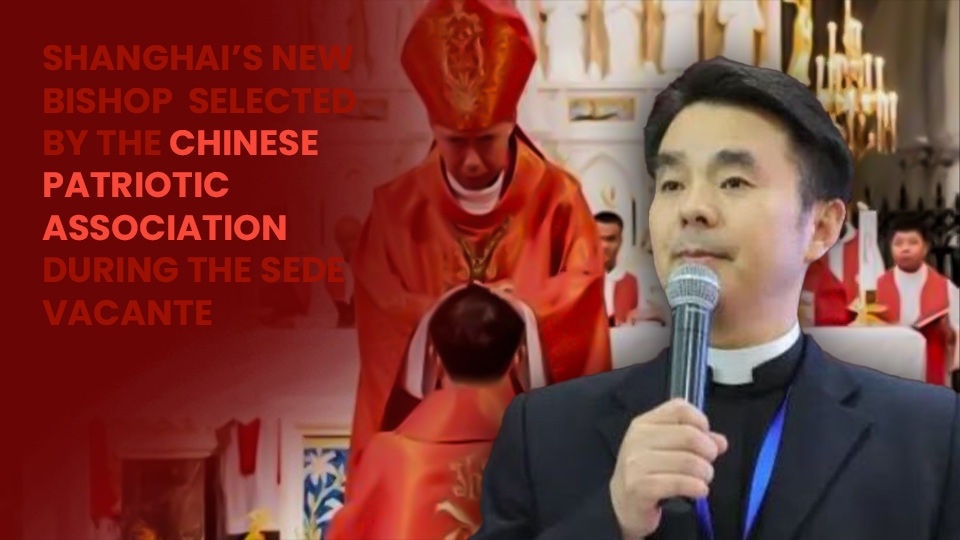

This week, Ignatius Wu Jianlin was ordained auxiliary bishop of the Diocese of Shanghai. The appointment took place with the approval of the Chinese Patriotic Association. This is yet another illicit appointment carried out by the post-Maoist regime, confirming that the Secret Agreements between Beijing and the Vatican do not serve to mend a fractured Church like the one in China.
On October 15th, Ignatius Wu Jianlin was ordained auxiliary bishop of the Diocese of Shanghai. The diocese itself made the formal announcement, specifying that the appointment took place with the approval of the Chinese Patriotic Association and the Episcopal Conference of the Catholic Church in China.
This is yet another illicit appointment carried out by the post-Maoist regime, confirming what we have already emphasized in previous analyses (see here and here): namely, that the Secret Agreements between Beijing and the Vatican do not serve to mend a fractured Church like the one in China.
That Church remains split between an official association — whose members pledge allegiance first to Xi Jinping’s directives and only secondarily to God — and an underground network of priests and laypeople forced to celebrate, pray, and catechize in secrecy, under threat of heavy fines or worse.
Wu Jianlin was selected by the Chinese Patriotic Association during the sede vacante, shortly after the death of Pope Francis. A mere act of discourtesy?
The regime does not take lightly those even suspected of conspiring against the State. Blindly following the magisterium of a foreign leader — such as the monarch of Vatican City, whose social doctrine affirms private property, subsidiarity, and the primacy of the human person — could easily be construed as just such an offense.
This is not the place to once again remind the reader what the Secret Agreements are, who wanted them, and why. For further insight, we refer to other articles (see here and here).
Wu Jianlin was selected by the Chinese Patriotic Association during the sede vacante, shortly after the death of Pope Francis. A mere act of discourtesy? Given the meticulousness and strategic disposition of the great Asian people, that’s hard to believe. In other contexts and with different actors, such a move would very likely be interpreted as a serious diplomatic incident.
The Vatican, far from protesting, ended up swallowing the bitter pill: on August 11th, it formally and discreetly approved Beijing’s appointment — months after the de facto unilateral decision. As the Holy See Press Office stated, the candidacy was “approved within the framework of the Provisional Agreement between the Holy See and the People’s Republic of China”. One must ask: was there ever really a choice not to approve it?
As if that weren’t enough, it’s worth noting that the Diocese of Shanghai is the most important Catholic diocese in China — and that Ignatius Wu Jianlin is the second Chinese “Patriotic Catholic” priest to be selected by Party officials — conveniently — during the sede vacante. The other was Li Jianlin, appointed bishop of the Diocese of Xinxiang.
The ordinary bishop of Shanghai, Joseph Shen Bin, is the leading figure of the movement for the “sinicization” of Catholicism — that is, the process initiated by Xi Jinping to align the teachings of the only religions legally permitted in China (Catholicism, Protestantism, Islam, Buddhism, and Taoism) with the ideology of the regime.
Shen Bin, who couldn’t care less about Catholic social teaching, stated explicitly during a Party conference that it was Xi Jinping’s thought, not the Pope’s, that ought to be studied. The circumstances surrounding Bin’s transfer to bishop of Shanghai are truly humiliating. It took place on April 4, 2023, and the Vatican itself admitted that it had been informed by the media (notably, not through official diplomatic channels!) only shortly before the installation. This confirmed that the Holy See had no time to approve — or reject — the appointment. Everything was unilaterally decided by Beijing.
The only plausible hypothesis that might “excuse” Pope Leo and the Vatican’s submissive stance is that the approval was granted secretly during the sede vacante. This would be consistent with the fact that the real manager of these Agreements is not the reigning Pope, but rather the Secretary of State, Cardinal Pietro Parolin — who, not coincidentally, was the chief architect of the Sino-Vatican Ostpolitik under Pope Francis.
The hypothesis is not far-fetched, given the weight the Secretariat of State currently holds within the Vatican and, more broadly, in the governance of the Catholic Church. One could even argue that the Secretariat now wields influence on par with that of the Supreme Pontiff himself. Moreover, it is well known — hinted at even in the recent interview book — that Pope Leo has entrusted the thorny China dossier entirely to Cardinal Parolin. One can only imagine what may have transpired during the sede vacante.
Indeed, on October 10th, during the inauguration of the academic year at the Pontifical Urban University in Rome, Cardinal Parolin — while presenting the proceedings of the conference on the Concilium Sinense of Shanghai — remarked that the Secret Agreements should be viewed “through the lens of faith: as an instrument, they certainly do not claim to have resolved or to resolve all problems — some might dismiss the results achieved so far as disappointing — but I believe the Agreement should be judged as a seed of hope”.
However, in my analysis, I find it necessary to go beyond the considerations offered thus far. I do so in light of a sobering observation: although the Apostolic Exhortation Dilexi Te addresses the care of the poor — a theme long central to the Church — it makes no mention of the fact that the world’s poorest populations live under socialist regimes. And yet, the Exhortation presents the “right of control” (sic) exercised by States over the lives of their citizens as a decisive solution to poverty.
This omission ends up reinforcing a narrative that has become dominant even in the West — namely, that poverty everywhere is caused by Western capitalism, and that the Global South remains an eternal victim of the West, despite decades of decolonization and successive socialist governments.
It is true that several of these regimes have historically — and in some cases still today — served as geopolitical puppets of the Pentagon. However, at present, the majority of African, Asian, and increasingly Latin American governments are tightly bound — both politically and economically — to Beijing, through mechanisms of outright indebtedness.
And yet, poverty in these regions has not improved. On the contrary, Chinese propaganda — now deeply embedded even in the West — claims that poverty in China has been “eradicated” thanks to the regime’s economic plans. This is a colossal distortion, built on manipulated statistics (for instance, the Chinese government considers citizens earning just over $2 a day as “not poor”) and aimed at presenting the Chinese model as successful and viable — not only for the Global South, but also for Western bureaucrats, especially in Europe, who are grappling with voter approval and deliberately uncontrolled immigration from that increasingly pro-China Global South.
Why is it that, while rightly denouncing the wars in Palestine, Ukraine, and elsewhere, the Vatican never addresses the humanitarian situation in China? And when it does, it speaks only briefly — and always in a hopeful tone.
Beijing has shown itself capable of operating on multiple fronts simultaneously: economic, cultural, and — not least — religious. If it exerts influence in Brussels, at the UN, and even within the corridors of the Pentagon, why wouldn’t it attempt a similar maneuver within the Sacred Palaces, where moral and pastoral decisions shape the consciences of millions around the globe?
We are speaking, of course, of a soft infiltration — diplomatic, psychological, and cultural. Beijing understands that Christianity — especially in its Catholic form — remains the only true obstacle to the full ideological hegemony of socialist materialism.
In the regime’s Confucian-Marxist vision, Catholicism is seen as a “foreign body” — one that proclaims a personal God, a natural law higher than the State, and a dignity not granted by the Party but bestowed by the Creator. It is therefore inevitable that the regime would seek either to neutralize Christianity or, if possible, to bend it to its own narrative.
It wouldn’t be the first time in recent history that a totalitarian regime has attempted similar pressure tactics. During the Cold War, the Soviet Union infiltrated agents and collaborators even within ecclesiastical circles, aiming to steer the Church’s social doctrine toward greater “understanding” of actually existing socialism. Numerous declassified documents from the 1990s have thoroughly confirmed this. Communism, after all, has always had a declared enemy: Rome.
It wouldn’t be the first time in recent history that a totalitarian regime has attempted similar pressure tactics. During the Cold War, the Soviet Union infiltrated agents and collaborators even within ecclesiastical circles, aiming to steer the Church’s social doctrine toward greater “understanding” of actually existing socialism.
The USSR sought to manipulate the Church through diplomacy, money, and the language of “dialogue.” What happened during the Second Vatican Council — which was expected to condemn communism but ultimately backed down — is now a matter of historical record.
China’s strategy today is never frontal: it unfolds through “friendships,” “cultural exchanges,” “academies,” and joint seminars on topics like ecology and integral human development. All seemingly harmless. Yet in the meantime, the regime works to reshape the very perception of Catholicism — nudging it toward a morally defanged message, more civic than supernatural, more philanthropic than theological.
It is within this framework that the Secret Agreements take on a dramatically symbolic weight: not merely an attempt at “normalization,” but an authorized ideological penetration — a breach opened in the heart of the Eternal City in the name of a misguided “dialogue”.
From this perspective, the Vatican’s silence on the reeducation camps in Xinjiang, the persecution of “unregistered” Catholics, and the disappearance or detention of priests takes on an even more bitter tone. It may not be merely diplomatic caution, but perhaps a deeper awareness: that within the very walls of the Leonine City, a much larger spiritual and political power struggle is unfolding. If the Chinese regime can exert influence over the UN, American universities, and European institutions, it would be naïve to think the Vatican is immune to such temptations.