
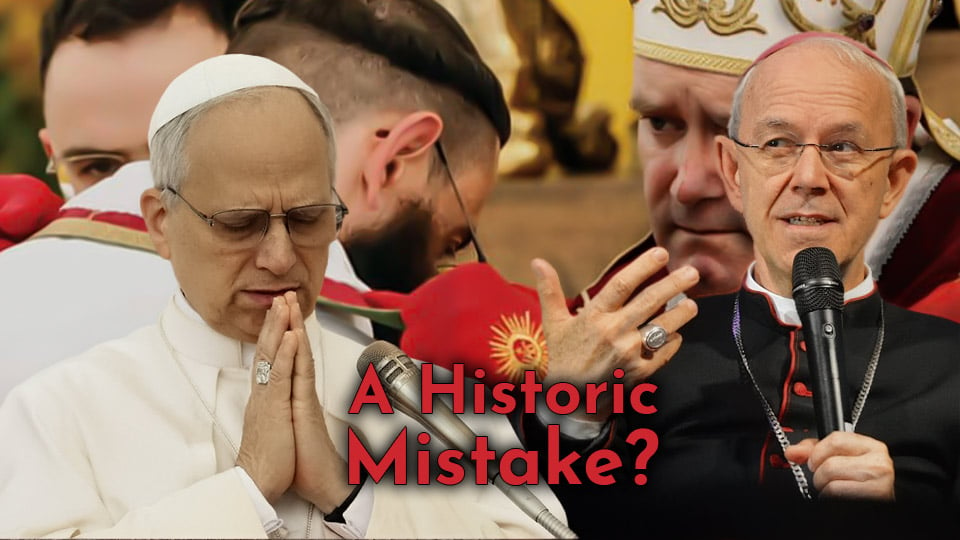

An important article about the situation of the Society of Saint Pius X and the crisis surrounding the episcopal consecrations in July is the one written by Carlos Balén, “Thirty Years Buying Time: When Rome Bet That the Problem Would Die on Its Own” and published by InfoVaticana. The article targets—and hits right in the bull’s-eye—the strategy adopted by Rome in order to eliminate the most important defender of Roman Catholic Tradition. It is the same thing that occurred during the lifetime of Archbishop Marcel Lefebvre: delaying approval for episcopal consecrations until the degrading biological dimension of our fallen world did the dirty work. Indeed, I have always had the impression that by endlessly postponing approval for the consecration of bishops, the Vatican was in fact waiting for the death of the founder of the Society.
After forty years of dialogue, the game of delays remains exactly the same.
The “game” of dialogue was nothing more than a strategy adopted in order to reach a long-awaited outcome. For the Pope and the hierarchs around him, the criticisms of the Society were always the thorn that reminded them of the problems of the Council and the liturgical revolution. The deeper issue manifested by all the new post-conciliar directions concerns the place of the Church within the context of the modern world. This world, with its fluid (pseudo-)values, poses serious challenges to pastoral work and mission. Likewise, the complete change in the political context, accompanied by the total secularization even of countries that remained Catholic (at least statistically), such as Poland, Spain, and Italy, creates additional difficult problems. It seems that attitudes toward heretics and heresies can no longer be the same as they were in the era when Europe was a vast Catholic commonwealth. At least this is what they seem to think. The collapse of the European monarchies—a process completed with the death of Blessed Charles I of Austria—left free rein for the manifestation of the most diverse political doctrines and the endless struggles for power among the factions involved.
In the face of the dominant relativism denounced by Pope Benedict XVI, some—and not a few—believe that adopting flexible positions represents the only solution. The “Modernists” and “Neo-Modernists” sought compromises that were more or less elegant. As a result, they came to read Kant, Hegel, and Heidegger more than Saints Augustine, Bonaventure, and Thomas Aquinas. The problem is that once Catholic education was reformed (that is, deformed), almost everything that had once been considered stable and definitive came to be regarded as relative and negotiable. This is why Pope Benedict XVI attempted to counter such tendencies by speaking of “non-negotiable values.” It is also why he eventually resigned. Although he passed the test of practical ecumenism and interpreted the Second Vatican Council through the lens of the famous “hermeneutic of continuity,” he aroused suspicion and even hostility through some of the documents he signed as Prefect of the Congregation for the Doctrine of the Faith—such as the declaration Dominus Iesus (2000)—as well as through several of his interviews and books.
Pope Francis and Pope Leo XIV have gradually eliminated every possibility of reconciliation between the firm positions of the Society of Saint Pius X and the Vatican. For them, the Second Vatican Council—whether pastoral or not—is the one thing that is not negotiable. This helps us understand why representatives of the priestly society founded by Lefebvre are not received in audience. The only ones willing to listen to them are those Cardinals and Bishops who recognize the real problems of the Council and the ruptures with earlier teachings and practices. For others, however, the Holy Spirit guarantees discontinuity and mutation. Such a position allows them to see only what they are capable of seeing, while the voices of wise and prudent leaders such as Bishop Athanasius Schneider are ignored.
The Vatican’s actions after July 1 will reveal something far more important than whether excommunications occur.
Beyond all our speculations and conjectures, the reality remains the one described by Mr. Carlos Balén in the article cited above. After forty years of “dialogue,” the game of delays remains the same. Likewise, the context in which we find ourselves remains unchanged: that of a Church in crisis in which nothing significant seems to have happened—except the deepening of neo-modernist errors and increasingly obvious un- and anti-orthodox tendencies. Meanwhile, the German Synodal Way appears to be followed ever more closely by the perpetual synod promoted by the Vatican. Some people seem to enjoy the game, with ecclesiastical politics becoming their “daily bread.”
The latest word from Pope Leo regarding the Society of Saint Pius X clearly shows the situation. The “springtime” of the Second Vatican Council moves forward, while those who do not accept its directions are left on the margins. If necessary, should they become too noisy, they are even excluded—unless, of course, they exclude themselves by becoming sedevacantists or by completely secularizing themselves. We are living through a confusion of enormous proportions, in which the French wartime saying sauve-qui-peut (“Every man for himself!”) seems unavoidable. It is precisely this situation that should lead us to greater charitable forbearance toward one another.
I dare say that apart from prayer, no one possesses the key to the present situation. God and His all-seeing Providence have permitted it, first and foremost, in order to compel us to rediscover prayer and deep spiritual non-negotiable principles of Christian life based on contemplation. Do not think that by this I propose or suggest a passive attitude—a kind of Catholic escapism. Rather, I mean the attitude of El Cid, Roland, the famous Cristeros, and all those heroes who prayed while fighting. This is the profound meaning of pilgrimages such as the one to Chartres and of all similar endeavors. This is the meaning of the Roman Forum and of every other effort to gather Catholics who wish to remain faithful to Tradition around the leaders of the present moment. Ideally, all of them should close ranks and make the slogan “unite the clans” one of the central axes of their activity. Otherwise, lost in endless polemics, they gradually lose their credibility.
Wise men still exist today. The question is whether anyone will listen.
Setting strategic questions aside, it is evident that the hierarchs of the Church—led by Pope Leo XIV—wish to free themselves from the shadow of Archbishop Lefebvre and his Society. For them, it is a relic of the past that has no right to exist—just like the Traditional Catholic Mass. Determined to move forward along the confusing path of the Second Vatican Council, they no longer wish to look back, not even when it comes to the perennial Tradition of the Church.
Yet here it is worth recalling the famous words of the wise Rabbi Gamaliel—the Jewish teacher of Saint Paul the Apostle—who said to the members of the Sanhedrin eager to destroy the Apostles and their Church:
“I say to you, refrain from these men, and let them alone; for if this counsel or this work be of men, it will come to nought; but if it be of God, you cannot overthrow it, lest perhaps you be found even to fight against God” (Acts 5:38–39).
This is precisely what His Excellency Bishop Athanasius Schneider attempted to convey to Pope Leo XIV regarding the status of the Society of Saint Pius X and the episcopal consecrations of July 1.
Many “prophecies” have already been made regarding the outcome of these consecrations. For many Catholic journalists, the question “Will they be excommunicated or not?” has become the subject that keeps them awake at night. Yet the Vatican’s actions after July 1 will reveal something far more important: will today’s Catholic hierarchs be capable of doing what the rabbis gathered with Gamaliel did? For Sacred Scripture states plainly:
“And they consented to him.”
We do not know whether Pope Leo XIV will listen to Bishop Athanasius Schneider or not. Nevertheless, in such a context, we rejoice—however modestly—that wise men still exist today.
