
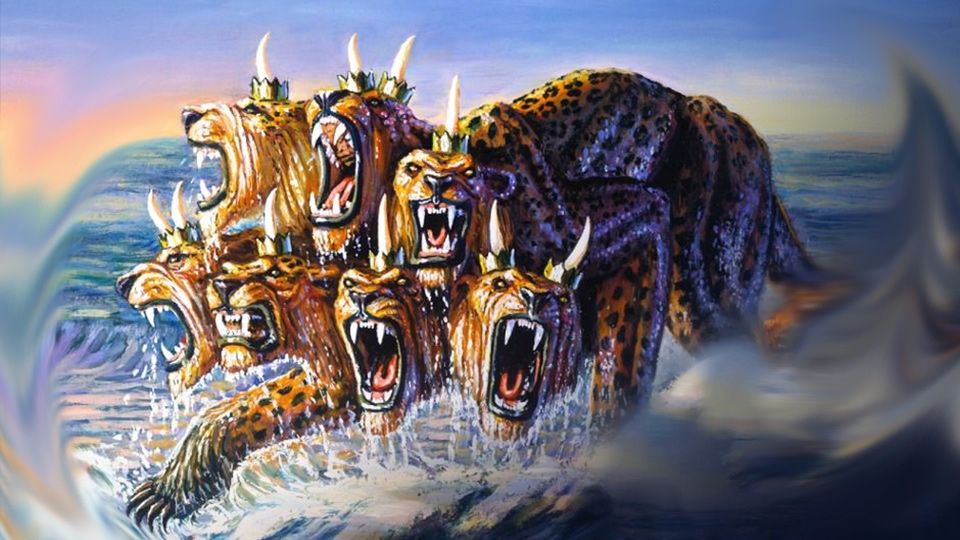

The Bible speaks of a beast, an enemy of God and His saints, which “shall make all, both little and great, rich and poor, freemen and bondmen, to have a character in their right hand, or on their foreheads. And that no man might buy or sell, but he that hath the character, or the name of the beast, or the number of his name” (Apocalypse 13:16-17).
Like any other sacrament of the Christian Church, Confirmation—the anointing with sacred chrism—has its own symbolism, which emerges from the gestures and elements that make up its celebration. However, before delving into these symbolic aspects, it is worth noting that through Confirmation, the Christian believer receives all the gifts of the Holy Spirit. As I have already pointed out in a previous article,i contrary to the interpretations proposed by certain charismatic (pseudo-Catholic) movements, which claim that even confirmed Catholics would require a new anointing to receive the Holy Spirit, we must firmly believe that the reception of His gifts coincides with the ritual of Confirmation described in the Acts of the Apostles.
“Now when the apostles, who were in Jerusalem, had heard that Samaria had received the word of God, they sent unto them Peter and John. Who, when they were come, prayed for them, that they might receive the Holy Ghost. For he was not as yet come upon any of them; but they were only baptized in the name of the Lord Jesus. Then they laid their hands upon them, and they received the Holy Ghost” (Acts 8: 14-17).
Sacred chrism perfects the grace of baptism; it is the sacrament that bestows the Holy Spirit to root us more deeply in God, to incorporate us more firmly into Christ, and to mature us so that we can even give public testimony to our Christian faith. In this sense, we can say that if Holy Baptism makes us—through the “bath of rebirth”—children in Christ, the Holy Sacrament of Confirmation makes us men in Christ.
When we read about the protection that sacred chrism confers upon us, we should think of the ancient Greek fighters who anointed their bodies to prevent their opponents from grasping them during combat.
In the traditional ritual of Confirmation, the key moment occurs when the bishop anoints the forehead of the recipient with Sacred Chrism. Before this moment, a prayer is recited in which the Holy Spirit is invoked with His seven gifts—wisdom and understanding, counsel and fortitude, knowledge and piety, and reverent fear of God (the Lord). At this point, the bishop already asks God to “mark (him) out for eternal life with the sign of the Cross ✠ of Christ.”ii Thus, we already understand that the heart of the matter is precisely this sign, which will be imprinted on the candidate at the very moment of the anointing:
“I sign thee with the sign of the ✠ Cross and I confirm thee with the Chrism of salvation.”
As the Roman Catechism (1566) teaches us, using the Aristotelian-Scholastic language established by Saint Thomas Aquinas, the words spoken by the bishop represent the form of the sacrament, while its matter is, of course, the sacred chrism. Why is this so? The rich symbolism—also referenced in the catechism—clearly explains the reasons:
“Nor indeed could any other matter than that of chrism seem more appropriate to declare the effects of this Sacrament. Oil, by its nature rich, unctuous and fluid, expresses the fullness of grace, which, through the Holy Ghost, overflows and is poured into others from Christ the head, like the ointment that ran down upon the beard of Aaron, to the skirt of his garment; for God anointed him with the oil of gladness, above his fellows, and of his fullness we all have received.
Balsam, the door of which is most pleasant, can signify nought save that the faithful, when made perfect by the grace of Confirmation, diffuse around them such a sweet door of all virtues, that they may say with the Apostle: ‘We are unto God the good odour of Christ.’ Balsam has also the power of preserving from corruption whatever it is used to anoint. This property seems admirably suited to express the virtue of the Sacrament, since it is quite evident that the souls of the faithful, prepared by the heavenly grace of Confirmation, are easily protected from the contagion of sins.”iii
The anointing with oil is simultaneously an imperial and warrior symbol. When we read about the protection that sacred chrism confers upon us, we should think of the ancient Greek fighters who anointed their bodies to prevent their opponents from grasping them during combat. It is like a protective film, similar to the water or oil used to secure shields—sometimes made of wood and leather—against the flaming arrows of enemies.
Just as God Himself has a sign with which He marks His chosen ones, so too does the devil have his sign, which will become especially evident with the unveiling of the Antichrist. Those who belong to the beast are marked with the number of its name.
Beyond reflecting on the matter and form of the sacrament, the importance of the sign of the Cross cannot be overstated. Considering this, we perceive an extraordinarily significant detail of the past centuries, following the Lutheran revolution: the abandonment and contempt shown toward the sign of the Holy Cross. Furthermore, the most terrible thing to contemplate are the (anti)rituals of darkness that involve the desecration of the Holy Cross.
For now, to clarify my thought, I will simply state that just as God Himself has a sign with which He marks His chosen ones, so too does the devil have his sign, which will become especially evident with the unveiling of the Antichrist. The Apocalypse of Saint John, the book of the secrets of history, contains passages that have always puzzled theologians and shepherds of the Church. In Chapter 13, it speaks of a beast, an enemy of God and His saints, which “shall make all, both little and great, rich and poor, freemen and bondmen, to have a character in their right hand, or on their foreheads. And that no man might buy or sell, but he that hath the character, or the name of the beast, or the number of his name” (Apocalypse 13:16-17). I will not now dwell on the symbolism of the number of the beast, which has prompted countless analyses in biblical exegesis. What I wish us to retain is simply this: those who belong to the beast are marked with the number of its name.
In Chapter 9 of the Apocalypse, the fifth trumpet of God’s wrath is described. From verse 4, we learn that “but only the men who have not the sign of God on their foreheads” (Apocalypse 9:4) will suffer the punishments sent as retribution. Later, in Chapter 14, this information is completed: the servants of the Lamb of God are surrounded by “a hundred forty-four thousand, having his name, and the name of his Father, written on their foreheads” (Apocalypse 14:1). Until the next article, where I will discuss the significance of the number of the beast, I wish to highlight only this: the moral and spiritual allegiance of people—whether to the service of the devil or to God—is marked by a seal with which the person is signed.
How long would it take for the world to convert? If a few apostles converted peoples, cultures, and empires, imagine what tens and hundreds of thousands of apostles could achieve! But for such an accomplishment, we must first live authentically Christian lives.
In the case of Confirmation, as in Baptism, the believer who receives the sacrament cannot keep for himself the treasure he has inherited. He is obliged to strive, to the best of his ability, to ensure that others also receive the light of faith and the graces he himself first received. If we were to take this obligation seriously, wouldn’t the world change? Imagine if all, absolutely all, Traditionalist Catholic believers became authentic apostles, moved and guided by the Holy Spirit. How long would it take for the world to convert? If a few apostles converted peoples, cultures, and empires, imagine what tens and hundreds of thousands of apostles could achieve! But for such an accomplishment, we must first live authentically Christian lives, and only then endeavor to ensure that others hear the faith, that hearing, they may believe, and believing, enter the Church of our Savior Jesus Christ to find salvation.
A symbolic gesture that speaks to this sacred duty of testimony, albeit indirectly, is the striking of the cheek of the one anointed by the bishop (“He [the Bishop] strikes him lightly on the cheek”) at the same moment he says, “Peace be with you.” The Roman Catechism explains the significance of this gesture (which has been removed from the new rite of Confirmation).
“The person when anointed and confirmed next receives a gentle slap on the cheek from the hand of the Bishop to make him recollect that, as a valiant combatant, he should be prepared to endure with unconquered spirit all adversities for the name of Christ.”
Clearly, the call to be true apostles and to endure adversities from an unbelieving world is encapsulated in the symbolic gesture of the bishop. Having established this, we can return to the symbolism of the anointing of the forehead with sacred chrism. As we have seen, the sign made by the bishop is that of the Holy Cross. Why the forehead? And why the sign of the Cross?
I begin with the latter, as it is more straightforward: the Cross represents the sacrifice of our Lord Jesus Christ, with all that it entailed. It was the result of a certain way of acting, living, and, above all, thinking on the part of the Savior Christ. It was a way of thinking in which the most important thing was always fidelity to God the Father and the service of one’s neighbor, even unto death, with the purpose of reconciling us with God and enabling us to reach Paradise. When we think of the sign of the Holy Cross, we do not think of a Roman instrument of torture but of this way of thinking, being, and acting embodied by our Lord, Jesus Christ.
Let us reflect a little on the forehead. The most visible part of the head, it belongs to that part of the human being we associate with thinking. Only the heart could be considered as equally important as the brain/head. In the treasury of universal literature, we encounter countless metaphors linking the forehead with the act of thinking. The most important creator in the entire history of Romanian poetry, Mihai Eminescu (1850–1889), has left us several verses that are extremely significant for our topic. For instance, in the love poem Gândind la tine (Thinking of You), the very first line reveals the connection between the forehead and thought:
“Gândind la tine fruntea-acum mă doare.” (“Thinking of you, my forehead now aches.”)
Or, in another of his masterpieces, Scrisoarea I (Epistle I), the poet describes the “frunţile pline de gânduri” (“foreheads full of thoughts”) of those who are observed from on high by the moon, which, as a wanderer, floats above the world. Thus, starting from the beautiful metaphors of such poets, we easily understand that “a thoughtful forehead” refers to a forehead marked by signs of intense intellectual activity.
Marking the forehead with the sign of the Holy Cross signifies that our entire way of thinking must be founded on the sacrifice of the Savior Christ and His exemplary life. Those meditations so often practiced by Christians in past centuries—beginning with the simple question, “What would the Savior Christ do if He were in my place?”—were the means by which Christians learned to unite their minds and hearts with God. This concretely meant following, day by day, the way of the Cross. For, as Saint John of the Cross (1542–1591) says, no other sign is more distinctly Christian. Only such a life demonstrates the divine measure of a love that enables the one who possesses it to sacrifice himself for those he loves.
i Entitled “The Holy Spirit, the Sacrament of Confirmation and the Errors of the‘Charismatic’ Movements” the article is available online here: https://www.remnantnewspaper.com/fetzen-fliegen/item/7185-the-holy-spirit-the-sacrament-of-confirmation-and-the-errors-of-the-charismatic-movements [Accessed: 25 November 2024].
ii All the quotations from my article are from the text of the Traditional ritual of Confirmation available on the official website of The Latin Mass Society of England and Wales: https://lms.org.uk/new-and-traditional-confirmations-side-side [Accessed: 25 November 2024].
iii For the Trent (i.e., Roman) Catechism I always use the translation realized by the Dominican fathers John A. McHugh, and Charles J. Callan (1923).
