
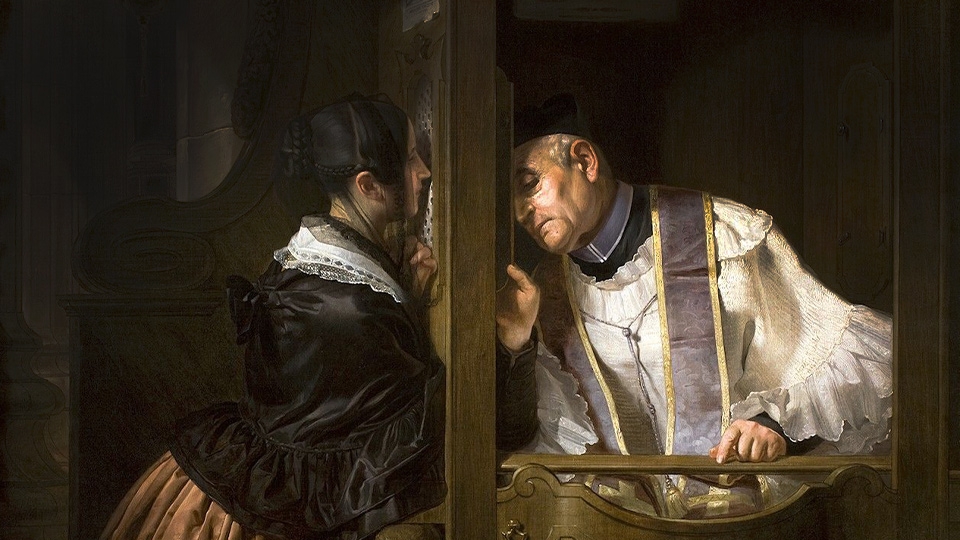

The Queen of the Universe, the Holy Virgin Mary, is “higher than the cherubim and more glorious beyond compare than the seraphim”—as an ancient Byzantine hymn says—because of the virtue in which she had no equal: humility. Without humility, repentance is not possible. And when we humbly acknowledge our sinfulness, we can approach the sacrament that reopens for us the gates of the heavenly Jerusalem: Confession.
The goal of our lives is, without a doubt, the true world—the Kingdom of Heaven. The condition for “admission” into this world beyond is unique: penitence (repentance). This is why, when it comes to expressing the Gospel in a single word, short and clear, we have no doubt. It is the very word that was from the beginning associated with the mission of the Lord’s herald—Saint John the Baptist:
“Do penance: for the kingdom of heaven is at hand” (Matthew 3:3).
Likewise, once our Lord Jesus Christ began His public ministry, we repeatedly encounter the same word, emphasized insistently. For example, to His fellow countrymen, who were horrified by Pilate’s killing of some Galileans, the Savior responded by questioning and warning them:
“Think you that these Galileans were sinners above all the men of Galilee, because they suffered such things? No, I say to you: but unless you shall do penance, you shall all likewise perish” (Luke 13:2-3).
Why have I quoted these verses, which clearly show that the essence of the Gospel announced by Saint John the Baptist and preached by Christ the Savior is penitence? To highlight that Christian life cannot be conceived without the Sacrament of Penance. If Holy Baptism is the “gateway” that opens the path to all the Sacraments, the Sacrament of Penance is the one that reopens this gate for us. It is not by chance, then, that in traditional Catholic circles, the Sacrament of Penance is highly esteemed.
The awakening to faith, accompanied—when necessary—by conversion to the Catholic Church, has meant for many of my acquaintances the establishment of a close relationship with the Sacrament of Penance. Without hesitation, I can say that this sacrament—along with the Holy Eucharist—is the most important “medicine” for me as well. And yet, over the years, I have often been surprised by the alarmingly large number of Novus Ordo Catholics who did not accept (and some still do not accept) the necessity of Confession. Moreover, in the post-pandemic period, not only has the number of those attending Holy Mass declined, but so has the number of those who go to Confession. Although there are several explanations for this phenomenon, I believe it is linked to the most fundamental aspect of Christian life, which I will reveal in the second part of this article. When confronted with Catholics who refuse the Sacrament of Confession, I have sought to understand, whenever possible, the reasons for such an attitude.
How do we still sin—and sometimes gravely—despite being sanctified with such an abundance of graces given to us by God Himself?
Often, and unfortunately, sometimes in irreverent or even outright offensive terms, the quality of the priest was accused: “How can I confess to that sinner?” or “What makes the priest any better than me?” In other words, the obstacle stemmed either from the shame of confessing before a priest who knows the penitent or from personal knowledge of the priest and doubts about his character. Unfortunately, in other cases, the issue could be something even more harmful: anti-clericalism. Evidently, such ideas can only lead to delaying—or even completely abandoning—Confession.
Other times, I was astonished to learn that some of my conversation partners, although baptized, did not consider themselves in any way part of Christ’s Church (i.e., the Catholic Church). Consequently, they did not acknowledge any obligation to fulfill sacramental acts or even recognize any duty in this regard. Others, however, were simply unaware that there is an obligation for annual Confession. This is why I will now quote directly from the Code of Canon Law of the Church:
“After having reached the age of discretion, each member of the faithful is obliged to confess faithfully his or her grave sins at least once a year” (Canon 989).
Third—but not least—I have encountered a type of believer who is afflicted by the “viruses” of a harmful syndrome, which could be called the “Snow White” syndrome. By examining a list of extremely grave sins (adultery, fornication, theft, murder, etc.) and comparing their own sins to these, they conclude that they have no sins that need to be confessed. A pious elderly woman with gray hair, when reminded by a priest that annual confession is mandatory, calmly replied: “What should I confess, Father? I haven’t killed anyone, I haven’t stolen anything, and at my age, there are no more sexual temptations.”
What can one say to this type of “saints”? Clearly, in most cases, such responses indicate a lack of proper moral formation and catechesis. For without knowing the sins (including the so-called “venial sins”) that arise from breaking God’s commandments and the Church’s teachings, it is impossible to recognize them in order to confess properly.
In his first letter to the Corinthians, the Apostle Paul makes a statement that characterizes the spiritual condition of the baptized:
“But you are washed, but you are sanctified, but you are justified in the name of our Lord Jesus Christ, and the Spirit of our God” (I Corinthians 6: 11).
On the other hand, in his first epistle, the Holy Apostle John firmly affirms our sinfulness:
“If we say that we have no sin, we deceive ourselves, and the truth is not in us” (I John 1:8).
How can we reconcile the statements of the two apostles quoted above? How can holiness and sinfulness coexist? That is the question…
If, through the Sacraments of Baptism, Confirmation, and the Eucharist, we have received all the necessary graces to truly be “the saints of God” (I Corinthians 1:2), why do we still need Confession? How do we still sin—and sometimes gravely—despite being sanctified with such an abundance of graces given to us by God Himself? Against any extremes, the Holy Church has always preached and taught that man is a fallen being who needs divine help to rise again. This is why neither the Pelagian heresy, against which St. Augustine fought so much—claiming that we need only our own willpower to become righteous—nor the heresies of Lutheranism and Calvinism—which assert that we are irredeemably fallen, predestined either for damnation or salvation regardless of our will and merits—represent the Truth on this grave matter.
Concupiscence remains active in the baptized to provide them with the opportunity to earn merits through spiritual fight. Moreover, the persistence of concupiscence is the most important means by which God keeps us humble, concretely emphasizing our vital need for grace, for God.
The orthodox doctrine of the Catholic Church first explains the consequences of original sin. Essentially, when discussing these consequences in relation to Holy Baptism, it is emphasized that the supernatural life of grace received through the Sacraments of Christian Initiation does not eliminate human weakness, nor does it erase the inclination to sin—traditionally called “concupiscence.” According to the consistent teaching of the Saints and the Church, concupiscence remains active in the baptized to provide them with the opportunity to earn merits through spiritual fight. Moreover, this persistence of concupiscence is the most important means by which God keeps us humble, concretely emphasizing our vital need for grace, for God. Just as the Savior Himself said that the Kingdom of Heaven belongs to children, we too must maintain our awareness of dependence on our Heavenly Father, the only one who can truly help us in any circumstance.
Following great Doctors such as St. Augustine, our Church has never accepted either excessive optimism—like that of the Pelagian heretics—or hopeless pessimism regarding human nature’s ability to do good and practice virtue. The Church’s doctrine is realistic, recognizing the fragility of fallen nature, which can only be restored through the sanctifying grace given to us by God Himself through the Holy Sacraments. This is why we need the Sacrament of Penance!
To illustrate this in the simplest and clearest way, we can adapt one of St. Thomas Aquinas’s favorite analogies: the image of a man who has fallen into a well. While God does not immediately pull him out, He does something remarkable—He provides him with a ladder. In other words, He offers the means by which the man can climb out. Clearly, if the man had been abandoned entirely, he would never have been able to escape (as the Lutheran and Calvinist heresies claim). And if he had been able to climb out on his own, escalating the walls of the well like Spider-Man, then he would fit the Pelagian view of salvation through personal effort alone. In this analogy, the man cannot escape without external help. That help—the ladder—is given under the form of the Holy Sacraments. The man’s responsibility is to use them—to climb the ladder. By now, it should be clear why the Holy Church requires every Catholic to confess at least once a year.
Let us turn our attention to confused Catholics who avoid Confession by using arguments like those mentioned earlier. Regarding the first objection—that the priest’s own sinfulness makes the idea of repentance unacceptable—the answer is simple: we do not confess so much to the priest as to God Himself. This must be emphasized with the greatest insistence: the one who forgives sins is God, not the priest. When I explained this to someone, he immediately asked: “Then why do we need the priest?” The answer to this question contains the key point of my article: for our humility. To attain the contrite state required for true Confession, the presence of the priest is truly beneficial. First, let us acknowledge: how could we stand before God? King David, terrified, asked:
“If thou, O Lord, wilt mark iniquities: Lord, who shall stand it?” (Psalm 129:3).
If the one chosen by God to lead the people of Israel asked this, what would we say if God Himself appeared before us to “mark our iniquities”? This is a primary reason why God has placed a man before us—a sinner like ourselves. On one hand, this should stir in us both shame and, more importantly, humility. This virtue can never be emphasized enough. The most difficult aspect of humility is that it cannot be taught or learned. So how do we acquire it? The brilliant Saint and Doctor Bernard of Clairvaux says there is only one way to gain humility: by being humiliated. No other method works. Only when we are humbled—usually involuntarily—do we gain humility. This is why God has ordained that this vital sacrament requires the immediate presence of a priest: to give us the opportunity to humble ourselves.
After Baptism, we are engaged in a battle meant to lead us to Heaven. However, this battle necessarily involves purification, the cleansing of the soul from sin, and resistance against the sinful tendencies of fallen nature.
A far more difficult issue is the case of Christians who live an apostate life, refusing to acknowledge—or failing to realize, whether out of ignorance or stubbornness—that the Baptism received in childhood requires a clear commitment to the path of salvation. Indifferent or even hostile to matters of faith, they dismiss the need for repentance and, consequently, the act of Confession. Discussions with such individuals, estranged from the Sacrament of Penance, are not easy. However, supernatural means—above all, prayer—are the most effective. Let us not hesitate to use them!
Finally, regarding the “Snow White” Catholics—those who believe they have nothing to confess—the situation is just as challenging: only proper moral education can lead them out of this state. Certain books—such as the journals of St. Teresa of Ávila—can help reveal the multitude of sins, even venial ones, that must be recognized and confessed. Additionally, well-structured examination of conscience questionnaires, like those available in the links provided in the notes,[i] can be useful.
Once we have entered the Kingdom of Heaven through the gate of Baptism, we are engaged in a battle meant to lead us from the initial state of the Kingdom—granted to us in the militant Church—to the status of a citizen of Heaven, attainable in the heavenly, triumphant Church. However, this battle necessarily involves purification, the cleansing of the soul from sin, and resistance against the sinful tendencies of fallen nature. While human nature is not evil in itself, it is affected by disordered passions and inclinations. This is why God Himself has given us an invaluable and irreplaceable support: the Sacrament of Confession.
[i] “How to make a good confession? The examination of conscience:” https://olmca.sspx.ca/en/news/how-make-good-confession-examination-conscience-24042 [Accessed: 10 February 2025] and “Instruction and Preparation for Confession:” https://www.sspxasia.com/Documents/Sacraments/Confession-instruction.htm [Accessed: 10 February 2025].
