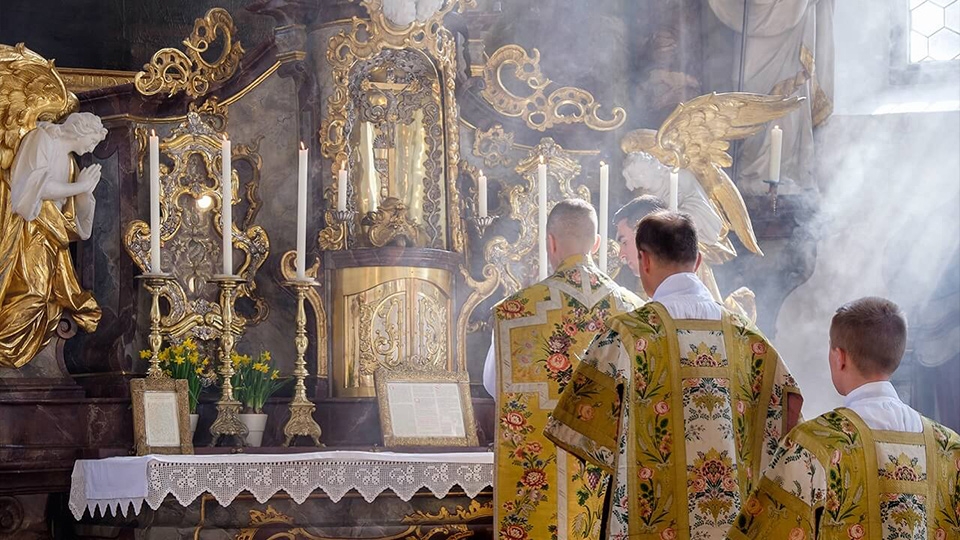

This article argues that, among the widely-celebrated forms of the Mass in the Roman Rite, the Traditional Latin Mass is undeniably the form that best satisfies the letter and spirit of Vatican II’s Constitution on the Sacred Liturgy, Sacrosanctum Concilium.
To set the stage for understanding this seemingly paradoxical reality, and why God might have permitted it, it is worth reflecting on the words of Fr. Daniel Cooper from his 2007 foreword to Fr. Joseph Dunney’s The Mass Explained (Imprimatur 1924):
“Most of us do not appreciate what we have until after it is gone, for example, our health, good parents, and close friends. The Catholic Mass also falls into this category. God allowed Catholics to lose this precious treasure, much like He allowed the Jews to lose the Ark of the Covenant in the Old Testament, so that they would learn to appreciate it. In the 1950’s, we had a very good pope (Pius XII) and there were many converts. Catholic churches were so plentiful, especially in our major cities, that one could go to Mass and confession whenever and wherever he pleased. However, when things are too easy, we grow lax. And while we hope no Catholic held the Mass in contempt, perhaps we no longer saw it for what it is: the most necessary thing on earth, the only perfect thing. In the 1960’s, in a span of just six years, the ancient Latin Mass was taken away.” (p. ix-x)
The Traditional Latin Mass was taken away and replaced by the Novus Ordo Missae. The process of this replacement was led by Archbishop Annibale Bugnini, who was almost certainly a Freemason. Bugnini was tasked with developing a Mass to satisfy the requirements of Sacrosanctum Concilium (SC), but as we can see from several excerpts from that Vatican II document below, he failed in key respects. As such, there is a real sense in which the only Mass that even comes close to satisfying the Vatican II requirements is the Traditional Latin Mass.
Even though the Novus Ordo Missae fulfills some requirements of SC, it never should have been promulgated without satisfying all essential requirements. Accordingly, the Traditional Latin Mass ought to have remained the “Ordinary Form” until those charged with developing the Novus Ordo Missae had properly fulfilled their responsibilities.
Moreover, even though the Novus Ordo Missae fulfills some requirements of SC, it never should have been promulgated without satisfying all essential requirements. Accordingly, the Traditional Latin Mass ought to have remained the “Ordinary Form” until those charged with developing the Novus Ordo Missae had properly fulfilled their responsibilities. As it turned out, though, the hasty promulgation of an inadequate replacement for the Traditional Latin Mass was such a profound insult to God that it was bound to produce the catastrophic results we have seen for almost sixty years. With that in mind, we can reflect on the key ways in which the Traditional Latin Mass is the only form of the Roman Rite that comes close to satisfying the requirements of SC.
Innovations Were Permitted Only As Necessary for the Good of the Church
SC states that there should have been no innovations other than those required for the good of the Church:
“Finally, there must be no innovations unless the good of the Church genuinely and certainly requires them; and care must be taken that any new forms adopted should in some way grow organically from forms already existing.”
This requirement is absolute and cannot be discharged simply because the innovators believe that the good of the Church demands the elimination of the Traditional Latin Mass. As such, we must look at every single change and ask two questions: (1) was the change genuinely required for the good of the Church, and (2) did the change grow organically from existing forms? Thanks be to God, the answer to the latter question is abundantly clear to all rational observers: the changes to the Mass, individually and collectively, constitute a completely inorganic development. By this test alone, the Novus Ordo Missae violates SC.
Going back to the first question — was the change genuinely required for the good of the Church? — the verdict becomes more clear every year. Among the countless manifestations of that verdict, we can look to the recent Chartres Pilgrimage, in which roughly twenty thousand young pilgrims showed the world what they thought about which form of the Roman Rite was “good for the Church.” As fewer and fewer Novus Ordo attendees can even muster the devotion to drive five minutes to fulfill their weekly Mass obligations, these pilgrims walked seventy miles over three days to show their love for the Traditional Latin Mass, which remains the most perfect thing on earth.
The Novus Ordo Missae, in its most prevalent manifestations, violates this key requirement of Sacrosanctum concilium.
The Use of Latin Must Be Preserved
In his They Have Uncrowned Him, Archbishop Marcel Lefebvre described how many Council Fathers were persuaded to accept SC’s call for the greater use of the vernacular language:
“[I]n the Constitution on the Liturgy, Sacrosanctum concilium, by writing at n. 36 #2: ‘A more extensive role can be granted to the vernacular language,’ and by entrusting to the episcopal assemblies the care of deciding whether the vernacular language will be adopted or not (cf. n. 36 #3), the drafters of the text opened the door to the suppression of Latin in the liturgy. In order to soften this intention, they took care to write at first, at n. 36 #1: ‘The use of the Latin language, except for particular law, will be kept in the Latin rites.’ Reassured by this assertion, the Fathers swallowed the two others without a problem.” (p. 168)
As a matter of simple logic and justice, it is completely illegitimate to ignore the requirement from SC that “the use of the Latin language is to be preserved in the Latin rites.” This requirement governs the application of the provisions permitting the use of the vernacular — and as Archbishop Lefebvre indicated, the Council Fathers would not have accepted the provisions allowing greater use of the vernacular without the provision requiring the preservation of Latin. As such, the Novus Ordo Missae, in its most prevalent manifestations, violates this key requirement of SC.
The Traditional Latin Mass’s Substance Must Be Preserved
Although SC permitted revision of the Mass, it clearly required that the substance of the Traditional Latin Mass must be preserved:
“The rite of the Mass is to be revised in such a way that the intrinsic nature and purpose of its several parts, as also the connection between them, may be more clearly manifested, and that devout and active participation by the faithful may be more easily achieved. For this purpose the rites are to be simplified, due care being taken to preserve their substance; elements which, with the passage of time, came to be duplicated, or were added with but little advantage, are now to be discarded; other elements which have suffered injury through accidents of history are now to be restored to the vigor which they had in the days of the holy Fathers, as may seem useful or necessary.”
Here we have a requirement that the innovators needed to take due care to preserve the substance of the Traditional Latin Mass. The only items to be eliminated were those that were redundant or of no benefit. Thus, the Council Fathers who took this passage seriously would not have recognized as legitimate any version of the Mass that discarded key elements of the Traditional Latin Mass. Because the Novus Ordo Missae discarded many key elements of the Traditional Latin Mass — which were neither redundant nor without benefit — it violates this key requirement of SC.
What good are “actions, gestures, and bodily attitudes” when they tend to obfuscate the reality that the Mass is the renewal of Our Lord’s Sacrifice on Calvary?
Active Participation is Encouraged
Finally, we can consider the primary aspect of the Novus Ordo that superficially appears to satisfy the requirements of SC:
“To promote active participation, the people should be encouraged to take part by means of acclamations, responses, psalmody, antiphons, and songs, as well as by actions, gestures, and bodily attitudes. And at the proper times all should observe a reverent silence.”
Those who attend the Traditional Latin Mass will likely agree that this description can be more easily applied to the High Masses that they attend than to Low Masses. However, those who contend that the Novus Ordo Missae better satisfies this SC requirement should consider that the Novus Ordo Missae eliminated “reverent silence” and fractured the connection between sacred mysteries of the Mass and the “actions, gestures, and bodily attitudes” of those attending it. What good are “actions, gestures, and bodily attitudes” when they tend to obfuscate the reality that the Mass is the renewal of Our Lord’s Sacrifice on Calvary? Much of the touted “active participation” at the Novus Ordo Missae would be far more appropriate at a banquet than at the Holy Sacrifice of the Mass, so it can scarcely be called good or consistent with the intentions of SC.
On this point of active participation, Dr. Peter Kwasniewski provided another vital consideration in his Our Roman Catholic Birthright: The Genius and Timeliness of the Traditional Latin Mass:
“Tellingly, the first time a pope used the expression ‘active participation’—it was in Pope Pius X’s motu proprio on sacred music, Tra le Sollecitudini, of November 22, 1903—the emphasis was not on the people or their contribution, but on the nature of the liturgy in which they were summoned to participate. The accent is placed on the objective reality, which must be a certain way in order to make the people’s involvement worthwhile if they are to acquire ‘the blessing of heaven’ and the ‘true Christian spirit.’ . . . The pope makes it clear that our first priority is the sanctity and dignity of the temple, the public and solemn prayer of the Church, the most holy mysteries, the homage we make to the Most High. When all this is in order, then the faithful will have access to the ‘foremost and indispensable font’ of the Christian spirit. And if we fail to give God and the things of God the primacy, the pope says we will be putting whips into the hand of Christ to drive us out of the church like intruders on a sacred domain. Astonishing!”
Thus, if we think about “active participation” properly, we can see that it is fostered by the Traditional Latin Mass and thwarted in many ways through the Novus Ordo Missae. If we refuse to see “active participation” in this proper context, then we might as well say that actively protesting during a Mass — perhaps with vandalism or violence — would be more pleasing to God than silent prayer because it is “active.” If we want to avoid this ludicrous conclusion, then we must understand the wisdom of Dr. Kwasniewski’s words above.
If we want genuine active participation in the way that draws us closer to Our Lord, we must respect the actual significance of the mysteries taking place at Mass.
Finally on this point, we can reflect on what Fr. Joseph Dunney wrote about silence in his The Mass Explained:
“The Mass is the best place to learn the value of silence. Lucky for us if we can learn the lesson of silence early in life. A growing number of girls and boys as they go on and up through the high school master the habit of thoughtful, meditative silence over their prayer book while at Mass. If we will hear Christ in our heart, we must place ourselves apart. That is why going to Mass mornings day after day makes us better Catholics, better characters. Mass sets our hearts thinking aright, lets in light on ourselves, stirs our duty toward our neighbor — all this while uniting us more closely to Christ. Nothing is more useful than silence. In silence and hope shall your strength be.” (p. 121)
If we want genuine active participation in the way that draws us closer to Our Lord, we must respect the actual significance of the mysteries taking place at Mass. When we try to engage as though our external actions were paramount, or even necessary, then we almost invariably sacrifice real participation in favor of purely superficial participation. Only in the Traditional Latin Mass can we find the “reverent silence” required by SC, which is necessary for us if we wish to “hear Christ in our heart.”
Overall, it is evident that Vatican II’s Sacrosanctum Concilium proposed certain changes that many Traditional Catholics would not willingly embrace. However, it is also the case that the Council Fathers in no way envisioned that promulgating a haphazard attempt to satisfy the requirements of SC was better than retaining the Traditional Latin Mass. The considerations above should make it abundantly clear that there is no alternative to the Traditional Latin Mass that fulfills the requirements of SC. As such, the best possible way to truly honor SC today is to attend the only widespread form of the Roman Rite that was not developed in contravention of SC, which is the Traditional Latin Mass.
Going back to Fr. Cooper’s foreword to Fr. Dunney’s book, we can see Divine Providence at work here. Our need to fight for the Traditional Latin Mass has given Catholics renewed fervor, allowing us to draw closer to Our Lord. We not only appreciate what was taken away through the misapplication of SC, but we can see that the Traditional Latin Mass is not the work of human hands — when men tried to replace it, they could only come up with something that generally leads to empty pews, broken hearts, and deepening disillusionment. May God grant Pope Leo XIV the wisdom and understanding to realize this and the fortitude to act appropriately. Immaculate Heart of Mary, pray for us!