
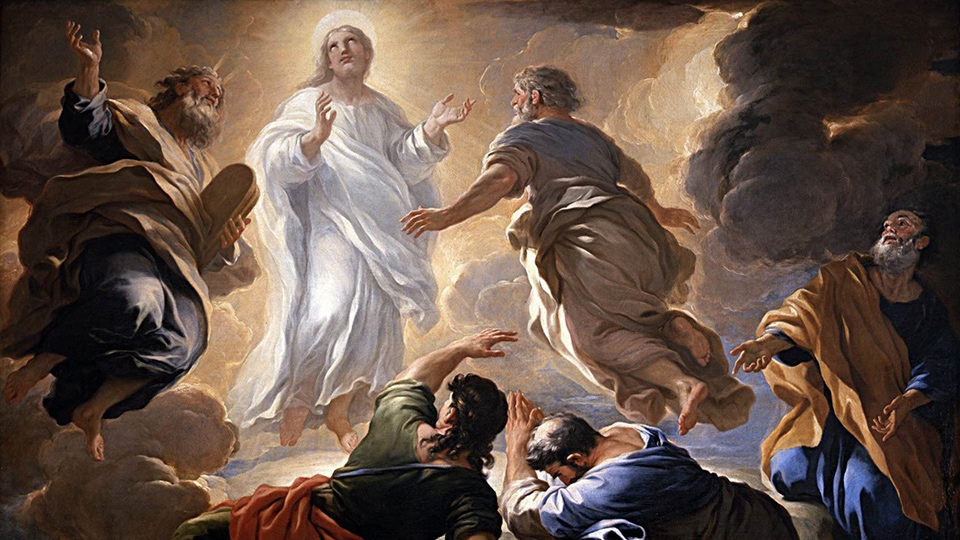
The Transfiguration of Christ is a profound revelation of the entire Paschal mystery—the new Exodus by which Christ would lead His people out of the bondage of sin and into the eternal Promised Land of heaven. The presence of Moses and Elijah bears witness to the culmination of the Old Covenant in the person of Christ. Moses, the lawgiver and deliverer, represents the liberation from Egypt and the covenant of the Law given at Sinai.
“And it came to pass about eight days after these words, that he took Peter and James, and John, and went up into a mountain to pray. And whilst he prayed, the shape of his countenance was altered, and his raiment became white and glittering. And behold two men were talking with him. And they were Moses and Elias, appearing in majesty. And they spoke of his decease that he should accomplish in Jerusalem. But Peter and they that were with him were heavy with sleep. And waking, they saw his glory, and the two men that stood with him. And it came to pass that, as they were departing from him, Peter saith to Jesus: Master, it is good for us to be here. And let us make three tabernacles, one for thee, and one for Moses, and one for Elias: not knowing what he said. And as he spoke these things, there came a cloud, and overshadowed them. And they were afraid, when they entered into the cloud. And a voice came out of the cloud, saying: This is my beloved Son; hear him” (Luke 9:28-35).
The Transfiguration of Christ is not merely a vision of divine glory but a profound revelation of the entire Paschal mystery—the new Exodus by which Christ would lead His people out of the bondage of sin and into the eternal Promised Land of heaven. The presence of Moses and Elijah bears witness to the culmination of the Old Covenant in the person of Christ. Moses, the lawgiver and deliverer, represents the liberation from Egypt and the covenant of the Law given at Sinai. Elijah, the great prophet, who was assumed into heaven, foreshadows the glorified departure of Christ and His ascension. The Gospel explicitly reveals the purpose of their presence, stating that they “spoke of his decease, which he should accomplish in Jerusalem” (Luke 9:31). The word used here for “decease” in the Greek text is ἔξοδος (exodos), meaning “departure” or “going out,” unmistakably invoking the original Exodus. This deliberate word choice unveils the deeper meaning of Christ’s mission: His passion, death, resurrection, and ascension constitute the true and definitive Exodus, delivering mankind not from mere temporal slavery but from the dominion of sin and death into the eternal Kingdom of God.
The mountain setting itself recalls Mount Sinai, where Moses communed with God and received the Law amid divine glory. The cloud that descends upon the apostles echoes the Shekinah—the visible manifestation of God’s presence. Yet, while Sinai was marked by fear and distance, the Transfiguration reveals divine intimacy: the glory of God is made manifest in the face of Jesus Christ. The voice from the cloud— “This is my beloved Son; hear him”—echoes the theophany of Sinai but surpasses it, as God now speaks not through fire and thunder, but through His Son, the incarnate Word. The command to “hear him” declares that the old covenant, represented by Moses and Elijah, is now fulfilled and superseded by the new covenant in Christ. The Fathers of the Church saw in this event the revelation of the new and eternal covenant, in which the old shadows give way to the reality of grace.
The fact that Peter evokes the tabernacles for Jesus and the patriarchs brings to mind the fact that the Feast of Tabernacles occurred as a festival at one of the three harvests the Jews had in their calendar. This connection is deeply significant, as the three annual harvests of the Jewish calendar—spring, summer, and fall—were far more than agricultural events. They were vastly theological, prefiguring the redemptive work of Christ and the sacraments of the Catholic Church. Each harvest corresponds to a significant stage in salvation history, representing Christ’s Passion, the outpouring of the Holy Spirit, and the final ingathering at the end of time.
The spring harvest symbolizes the Paschal Mystery, culminating in Baptism. The summer harvest points to Pentecost and the Eucharist, by which the Church is nourished. The fall harvest prefigures the Last Judgment, when the fruits of the spiritual harvest will be gathered. Together, they reveal the divine economy.
The spring harvest occurred in the month of Nisan (March-April) and centered on the barley crop, the first grain to ripen. This harvest was marked by the Feast of Unleavened Bread, beginning the day after Passover. On the second day, the Israelites presented the Omer offering, the first sheaf of barley, as a wave offering to God (Leviticus 23:10-11). This event foreshadowed the resurrection of Christ, the first fruits of the dead (1 Corinthians 15:20), who rose on the day after the Sabbath. The humble barley, the grain of the poor, prefigures Christ’s self-offering in humility. Liturgically, this harvest corresponds to Baptism, by which Christians pass through the waters of death and rise to new life, just as Israel passed through the Red Sea at the first Passover. The unleavened bread of the feast foreshadows the Eucharistic Bread, the Body of the true Paschal Lamb sacrificed for the redemption of the world.
Fifty days later, the summer harvest in the month of Sivan (May-June) marked the ripening of the wheat, a more substantial and valuable grain. This was celebrated with the Feast of Shavuot (Pentecost), when the Israelites presented two loaves of leavened wheat bread (Leviticus 23:17), symbolizing the fullness of the harvest. Jewish tradition also held that the Law was given on Mount Sinai on this day, commemorating the covenant. In the Catholic Church, this harvest prefigures the descent of the Holy Spirit at Pentecost, which occurred fifty days after the Resurrection. The two loaves represent the Jew and Gentile united in the New Covenant, forming one Church in Christ. Wheat, the superior grain, points to the Eucharist, the Bread of Life, which nourishes the faithful with the very Body of Christ. Just as the Law was given to Israel at Sinai, the Spirit writes the New Law on the hearts of the faithful, transforming them into temples of God.
The fall harvest in the month of Tishri (September-October) was the most abundant, gathering grapes, figs, pomegranates, and olives. It was celebrated with the Feast of Tabernacles (Sukkot), also called the Feast of Ingathering (Exodus 23:16), marking the end of the agricultural year. During this feast, the Israelites lived in temporary booths, recalling their sojourn in the wilderness and their dependence on God. The fall harvest prophetically symbolizes the Final Judgment and the ingathering of souls at the end of time. The grapes, pressed into wine, represent both wrath and joy—wrath for the unrepentant (Revelation 14:19) and joy for the redeemed at the heavenly banquet (Matthew 26:29). The olives, crushed for oil, prefigure the Sacrament of Confirmation, where the faithful are anointed with sacred chrism, receiving the indelible seal of the Holy Spirit. The final day of Tabernacles, Hoshana Rabbah, with its cry for salvation, foreshadows the Church’s longing for Christ’s return and the fulfillment of the Kingdom, which coincides with the cry in the penultimate verse of the last chapter of the last book in the Bible, Revelations 22:20: “He that giveth testimony of these things, saith, Surely I come quickly: Amen. Come, Lord Jesus.”
These three harvests form a prophetic arc of salvation history. The spring harvest symbolizes the Paschal Mystery, culminating in Baptism. The summer harvest points to Pentecost and the Eucharist, by which the Church is nourished. The fall harvest prefigures the Last Judgment, when the fruits of the spiritual harvest will be gathered. Together, they reveal the divine economy, where God draws all things to Himself through Christ, gathering souls into the eternal harvest of heaven.
Both Zechariah and Isaiah foresee the universal reign of God, in which the nations will submit to the Messianic King and be gathered into the Kingdom. The fulfillment of these prophecies is realized in the Catholic Church, which is the new and eternal Jerusalem.
Once the Jewish feasts are understood in their proper perspective, one needs at this point to examine what precedes verse 28 that starts the narrative of the Transfiguration proper, as it indicates that what was about to happen occurred about eight days after “these words.” What words were these? The Gospel records in the preceding text:
“And it came to pass, as he was alone praying, his disciples also were with him: and he asked them, saying: Whom do the people say that I am? But they answered, and said: John the Baptist; but some say Elias; and others say that one of the former prophets is risen again. And he said to them: But whom do you say that I am? Simon Peter answering, said: The Christ of God. But he strictly charging them, commanded they should tell this to no man. Saying: The Son of man must suffer many things, and be rejected by the ancients and chief priests and scribes, and be killed, and the third day rise again. And he said to all: If any man will come after me, let him deny himself, and take up his cross daily, and follow me. For whosoever will save his life, shall lose it; for he that shall lose his life for my sake, shall save it. For what is a man advantaged, if he gain the whole world, and lose himself, and cast away himself?” (Luke 9:18-25).
The Gospel shows that the Transfiguration event directly follows Christ’s prediction of His Passion and His call to discipleship through self-denial and the cross. The divine glory revealed on the mountain is thus inseparably linked to the suffering He foretells. The Transfiguration offers the disciples a foretaste of the glory that will follow the Passion, strengthening them for the scandal of the cross.
The mention of the “eighth day” carries teleological significance. In Jewish tradition, the number eight symbolizes a new beginning and transcendence of the natural order, which is represented by the seven days of creation. The eighth day thus signifies the entry into a new, divine reality—eternal rest. The Talmud describes the “eighth day” of the Feast of Tabernacles (Shemini Atzeret) as a foreshadowing of the eschatological gathering of the nations and the final age of divine glory:
“The Gemara cites a parable about a king of flesh and blood who said to his servants: Prepare me a great feast that will last for several days. When the feast concluded, on the last day, he said to his beloved servant: Prepare me a small feast so that I can derive pleasure from you alone.” (Talmud, Sukkah 55b).
The eighth day thus symbolizes the culmination of the divine plan, pointing toward the eternal Sabbath of heaven, where the faithful will dwell in the divine presence. The Transfiguration, occurring on the “eighth day,” prefigures this final rest, in which Christ leads the redeemed into the eternal Promised Land of the heavenly Jerusalem.
The Transfiguration is not only a revelation of Christ’s glory but also a promise of the future glorification of the Church.
The Transfiguration evokes the Feast of Tabernacles (Sukkot), as suggested by Peter’s impulsive desire to build three tabernacles. Though the Gospel says that Peter spoke “not knowing what he said,” his instinct was very symbolic. The Feast of Tabernacles commemorated Israel’s forty-year sojourn in the wilderness, when the people dwelt in tents and God’s presence was made manifest in the tabernacle. Yet the feast also carried eschatological overtones, symbolizing the coming of the Messianic age when God’s kingdom would be fully manifest. The Targum of Zechariah interprets the prophecy of Zechariah 14:16 in this Messianic light:
“And it shall come to pass that every one that is left of all the nations which came against Jerusalem shall go up year by year to worship the King, the Lord of Hosts, and to keep the Feast of Tabernacles” (Targum Zechariah 14:16).
This prophecy envisions the eschatological age when all nations will ascend to Jerusalem and worship the Messianic King. The pilgrimage to Jerusalem to keep the Feast of Tabernacles symbolizes the conversion of the Gentiles and their participation in the Messianic reign. Isaiah also prophesies this universal pilgrimage of the nations:
“And in the last days the mountain of the house of the Lord shall be prepared on the top of mountains, and it shall be exalted above the hills, and all nations shall flow unto it. And many people shall go, and say: Come and let us go up to the mountain of the Lord, and to the house of the God of Jacob, and he will teach us his ways, and we will walk in his paths” (Isaiah 2:2-3).
Both Zechariah and Isaiah foresee the universal reign of God, in which the nations will submit to the Messianic King and be gathered into the Kingdom. The fulfillment of these prophecies is realized in the Catholic Church, which is the new and eternal Jerusalem. The spiritual pilgrimage of the nations, prefigured in the annual Feast of Tabernacles, finds its reality in the countless souls from every tribe, tongue, and nation who enter the Church through baptism and partake of the Eucharistic sacrifice and feast.
Peter’s instinct to build tabernacles also carries sacramental significance. In the Old Covenant, the tabernacle housed the divine presence in the Ark of the Covenant. In the new covenant, the sacraments become the true tabernacles, in which Christ’s presence is made manifest.
The parallelism with the prophets Zechariah and Isaiah further reinforces the redemptive significance of the Transfiguration. The Gospel states that Christ’s garments became dazzling white, which recalls the prophetic vision of Zechariah:
“And Jesus shewed me Joshua the high priest standing before the angel of the Lord: and Satan stood at his right hand to be his adversary… And the Lord said to him: Behold I have taken away thy iniquity, and have clothed thee with a change of garments” (Zechariah 3:1, 4).
The “change of garments” symbolizes the justification of sinners through Christ’s Passion. Isaiah likewise prophesied:
“Though your sins be as scarlet, they shall be made as white as snow” (Isaiah 1:18).
Christ’s radiance in the Transfiguration prefigures the glorified state of the redeemed, made white by the blood of the Lamb. This is echoed in the Apocalypse:
“These are they who are come out of great tribulation, and have washed their robes, and made them white in the blood of the Lamb” (Revelation 7:14).
Peter’s instinct to build tabernacles also carries sacramental significance. In the Old Covenant, the tabernacle housed the divine presence in the Ark of the Covenant, overshadowed by the Shekinah. In the new covenant, the sacraments become the true tabernacles, in which Christ’s presence is made manifest. The Eucharist, in particular, is the new manna that sustains the people of God on their journey to the true Promised Land. Just as the Israelites were nourished with manna in the desert, the faithful are fed with the Bread of Life as they journey toward heaven. The Fathers of the Church frequently made this connection. Saint Ambrose writes:
“Now return with me to my proposition. Great and venerable indeed is the fact that manna rained upon the Jews from heaven. But understand! What is greater, manna from heaven or the body of Christ? Surely the body of Christ, who is the Author of heaven. Then, he who ate the manna died; he who has eaten this body will effect for himself remission of sins and ‘shall not die forever’” (De Sacramentis, 4.24).
Thus, the sacraments of the Church fulfill the Old Testament types and prefigure the heavenly banquet, where the faithful will dwell not in earthly tents, but in the eternal tabernacle of God.
The Greek text of the Transfiguration reveals the transformative nature of the event. The word used for Christ’s altered appearance is μετεμορφώθη (metemorphōthē) (Matthew 17:2), from which the English word “metamorphosis” is derived. This verb signifies a complete and radical transformation, indicating that Christ revealed not merely an external radiance but the intrinsic glory of His divine person. The whiteness of His garments, described as “glittering,” symbolizes the purity and immortality of the glorified body, which Christ will communicate to the saints through His victorious Exodus.
Saint Leo the Great writes that the Transfiguration reveals the destiny of all the faithful:
“And in this Transfiguration the foremost object was to remove the offense of the cross from the disciple’s heart, and to prevent their faith being disturbed by the humiliation of His voluntary Passion by revealing to them the excellence of His hidden dignity. But with no less foresight, the foundation was laid of the Holy Church’s hope, that the whole body of Christ might realize the character of the change which it would have to receive, and that the members might promise themselves a share in that honor which had already shone forth in their Head” (Sermones, 51, 3).
Thus, the Transfiguration is not only a revelation of Christ’s glory but also a promise of the future glorification of the Church. Through His glorified humanity, Christ leads the faithful into the eternal kingdom, where they will share in His divine life. The sacraments of the Church, prefigured by the tabernacles of the Old Covenant, sustain the faithful on their journey, nourishing them with the Bread of Life until they reach the eternal tabernacle of heaven, where they will see God face to face. The Transfiguration, therefore, is not merely a foreshadowing of Christ’s glory, but a revelation of the destiny of the entire Church—the final glorification of the saints, who will dwell in the eternal kingdom, no longer as pilgrims, but as citizens of the heavenly Jerusalem.
