
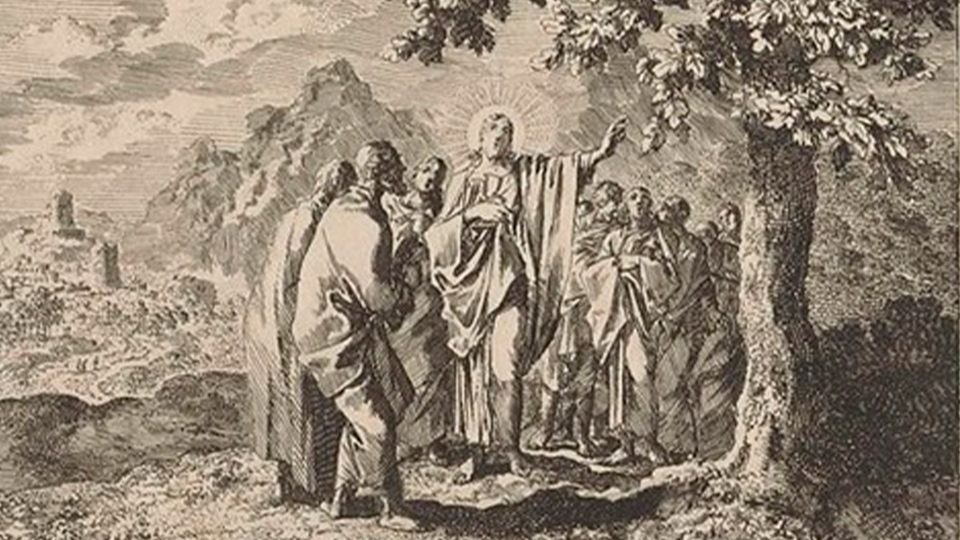

The prohibition of the Tree of the Knowledge of Good and Evil, revealed as the fig tree, symbolizes man’s fall into concupiscence. The sewing of fig leaves represents man’s futile attempt at self-mortification, while God’s gift of animal skins foreshadows Christ’s sacrifice. Thus, from Eden to Calvary, the fig tree stands as a profound symbol of the human condition and divine mercy.
The prohibition against eating from the Tree of the Knowledge of Good and Evil in the Garden of Eden is one of the most pivotal commands in salvation history. Its violation by Adam and Eve brought about the fall of mankind and the introduction of death, concupiscence, and the corruption of the human race. This essay argues that the forbidden tree was the fig tree, based on the immediate consequences of the fall, the scriptural and patristic evidence, and the symbolic significance of the fig throughout salvation history.
This essay further explores the patristic tradition, particularly Saint Augustine’s insight, which suggests that after their sin, Adam and Eve’s disordered lust was awakened. This is evidenced by their shame in their nakedness, which prompted them to cover themselves with fig leaves—a tree emblematic of mortification due to its prickly and irritating texture. God, in His mercy, replaced their self-imposed fig-leaf aprons with garments of animal skins, which foreshadowed the sacrificial system and prefigured the ultimate sacrifice of Christ, the Lamb of God.
This article will also examine Christ’s cursing of the barren fig tree, interpreting it as a symbol of divine judgment upon the unfruitful human nature inherited from Adam. This act, far from being an irrational display of wrath, is a deliberate typological action recalling the original fall. We will further explore the garments of light that Adam and Eve lost due to their sin, linking them to the priestly vestments God ordained for Aaron and his sons, which symbolized the restoration of the lost radiance. Lastly, it will consider how Saint Peter invokes this restored priestly dignity when he calls all believers “a chosen generation, a kingly priesthood” (1 Peter 2:9).
The Loss of Radiance
After Adam and Eve disobeyed God’s command and ate from the forbidden tree, their eyes were opened, and they became aware of their nakedness:
“And the eyes of them both were opened: and when they perceived themselves to be naked, they sewed together fig leaves, and made themselves aprons” (Genesis 3:7).
The immediate detail that they sewed aprons from fig leaves provides an important clue about the identity of the forbidden tree. The Church Fathers and medieval commentators often interpreted this detail allegorically. Saint Augustine, however, in his De Civitate Dei (City of God), offers a deep psychological and theological reflection on this moment, explaining that Adam and Eve’s awareness of their nakedness was not merely physical but moral and spiritual. Their original innocence, which enabled them to view each other with pure love, was lost. In its place arose concupiscence, the disordered appetite that led to shame.
According to Augustine, prior to the fall, Adam and Eve possessed perfect self-mastery over their bodies, and their sexual faculties were subject to reason and the will. After their sin, this mastery was lost.
Augustine writes:
“Justly is shame very specially connected with this lust; justly, too, these members themselves, being moved and restrained not at our will, but by a certain independent autocracy, so to speak, are called shameful. Their condition was different before sin. For as it is written, they were naked and were not ashamed, Genesis 2:25 — not that their nakedness was unknown to them, but because nakedness was not yet shameful, because not yet did lust move those members without the will’s consent; not yet did the flesh by its disobedience testify against the disobedience of man. For they were not created blind, as the unenlightened vulgar fancy; for Adam saw the animals to whom he gave names, and of Eve we read, the woman saw that the tree was good for food, and that it was pleasant to the eyes. Genesis 3:6 Their eyes, therefore were open, but were not open to this, that is to say, were not observant so as to recognize what was conferred upon them by the garment of grace, for they had no consciousness of their members warring against their will. But when they were stripped of this grace, that their disobedience might be punished by fit retribution, there began in the movement of their bodily members a shameless novelty which made nakedness indecent.” (De Civitate Dei, Book XIV, chapter 17).
According to Augustine, prior to the fall, Adam and Eve possessed perfect self-mastery over their bodies, and their sexual faculties were subject to reason and the will. After their sin, this mastery was lost. Adam and Eve experienced uncontrolled arousals with concupiscent desire. This is reflected in the punishment God inflicts upon Eve:
“Thou shalt be under thy husband’s power, and he shall have dominion over thee” (Genesis 3:16).
However, it is essential to highlight the full curse:
“Thou shalt be under thy husband’s power, and he shall have dominion over thee. In sorrow shalt thou bring forth children, and thou shalt be under thy husband’s power, and he shall rule over thee” (Genesis 3:16).
The phrase, “Thou shalt be under thy husband’s power,” denotes more than mere submission—it reveals a perverse, disordered desire that emerged after the fall. The Hebrew text suggests not only a longing for union but a craving to dominate and control. This explains the perennial conflict of the sexes: Eve’s desire would be both sexual and a usurpation of her husband’s headship, which mirrors the feminist rebellion that echoes through the ages. This desire or urge is clearly seen in both the French and American Bible translations of the Jerusalem Bible and the official Bible version used in the liturgy by the USCCB in America, the New American Bible (NAB). The Jerusalem Bible renders Genesis 3:16 as: “Your yearning shall be for your husband, and he will dominate you,” emphasizing the craving and subjugation. Meanwhile, the NAB translates the verse as: “Your desire shall be for your husband, and he will rule over you,” highlighting both the longing and the power dynamic, indicating not mere affection but a disorderly desire mixed with the struggle for dominance. Both of these versions were the result of fairly recent efforts by the French and American bishops to respond to Pope Pius XII’s request for new translations directly from the original Hebrew, Aramaic, and Greek texts, rather than relying on the Latin Vulgate. This initiative was outlined in his 1943 encyclical Divino Afflante Spiritu, where he encouraged the use of original language manuscripts to enrich biblical scholarship and make the Scriptures more accessible in the vernacular.
The Barren Fig Tree
The fig tree, therefore, becomes a fitting symbol of their fallen condition. Its broad leaves, irritating texture, and roughness symbolize the disordered desires that now plagued them. Their attempt to cover themselves with fig leaves reflects a self-imposed form of mortification, which, in their ignorance, failed to restore their lost innocence. The fact that Adam and Eve used the fig tree is fitting because the entire drama occurred within the restricted area known as the Garden of Eden. Adam was present during Eve’s conversation with the devil, as indicated by the text: “She took of the fruit thereof, and did eat, and gave to her husband who did eat” (Genesis 3:6), showing that he was with her. Their loss of innocence was immediate, since God had warned, “For in what day soever thou shalt eat of it, thou shalt die the death” (Genesis 2:17), signifying the instant spiritual death that accompanied their disobedience. The fig tree was the tree of their downfall and thus, fittingly, the very one they used to cover their nakedness—a poetic justice in their self-inflicted shame.
The fig tree, therefore, becomes a fitting symbol of their fallen condition. This same symbolism appears when Jesus encounters the barren fig tree and curses it. The fig tree represents Israel, which, despite its external religious observances, failed to recognize its time of visitation and bore no fruit of repentance.
This same symbolism appears when Jesus encounters the barren fig tree and curses it. Though it was not the season for figs, He nonetheless expects fruit and condemns the tree for its barrenness: “And when he had seen a fig tree afar off having leaves, he came, if perhaps he might find anything on it. And when he was come to it, he found nothing but leaves; for it was not the time for figs. And answering, he said to it: May no man hereafter eat fruit of thee any more forever” (Mark 11:13-14). Some might find it unjust for Christ to curse the fig tree out of season, but this action is deeply symbolic. The fig tree represents Israel, which, despite its external religious observances, failed to recognize its time of visitation and bore no fruit of repentance. This is confirmed when Jesus laments over Jerusalem, saying: “If thou also hadst known, and that in this thy day, the things that are to thy peace: but now they are hidden from thy eyes” (Luke 19:42). The fig tree, which should have produced early figs—a sign of spiritual preparedness—was barren, just as Israel remained spiritually barren at the coming of the Messiah.
The identification of Israel with the fig tree is rooted in the Old Testament. The prophet Jeremiah uses the image of the fig tree to symbolize the people of Israel, portraying both the faithful remnant and the corrupt majority: “And the word of the Lord came to me, saying: What seest thou, Jeremiah? And I said: Figs, the good figs, very good: and the bad figs, very bad, which cannot be eaten, because they are bad” (Jeremiah 24:3). Here, the good figs represent the exiles whom God would preserve, while the bad figs symbolize the unfaithful who would be destroyed. Similarly, the prophet Hosea laments Israel’s unfruitfulness under the same fig tree imagery: “I found Israel like grapes in the desert, I saw their fathers like the firstfruits of the fig tree in the top thereof: but they went in to Beelphegor, and were separated to that confusion, and became abominable as those things which they loved” (Hosea 9:10). The prophet Micah uses the withered fig tree as a metaphor for Israel’s spiritual desolation: “There is no cluster to eat of the first-ripe fruit: my soul desired the first-fruits. The holy man is perished out of the earth” (Micah 7:1-2). “Under their vine and fig tree” is a phrase quoted in the Hebrew Scriptures in three different places: Micah 4:4, 1 Kings 4:25, and Zechariah 3:10. These prophetic passages confirm the fig tree as a well-established symbol of Israel’s spiritual condition: at times fruitful but more often barren and corrupt. And their most abject time was when their Messiah arrived and they rejected Him.
This symbolism is further confirmed by Jesus’ interaction with Nathanael. When Philip calls Nathanael to meet Jesus, he is skeptical: “Can anything of good come from Nazareth?” (John 1:46). Yet when Jesus sees him, He says, “Before that Philip called thee, when thou wast under the fig tree, I saw thee” (John 1:48). At this, Nathanael immediately declares: “Rabbi, thou art the Son of God, thou art the King of Israel” (John 1:49). Jesus’ mention of the fig tree reveals something deeply personal to Nathanael, likely a moment of prayer or meditation on the Messiah. The fig tree here serves as a symbol of the spiritual awakening that Israel should have undergone at Christ’s arrival. Yet, unlike Peter, who makes the same confession—”Thou art Christ, the Son of the living God” (Matthew 16:16)—and is then declared the rock upon which the Church is built, Nathanael receives no such commission. His recognition of Christ is genuine, but it does not yet bear the ecclesiastical fruit that Peter’s confession does. This further ties into the barren fig tree, which, while outwardly appearing to be in a season of spiritual readiness, bore no real fruit when the time of judgment came.
Thus, the fig tree weaves through Scripture as a symbol of man’s fall, Israel’s failure to bear fruit, and the individual soul’s recognition or rejection of Christ.
Thus, the fig tree weaves through Scripture as a symbol of man’s fall, Israel’s failure to bear fruit, and the individual soul’s recognition or rejection of Christ. Just as Adam and Eve turned to the fig tree to cover their shame, so too does Israel use outward religious observance to mask its spiritual barrenness. And just as Christ curses the unfruitful fig tree, so too does He pronounce judgment upon Jerusalem for failing to recognize the time of its visitation: “Behold, your house shall be left to you desolate” (Matthew 23:38).
Furthermore, the tradition that the forbidden tree was an apple tree stems from a linguistic play on words. In the Latin Vulgate, the word malum means both “evil” and “apple,” which led to the popular association. Since the Vulgate was the standard Bible for the majority of Christendom for centuries, this homophonic connection inspired artists and popular imagination to depict the apple tree as the cause of man’s fall, though Scripture gives no such indication.
In an act of divine mercy, God replaced their self-imposed fig-leaf aprons with garments of animal skin: “And the Lord God made for Adam and his wife garments of skins, and clothed them” (Genesis 3:21). This is the first recorded sacrifice in Scripture. Though the text does not specify the animal, the sacrificial connotation is clear: blood was shed to provide a covering for human shame. The early Church Fathers saw this as a prefiguration of the sacrificial system, which pointed toward the ultimate sacrifice of Christ.
The loss of innocence is also symbolized by the stripping of their garments of light. The Biblical background for such an understanding includes the passage from Gen 3:21, where “the Lord God made for Adam and his wife garments of skin and clothed them.” The Targumic traditions, both Palestinian and Babylonian, read, instead of “garments of skin,” “garments of glory.” This Targumic interpretation is reinforced by Rabbinic sources. One of them can be found in Genesis Rabbah 20:12, which tells that the scroll of Rabbi Meir reads “garments of light” instead of “garments of skin”: “In Rabbi Meir’s Torah it was found written, ‘Garments of light: this refers to Adam’s garments, which were like a torch [shedding radiance], broad at the bottom and narrow at the top.'” This interpretation hinges on the play on Hebrew words: אור (ohr) meaning “light” and עור (ohr) meaning “skin.” Rabbi Meir, one of the foremost Tannaim, maintained that the original garments were luminous, reflecting the pre-fallen glory of man, which was lost through sin.
The reality of man’s original luminous state is reflected in Moses, who, after speaking with God face to face, radiated such brilliance that the Israelites could not bear to look upon him.
The reality of man’s original luminous state is reflected in Moses, who, after speaking with God face to face, radiated such brilliance that the Israelites could not bear to look upon him: “And when Moses came down from Mount Sinai, he held the two tables of the testimony, and he knew not that his face was horned from the conversation of the Lord. And Aaron and the children of Israel seeing the face of Moses horned, were afraid to come near” (Exodus 34:29-30). Moses, who beheld God’s glory, was transformed to such an extent that a veil was required to shield the people from his countenance: “And having done speaking, he put a veil upon his face” (Exodus 34:33). This transformation in Moses parallels the prelapsarian state of Adam and Eve, who walked in the presence of God and, in doing so, possessed garments of light. This also corresponds to God’s warning to Moses: “Thou canst not see my face: for man shall not see me and live” (Exodus 33:20). Yet Adam and Eve, before their fall, were capable of seeing God in some way (though definitely not the beatific vision of heaven) and yet living on earth, which suggests that their luminous state was an aspect of their original divinization. Their loss of this divine radiance after their sin explains why they now perceived their nakedness and experienced shame. This luminous dignity is what Saint Paul evokes when he exhorts the faithful: “Let us therefore cast off the works of darkness, and put on the armor of light” (Romans 13:12), calling them to regain the lost splendor through grace. The priestly vestments of Aaron, adorned with precious stones, symbolized this restoration. Saint Peter, reflecting on this, calls the faithful “a chosen generation, a kingly priesthood, a holy nation” (1 Peter 2:9), signifying the restoration of the divine radiance through Christ’s redemptive sacrifice.
Saint Irenaeus comments:
“Proverbs 9:10, the sense of sin leads to repentance, and God bestows His compassion upon those who are penitent. For [Adam] showed his repentance by his conduct, through means of the girdle [which he used], covering himself with fig-leaves, while there were many other leaves, which would have irritated his body in a less degree. He, however, adopted a dress conformable to his disobedience, being awed by the fear of God; and resisting the erring, the lustful propensity of his flesh (since he had lost his natural disposition and child-like mind, and had come to the knowledge of evil things), he girded a bridle of continence upon himself and his wife, fearing God, and waiting for His coming, and indicating, as it were, some such thing [as follows]: Inasmuch as, he says, I have by disobedience lost that robe of sanctity which I had from the Spirit, I do now also acknowledge that I am deserving of a covering of this nature, which affords no gratification, but which gnaws and frets the body. And he would no doubt have retained this clothing for ever, thus humbling himself, if God, who is merciful, had not clothed them with tunics of skins instead of fig-leaves. For this purpose, too, He interrogates them, that the blame might light upon the woman; and again, He interrogates her, that she might convey the blame to the serpent. For she related what had occurred. The serpent, says she, beguiled me, and I ate. Genesis 3:13 But He put no question to the serpent; for He knew that he had been the prime mover in the guilty deed; but He pronounced the curse upon him in the first instance, that it might fall upon man with a mitigated rebuke. For God detested him who had led man astray, but by degrees, and little by little, He showed compassion to him who had been beguiled.” (Adversus Haereses, III.23.5).
The animal skins not only symbolize the sacrificial atonement, but also God’s tenderness and mercy. Whereas Adam and Eve inflicted upon themselves the prickly irritation of the fig leaves as an act of penance, God replaced their harsh coverings with the more humane and protective animal skins, which signified His desire to alleviate their suffering despite their sin.
The prohibition of the Tree of the Knowledge of Good and Evil, revealed as the fig tree, symbolizes man’s fall into concupiscence. The sewing of fig leaves represents man’s futile attempt at self-mortification, while God’s gift of animal skins foreshadows Christ’s sacrifice. Thus, from Eden to Calvary, the fig tree stands as a profound symbol of the human condition and divine mercy.
