
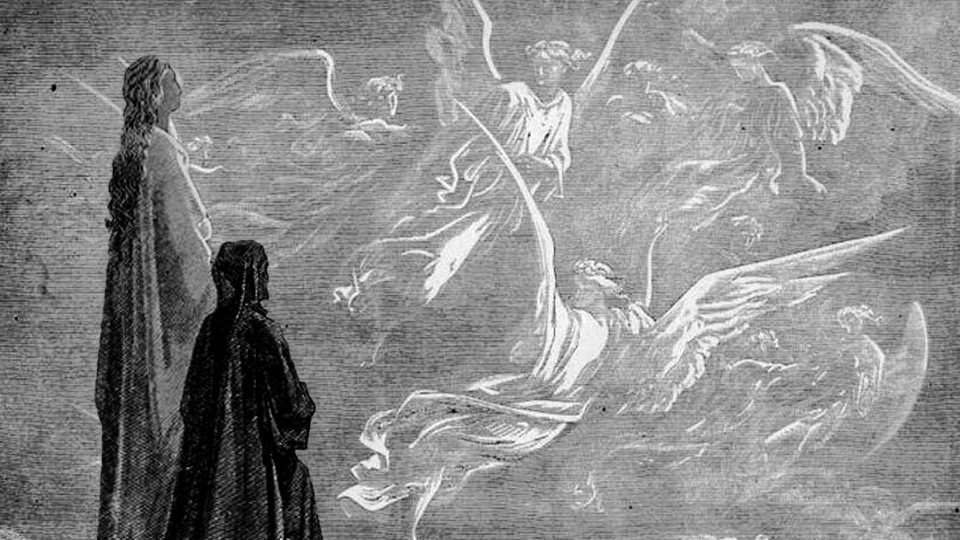

For that cosmic jewel described in the final chapters of the Revelation of Saint John, there is simply no possible comparison. Even if we witnessed the most stunning sunrises and sunsets in the most exotic locations imaginable, none of these could compare to Paradise. St. Don Bosco experienced multiple prophetic dreams. One of them, occurring in 1847 and repeated in 1848 and 1856, allowed him to glimpse both the Paradise reserved for the elect.
Let us suppose that one of us were to discover the most beautiful secret place in Venice: a garden full of rare, exotic flowers and majestic palm trees offering their protective shade, hidden in the inner courtyard of a 500-year-old palazzo. Or an island full of weeping willows and multicolored birds, lost in the labyrinth of canals in the Danube Delta. Inevitably, we would wish to share the joy of such discoveries with our loved ones. We would tell them about it, send them photos, show them videos. Yet despite all the sophisticated digital means of mimicking appearances, they could not truly behold or enjoy these “corners of paradise” that we discovered here on earth—unless they visited them themselves. If this is true for rare places on this fleeting earth, how much more true is it when it comes to Paradise?
For that cosmic jewel described in the final chapters of the Revelation of Saint John, there is simply no possible comparison. Even if we witnessed the most stunning sunrises and sunsets in the most exotic locations imaginable, none of these could compare to Paradise. The Catechism of the Catholic Church rightly emphasizes this unbridgeable limit in four articles—1026 to 1029—which it dedicates to Paradise:
“By his death and Resurrection, Jesus Christ has ‘opened’ heaven to us. The life of the blessed consists in the full and perfect possession of the fruits of the redemption accomplished by Christ. He makes partners in his heavenly glorification those who have believed in him and remained faithful to his will. Heaven is the blessed community of all who are perfectly incorporated into Christ. This mystery of blessed communion with God and all who are in Christ is beyond all understanding and description. Scripture speaks of it in images: life, light, peace, wedding feast, wine of the kingdom, the Father’s house, the heavenly Jerusalem, paradise: ‘no eye has seen, nor ear heard, nor the heart of man conceived, what God has prepared for those who love him’ (1 Corinthians 2: 9). Because of his transcendence, God cannot be seen as he is, unless he himself opens up his mystery to man’s immediate contemplation and gives him the capacity for it. The Church calls this contemplation of God in his heavenly glory ‘the beatific vision:’ ‘How great will your glory and happiness be, to be allowed to see God, to be honored with sharing the joy of salvation and eternal light with Christ your Lord and God, . . . to delight in the joy of immortality in the Kingdom of heaven with the righteous and God’s friends’ (Saint Cyprian, Epistle 58). In the glory of heaven the blessed continue joyfully to fulfill God’s will in relation to other men and to all creation. Already they reign with Christ; with him ‘they shall reign for ever and ever’ (Revelation 22: 5; cf. Matthew 25: 21 and 23).”
As is clearly seen, all the teachings about Paradise in the Catechism are a faithful echo of the biblical texts of the prophets and apostles. However, absolutely all the visions of the world to come by the great prophets Isaiah and Ezekiel find their fulfillment in the Apocalypse of the Apostle John. In this inspired text, revealed to us through the eagle of Patmos, we encounter the most complete and beautiful symbolic description of Paradise, represented by the heavenly Jerusalem:
“And he took me up in spirit to a great and high mountain: and he shewed me the holy city Jerusalem coming down out of heaven from God, Having the glory of God, and the light thereof was like to a precious stone, as to the jasper stone, even as crystal. And it had a wall great and high, having twelve gates, and in the gates twelve angels, and names written thereon, which are the names of the twelve tribes of the children of Israel. On the east, three gates: and on the north, three gates: and on the south, three gates: and on the west, three gates. And the wall of the city had twelve foundations, and in them, the twelve names of the twelve apostles of the Lamb. And he that spoke with me, had a measure of a reed of gold, to measure the city and the gates thereof, and the wall. And the city lieth in a foursquare, and the length thereof is as great as the breadth: and he measured the city with the golden reed for twelve thousand furlongs, and the length and the height and the breadth thereof are equal. And he measured the wall thereof an hundred and forty-four cubits, the measure of a man, which is of an angel. And the building of the wall thereof was of jasper stone: but the city itself pure gold, like to clear glass. And the foundations of the wall of the city were adorned with all manner of precious stones. The first foundation was jasper: the second, sapphire: the third, a chalcedony: the fourth, an emerald: the fifth, sardonyx: the sixth, sardius: the seventh, chrysolite: the eighth, beryl: the ninth, a topaz: the tenth, a chrysoprasus: the eleventh, a jacinth: the twelfth, an amethyst. And the twelve gates are twelve pearls, one to each: and every several gate was of one several pearl. And the street of the city was pure gold, as it were transparent glass. And I saw no temple therein. For the Lord God Almighty is the temple thereof, and the Lamb. And the city hath no need of the sun, nor of the moon, to shine in it. For the glory of God hath enlightened it, and the Lamb is the lamp thereof” (Apocalypse 21, 10-23).
Troubled by the nostalgia for the Paradise lost through the original sin of Adam and Eve, yet with their gaze fixed on the heavenly Jerusalem depicted by Saint John the Theologian, the Fathers and Doctors of the Church—alongside the saints and mystics of various eras—have passed down their own testimonies and visions meant to draw our attention to a world incomparably more beautiful and better than the corrupted and fallen one we now know.
The monk Girolamo Savonarola (1452–1495) also offered a description of Paradise in his Compedium de Révélations (Compendium of Revelations): a land full of wondrous flowers, indescribable trees and fruits, and gentle, friendly little animals.
A true synthesis of Christian reflection from the patristic era was offered to us by Saint John of Damascus, in the trilogy known as The Fountain of Knowledge (Greek: Pegé gnóseos).[i] In the final part of his work, The Dogmatics (in fact, the Greek title is Ékdosis akribés tés orthodóxou písteos, translated into Latin as Expositio fidei), we find a special section dedicated to the original Paradise:
“Since God intended to fashion man after His own image and likeness from the visible and invisible creation to be a sort of king and ruler over the whole earth and the things in it, He prepared a sort of kingdom for him, in which he might dwell and lead a blessed and blissful life.’ And this divine paradise prepared in Eden by the hands of God was a treasure house of every joy and pleasure. For ‘Eden’ is interpreted as meaning ‘delight.’ It was situated in the east and was higher than all the rest of the earth. It was temperate in climate and bright with the softest and purest of air. It was luxuriant with ever-blooming plants, filled with fragrance, flooded with light, and surpassing all conception of sensible fairness and beauty. In truth, it was a divine place and a worthy habitation for God in His image. And in it no brute beasts dwelt, but only man, the handiwork of God.”[ii]
Equally detailed as that of Saint John of Damascus is the description of Paradise offered by another great representative of Syrian Christianity, Saint Ephrem (c.307–373). In one of the most beautiful and profound texts of the 4th century, titled Hymns on Paradise, we find a meditation on the structure of the original world before the Fall. Although the text must be read in its entirety to grasp its deep meanings, we will be content here with a few short excerpts:
“Who can behold the radiance of the garden,
seeing its marvelous design, its skillful proportions,
how spacious it is for those who dwell within,
how luminous its dwellings?
Its fountains delight with their fragrance (…).
The tongue cannot express what is within Paradise,
nor is it enough even for its outward beauties,
for not even the simple ornaments of its surroundings
can be told as they deserve.
Its colors are joyful, its fragrances truly wondrous,
its beauties most beloved, and its delights exalted.
Paradise embraces the senses with its many delights:
the eyes with its adornments, the ears with its sounds,
the mouth and nostrils with its tastes and fragrances.”[iii]
The Christian Middle Ages were no less preoccupied with the unseen world than the brilliant era of the Church Fathers. One of the most famous texts about the afterlife is Saint Patrick’s Purgatory. Although the exact date of its writing is uncertain (likely toward the end of the 12th century AD), this triple description—of Hell, Purgatory, and Paradise—enjoyed exceptional popularity. As Shane Leslie, quoted by French historian Jacques Le Goff, put it, it became “one of the bestsellers of the Middle Ages.”
In short, it recounts the journey of a knight, Owein, into the unseen world, which he enters through the mouth of a deep cave. This becomes the passage into the invisible realm, allowing him—well before Dante—to visit all the dwellings of the afterlife. Regarding Paradise, it is described as being surrounded by “a very high and beautiful wall, with gates of pure gold and precious stones, from which a most pleasant fragrance emanated.” Inside lies a marvelous city, its perfectly harmonized proportions reminiscent of the Apocalypse of Saint John. Most scholastic authors broadly share this vision, although some—such as Saint Thomas Aquinas—emphasize the content of the eternal life of those in the heavenly Jerusalem, namely the “beatific vision” of God.
We can never cease to be amazed by the consistency of the saints’ interpretations, even when separated by over a thousand years (for example, between Saint Gregory of Nyssa and Saint John Bosco).
The monk Girolamo Savonarola (1452–1495) also offered a description of Paradise in his Compedium de Révélations (Compendium of Revelations): a land full of wondrous flowers, indescribable trees and fruits, and gentle, friendly little animals. Above these reigns the hierarchy of angels, over whom preside the Holy Virgin Mary and the Holy Trinity.
Although I could endlessly multiply the quotations from saints and Christian mystics across various eras who contemplated Paradise, I will keep within the limits suitable for a newspaper article and conclude with the vision of a modern Catholic saint: Don Giovanni Bosco (1815–1888). Endowed with extraordinary supernatural gifts and remarkable natural talents, Don Bosco experienced multiple prophetic dreams. One of them, occurring in 1847 and repeated in 1848 and 1856, allowed him to glimpse both the Paradise reserved for the elect and the hardships of the path leading to it.[iv]
He was shown a garden of unimaginable beauty, which could be reached by a path lined with roses. Boldly stepping onto that path, the saint quickly realized the hidden challenges: the thorns of the beautiful flowers pierced his skin and flesh, causing his feet to bleed. Eventually, by putting on a pair of sturdy shoes, he succeeded in reaching a monumental building—a castle of a beauty and splendor unimaginable in our world. The Virgin Mary, his guide, helped him understand the meaning of what he had seen: the thorns represented sensitive affections, human likes and dislikes, and also the sum of obstacles, sorrows, and sufferings that the saints endure from the world; the roses symbolized love. Clearly, the grand palace seen at the end is the eternal city, the heavenly Jerusalem, toward which every true Christian aspires.
According to the symbolic interpretation of his own dream that Don Bosco himself shared with us, the shoes that allowed him to walk through the thorns represent mortification—that is, the ensemble of spiritual practices such as fasting, prayer, self-restraint, almsgiving, etc.—which liberate the soul from the prison of passions and unhealthy attachments to worldly things. This interpretation finds confirmation in a classic text by Saint Gregory of Nyssa, On the Life of Moses:
“So that we may not be harmed by the thorns of this life (and the thorns are sins), having bare and unprotected feet, let us arm them with sturdy shoes. And these shoes mean the self-restrained and austere life, which crushes and breaks the strength of the thorns and prevents sin from entering the soul, even from its most subtle and unseen beginnings.”
We can never cease to be amazed by the consistency of the saints’ interpretations, even when separated by over a thousand years (for example, between Saint Gregory of Nyssa and Saint John Bosco). And yet, despite the “temporal distances,” across the ages, their visions and interpretations—in perfect harmony with the revealed texts of Holy Scripture—always convey the same immortal teachings about the unimaginable beauty of Paradise and the way we can reach it.
[i] There is at least one complete English translation of the treatise of Saint John of Damascus: Writings, Translated by Frederic H. Chase Jr., Washington: The Catholic University of America Press, 1999.
[ii] Op. cit., p. 230.
[iii] I quote from Sebastian Brock, Efrem Sirul, Translated by Ioan Ică Jr., Sibiu: Deisis Publishing House, 1998.
[iv] I took all the information about Saint John Bosco from a substantial monograph – in two volumes – by the Greek Catholic Father Liviu Pandrea: Don Bosco. The Herald of Joy, Cluj-Napoca, “Unitas” Publishing House, 1997.
