

Among all the treasures that God offers us through the Holy Church, the first and the most valuable, upon which all others depend, is supernatural faith (with all the teachings about God and His works). Crystallized in the Credo we recite both in personal prayers and at every Holy Mass, this faith represents the foundation of Christian religious life. Although relatively short, the small “poem” of the Credo is rich in content. Specifically, we are taught everything we need to know about God and the manifestations of His wonderful omnipotence.
Among the dogmas systematized here, article 4 speaks about the Savior Jesus Christ – “Who for us men and for our salvation came down from the heavens, and was incarnate of the Holy Spirit and the Virgin Mary, and became man” (“Qui propter nos homines et propter nostram salutem descendit de caelis. Et incarnatus est de Spiritu Sancto ex Maria Virgine, et homo factus est”). An almost identical statement is found in the Apostles’ Creed. The point I wish to focus on in this article concerns the incarnation of God the Son “of the Holy Spirit and the Virgin Mary.”
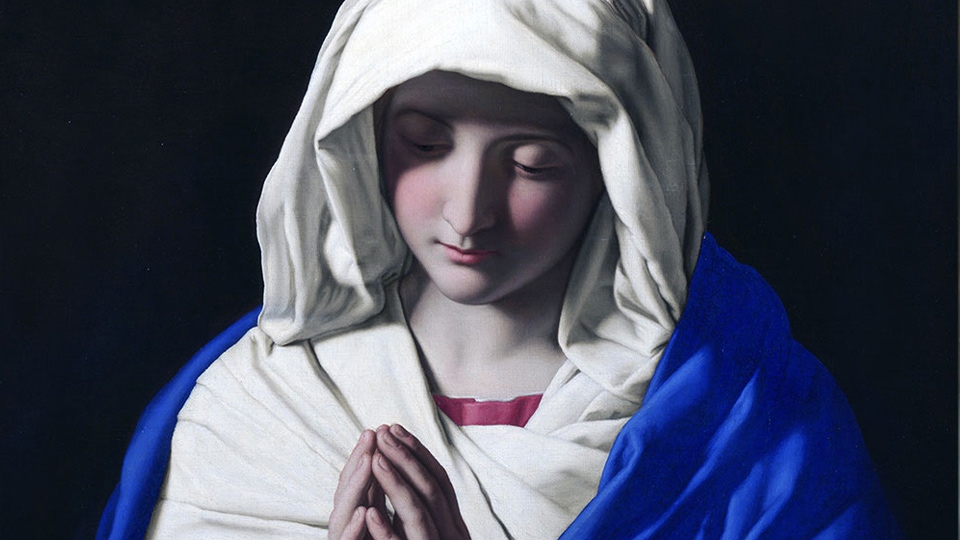
Reduced to its essence, this statement clearly speaks of two aspects involved in the supernatural event of the birth of our Savior: the first is related to the divine power of the Holy Spirit manifested then. The second refers to the appellation applied to the mother of God, Mary: Virgin. This word, practically indissolubly linked to the name of the one through whom our Lord, Jesus Christ, was incarnate, indicates a perpetual state: for Mary’s virginity concerns all stages of this extraordinary Jewish woman’s life. According to the teaching of Christian Tradition, the Mother of God was always a virgin – before, during, and after birth. Obviously, this is a teaching of supernatural faith. Unfortunately, however, like all the other revealed dogmas of the Creed, this doctrine concerning the perpetual virginity of our Queen, Mary, has been attacked by numerous heresies and blasphemies, when it has not been simply ignored.
Scandalous events like the exposure of that statue in the cathedral in Linz prove the hostility of those who, gravely infected with the virus of anti-Christian humanism, trample on the teaching of faith.
Scandalous events like the exposure of that statue in the cathedral in Linz prove the hostility of those who, gravely infected with the virus of anti-Christian humanism, trample on the teaching of faith. It is worth remembering that only the Catholic Church holds the complete truth regarding the Holy Virgin Mary: while the communities post-Reformation deny both the Immaculate Conception and the supernatural birth – through the work of the Holy Spirit, the schismatic autocephalous churches of the East reject only the first teaching on the grounds that it is a papist invention. However, we must always follow the exhortation of Saint Ignatius of Antioch who says that the supernatural birth of Christ is a “mystery which must be proclaimed aloud.” This should especially prompt us in light of the ignorance often found even among those Catholics who do not know the faith. I was surprised to discover that people who could be categorically defined as “practicing Catholics” did not know the Church’s teaching about the supernatural birth of Christ. This is why it is necessary to recapitulate this teaching, to always be ready to present it – when needed – to those Christians who simply do not know it.
The Roman Catechism (1566) states that “the faithful are bound to believe that Jesus the Lord was not only conceived by the power of the Holy Ghost but was also born of the Virgin Mary.” From these words, we understand that the power of the Holy Spirit was manifested not only in the conception of Christ but also in His birth from a virgin. In other words, in this second case as well, we are encountering a supernatural event. To make this clear, the catechism expresses it as follows:
“But as the Conception itself transcends the order of nature, so also the birth of Our Lord presents to our contemplation nothing but what is divine.”
Dealing with the greatest mysteries of the Christian faith, it is self-evident how difficult it is to seek any explanation for such supernatural facts. Moreover, we expect a certain discretion (or delicacy) to cause Christians to be reserved in approaching such subjects. Yet, the teaching of faith must be known, must be spread, and, as far as possible, clarified. But how to do this in an appropriate way?
In his reference work Fundamentals of Catholic Dogma (TAN Books, 1974, p. 205), Dr. Ludwig Ott first states the teaching of faith concerning the birth of the Savior from the Virgin:
“Mary bore her Son without any violation of her virginal integrity.”
Then he points out that “the dogma merely asserts the fact of the continuance of Mary’s physical virginity without determining more closely how this is to be physiologically explained.” The reference to Saint Thomas Aquinas’ Summa Theologica (III 28, 2) targets an article where the Angelic Doctor summarizes the teachings of the Fathers, who say – in negative terms – only that the supernatural birth of the Savior excludes both the normal biological consequences of normal births and the pains.
Taking into account all the above details, we now return to the Roman Catechism. Its pedagogical strategy is the same used by both God, the author of Holy Scripture, and the great commentators of the sacred texts – the Holy Fathers and Doctors of the Church. After emphasizing that the Lord Jesus Christ “is born of His Mother without any diminution of her maternal virginity,” it proposes a series of symbolic images that, through analogy, illuminate this mystery to some extent.
The metaphor of the sun’s rays passing unimpeded through a perfectly transparent glass indicates that both the body of the Holy Virgin and that of the Savior Christ, although truly human, still had exceptional, mysterious qualities, stemming from the fact that both persons were born without falling under the terrible consequences of original sin.
The first reminds us of the supernatural way the Savior emerged, resurrecting, from the tomb that was sealed and guarded, while the second evokes the moment when He came among the disciples through locked doors. Then, the most spectacular and frequently used is that of the sun’s rays passing unimpeded through a perfectly transparent glass or crystal body. The metaphor of the compact transparent body is one of the most profound and significant possible: it indicates that both the body of the Holy Virgin and that of the Savior Christ, although truly human – because God willed to make Himself known to us as a true man – still had exceptional, mysterious qualities, stemming from the fact that both persons were born without falling under the terrible consequences of original sin.
In the context of the Old Testament, the image that some Church Fathers say refers to the conception of the Savior from the Virgin is that of the burning bush. We remember from the book of Exodus (chapter 3) how surprised Moses was seeing the bush burning with fire but not consumed:
“And the Lord appeared to him in a flame of fire out of the midst of a bush: and he saw that the bush was on fire and was not burnt. And Moses said: I will go and see this great sight, why the bush is not burnt” (Exodus 3:2-3).
Even before hearing God’s voice, the great prophet was clear that he was dealing with something extraordinary. Commenting on this biblical episode, Saints Ephrem the Syrian and John of Damascus see here a pre-figuration of how Christ would be born. Here is the comment of the latter:
“The burning bush was a type of the Virgin Mary, who was burning with the fire of the Holy Spirit, but remained a virgin. Just as the bush was not consumed by fire, so Mary was not consumed by the incarnation of Christ.”
The supernatural character of such events needs no comment. Likewise, we must acknowledge the limits of rational explanations: we are simply incapable of penetrating such mysteries. However, this does not prevent us from accepting what the Holy Church teaches through the Roman Catechism:
“Such was the work of the Holy Ghost, who at the Conception and birth of the Son so favored the Virgin Mother as to impart to her fecundity while preserving inviolate her perpetual virginity.”
Sancta Virgo virginum, ora pro nobis!
