
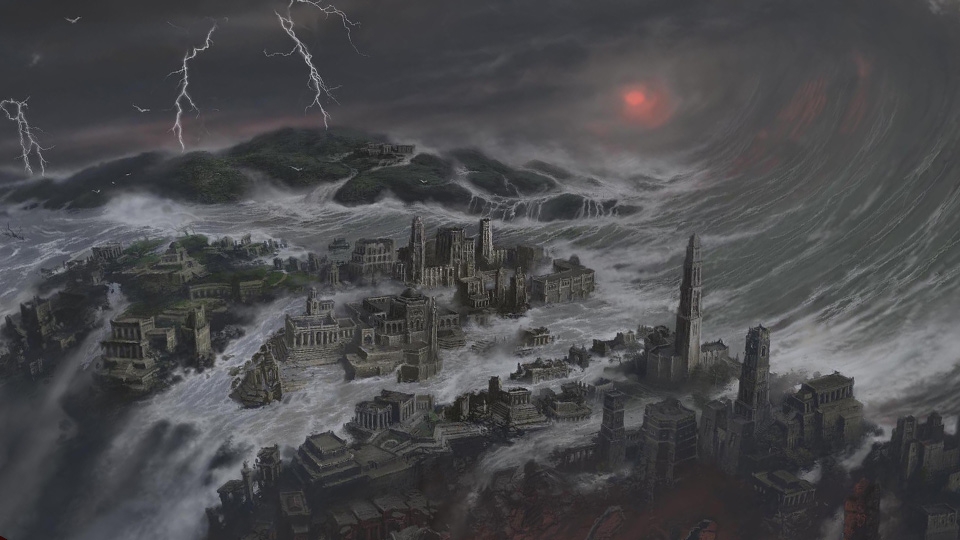

The pride born of the belief that science can do anything knows no bounds. Life has become a convenience, and death an obstacle to be eliminated. Professor Tolkien, using the fascinating power of literature, declares through his stories that such an attitude reveals the most dreadful sin—one that led to the sinking of Atlantis and the destruction of Sodom and Gomorrah: hybris. And we, in the context of the most profound crisis in the history of the Church, must be aware that all the deviations we have been witnessing for many decades are the bitter fruits of that same sin.
Since ancient times, the story of Atlantis — whose main source is the Critias dialogue written by the Athenian philosopher Plato — has ignited the imagination of philosophers, theologians, historians, and even the most eccentric adventurers. Fascinated by it, Professor J.R.R. Tolkien transformed it into a literary meditation on the consequences of forgetting the worship of the Living God.
An Old, True Story
The detailed information in Critias seemed, at least to some, to offer sufficiently strong evidence of its truth. How could one doubt the existence of a city whose customs, organization, political and economic structure, religious and spiritual life were described in such detail by Plato? Every time we read Critias, it is enough to close our eyes to envision everything the author so vividly describes:
“The whole region rose sheer out of the sea to a great height, but the part about the city was all a smooth plain, enclosing it round about, and being itself encircled by mountains which stretched as far as to the sea; and this plain had a level surface and was as a whole rectangular in shape, being 3000 stades long on either side and 2000 stades wide at its center, reckoning upwards from the sea” (Critias, 118a).[1]
Taking these descriptions into account, it is no surprise that there are many authors who do not for a moment doubt the existence of Atlantis. The most important among them seems to be the famous Neoplatonist philosopher Proclus (412–485 BC), a distinguished commentator on the Timaeus dialogue. In his commentaries, he recounts how a certain Crantor visited Egypt about 300 years after a similar visit by the wise Solon (c.630–c.560 BC), the lawgiver of ancient Athens. There, in the city of Sais, Crantor is said to have seen several columns covered in ancient texts—testimonies identical to Plato’s, confirming the real existence of Atlantis.
The search for Atlantis remains a passion as intense as the exploration of the Great Pyramid of Khufu or the investigation of the ancient Mayan structures at Palenque. At times the exploration of seas and oceans in pursuit of the sunken island seems more alluring, more fascinating than the study of tangible archaeological sites. From this perspective, we can note a certain similarity to the explorations aimed at locating the biblical Paradise.
It is also Proclus who cites Marcus Claudius Marcellus (c.270–208 BC), a historiographer who confirmed the existence in the Atlantic Ocean of seven islands dedicated to the goddess Proserpina, alongside which stood three other islands whose inhabitants were aware of Atlantis—also dedicated to Poseidon. Despite such “evidence,” Aristotle did not hesitate to dispute the historical existence of the legendary city, considering it merely a fictional story invented by Plato to offer additional arguments in support of the possibility of the ideal state described in Politeia (i.e., The Republic). And not only its existence, but also its necessity, born from the desire to create a political system immune to the ultimate sin known as hybris.
Disregarding the contradictions between ancient authors, the search for Atlantis remains a passion as intense as the exploration of the Great Pyramid of Khufu or the investigation of the ancient Mayan structures at Palenque. Even more so, at times the exploration of seas and oceans in pursuit of the sunken island seems more alluring, more fascinating than the study of tangible archaeological sites. From this perspective, we can note a certain similarity to the explorations aimed at locating the biblical Paradise, where the first humans, Adam and Eve, lived in original innocence.
Before approaching the primary sources (beginning, of course, with Plato’s Critias) or reviewing the older and more recent research intended to reveal where Atlantis might be located, any curious person can try to answer a question prompted by the feverish debates and searches surrounding the myth of the sunken island: How can we explain the enormous interest Atlantis has generated over thousands of years?
The desire to find hidden lands, whether real or imagined, points to the presence, deep within the human soul, of a nostalgia for a lost world. The archetype of the lost paradise, the wondrous city where eternal youth and everlasting life are possible, reveals one of the essential aspirations of humans from all ages. A brilliant scholar of classical cultures, the Egyptologist Professor John Gwyn Griffiths of Swansea University (Wales), explains the attraction to Atlantis in distinctly melancholic terms:
“There is something splendid about everything that is unknown; and here the mystery concerns an island-continent which has vanished forever. Moreover, Atlantis was an island which enshrined human ideals, so that its mystery is fused with a sense of longing.”[2]
The success of Indiana Jones films or cinematic epics that directly engage with the myth of Atlantis demonstrates—beyond the sometimes questionable quality of such productions—the irresistible allure that lost worlds hold over us. After all, a significant part of classical culture was born from speculation about that “unseen world” which both Plato and Saints Augustine, Maximus the Confessor, and Abbess Hildegard of Bingen testified to be more desirable than our tangible one.
Perhaps surprisingly to many, the story in the Critias dialogue contains a very important lesson in political philosophy. For, as seen in the surviving part of the text, Atlantis disappeared as a result of a divine verdict. The heavenly punishment was the inevitable consequence of the Atlanteans’ replacement of the virtues of King Atlas’s descendants with the vice of power. Instead of remaining devoted to a life of wisdom, the Atlanteans sought to conquer the entire known world, which led to a prolonged war with the Greeks. (This ambition would later be realized by Alexander the Great, 356–323 BC).
In a world like ours, obsessed with the concreteness of things perceived by the senses—superficially equated with reality—only such a discovery would bring back into focus the meaning of that civilization’s fate. And perhaps it would awaken greater awareness of the grand yet uncomfortable theme of the end of universal history. In essence, this is the meaning of the rise and fall of the island beyond the Pillars of Heracles: its hybris was punished by a power beyond the boundaries of the visible world. When vices replace virtues, the outcome becomes only a matter of time. That nemesis acts implacably not only in individual cases, but also in those of cities, peoples, continents, and—at the end of universal history—even the entire world. This is the central theme, the guiding thread of the Critias dialogue by the Athenian Plato.[3]
The disaster of the island of Númenor was foretold by the abandonment of the worship owed to God by the majority of its inhabitants during the reign of the last king, Ar-Pharazôn.
The Tragic Fate of Númenor
One of the major themes of the epic romances written by Professor Tolkien is that of the Fall. On one hand, we have the moral downfall of numerous characters, mirroring the Fall of Adam and Eve from Eden; on the other hand, we see the consequences suffered by the entire world as a result of this tragic event. Among the many instances of this theme, perhaps none is more significant than that of the island of Númenor.
Inhabited since ancient times by men, this wondrous land has at its very center a truly special sacred place:
“In the midst of the land was a mountain tall and steep, and it was named the Meneltarma, the Pillar of Heaven, and upon it was a high place that was hallowed to Eru Iluvatar, and it was open and unroofed, and no other temple or fane was there in the land of the Numenoreans.”[4]
Here, on this mountain called the Pillar of Heaven, the king himself and all the inhabitants would come during the great festivals to worship God and offer Him sacrifices from the fruits of the earth. In an atmosphere of deep piety, wrapped in a solemn silence reminiscent of the moments of quiet in the Liturgy of the Ages, they practiced the virtue of religion, maintaining their connection with the almighty Creator — known in Tolkien’s tales as Eru Ilúvatar. The disaster of the island of Númenor was foretold by the abandonment of the worship owed to God by the majority of its inhabitants during the reign of the last king, Ar-Pharazôn:
“Meneltarma was utterly deserted in those days; and though not even Sauron dared to defile the high place, yet the King would let no man, upon pain of death, ascend to it, not even those of the Faithful who kept Iluvatar in their hearts.”[5]
A true embodiment of the Antichrist from Holy Scripture, Ar-Pharazôn had transformed from king into tyrant, forbidding divine worship. The first thing Tolkien draws our attention to through the details of his story is that this did not happen without the complicity of the people who, like the inhabitants of Atlantis, had become increasingly proud and irreligious. Clearly, the author intended to encode a stern warning here about the state of the modern world—the only era in the history of mankind in which atheism and irreligion have become dominant. However, the most significant detail of the story refers to the most terrible ambition that would ultimately consume the Númenóreans: the desire to obtain immortality.
Since ancient times, death has been the most dreadful trial humanity has endured. A punishment for the disobedience of Adam and Eve in Eden, we know from the wise Solomon that “by the envy of the devil, death came into the world” (Wisdom 2:24). Troubled by the disappearance of loved ones and the prospect of their own end, people have attempted in countless ways—especially through the manufactured religions—to overcome it. All these efforts have only proven that, without God, this is not possible. The Incarnation and Resurrection of the Son of God, our Lord Jesus Christ, had as their supreme purpose the triumph over death. Yet for us, as we well know, this victory requires faith in Christ and a life in accordance with it. It is no surprise, then, that Tolkien, a faithful son of the Catholic Church, wove into his tale the desire to conquer death as a central thread in the story of the island of Númenor.
In a clear parallel to the decision of the Atlanteans to conquer all the lands known to them—the Númenóreans attack the island of Valinor, home of the immortals. In the chaos of these events, God intervenes. The punishment is decreed.
In pursuit of this goal—and in a clear parallel to the decision of the Atlanteans to conquer all the lands known to them—the Númenóreans attack the island of Valinor, home of the immortals. Their desire was, evidently, to uncover the secret of immortality. In the chaos of these events, God intervenes. The punishment is decreed and carried out by the divine tribunal, after numerous signs had already foretold the approaching end:
“In an hour unlooked for by Men this doom befell, on the nine and thirtieth day since the passing of the fleets. Then suddenly fire burst from the Meneltarma, and there came a mighty wind and a tumult of the earth, and the sky reeled, and the hills slid, and Numenor went down into the sea, with all its children and its wives and its maidens and its ladies proud; and all its gardens and its halls and its towers, its tombs and its riches, and its jewels and its webs and its things painted and carven, and its laughter and its mirth and its music, its wisdom and its lore: they vanished for ever. And last of all the mounting wave, green and cold and plumed with foam, climbing over the land, took to its bosom Tar-Miriel the Queen, fairer than silver or ivory or pearls. Too late she strove to ascend the steep ways of the Meneltarma to the holy place; for the waters overtook her, and her cry was lost in the roaring of the wind.”[6]
Apocalyptic in nature, recalling both the downfall of Plato’s Atlantis and the great catastrophes described in the Book of Revelation written by Saint John the Apostle, the end of the island of Númenor carries a warning more relevant than ever. For today, as the rich people of the world create institutions seeking to attain immortality without faith, without the Christian religion, without God, modern man appears to be following the same path to destruction.
The pride born of the belief that science can do anything knows no bounds. Life has become a convenience, and death an obstacle to be eliminated. Professor Tolkien, using the fascinating power of literature, declares through his stories that such an attitude reveals the most dreadful sin—one that led to the sinking of Atlantis and the destruction of Sodom and Gomorrah: hybris. And we, in the context of the most profound crisis in the history of the Church, must be aware that all the deviations we have been witnessing for many decades are the bitter fruits of that same sin.
[1] I quote W.R.M. Lamb’s translation available on the Perseus Digital Library: https://www.perseus.tufts.edu/hopper/text?doc=Perseus%3Atext%3A1999.01.0180%3Atext%3DCriti.%3Asection%3D118a [Accessed: 30 Aprilie 2025].
[2] The quote is from a study by Griffiths entitled “Atlantis and Egypt,” in Historia: Zeitschrift für Alte Geschichte, Vol. 34, No. 1 (1st Qtr., 1985), pp. 3-28.
[3] My first historic novel, entitled The Island Without Seasons, is dedicated – at least partially – to this crucial theme. Video Here [Accessed: 30 Aprilie 2025].
[4] J.R.R. Tolkien, Silmarillion, Edited by Christopher Tolkien, New York: Ballantine Books, p. 322.
[5] J.R.R. Tolkien, Silmarillion, p. 336.
[6] J.R.R. Tolkien, Silmarillion, pp. 345-346.
