
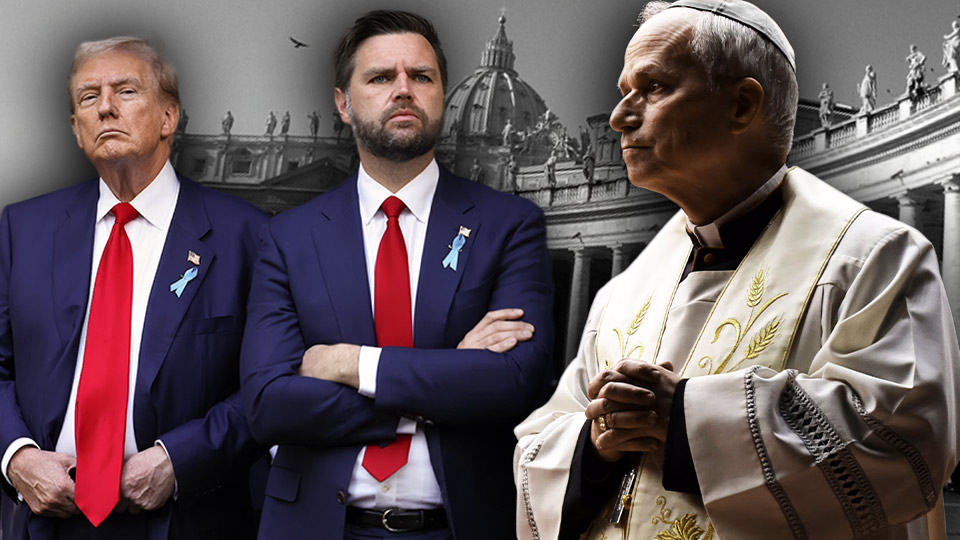

Although the recent media clash between the President of the United States Donald Trump and Pope Leo XIV has literally polarized the Catholic world—and not only—between supporters (in reality increasingly few) of the former and supporters of the latter, it cannot be reduced to a contingent controversy nor interpreted unilaterally as a clash between truth and error. Rather, it reveals a deeper crisis: the presence today of two conceptions of authority, both problematic, albeit for different and non-symmetrical reasons.
On April 7, Donald Trump publicly threatened Iran with annihilation, leaving practically all humanity for a few hours in a state of understandable apprehension.
On the one hand, Trump embodies a form of political conservatism that presents itself as a defense of order, but which tends to empty the objective moral dimension of political action, subordinating it to the will and strategic interest of the nation. On the other hand, Leo XIV represents a moral authority which, although formally legitimate, now appears weakened by a process of doctrinal and pastoral dilution in the name of so-called multilateralism, which compromises its capacity to demand recognition even on the natural level from civil authorities.
Let us start from the facts…
The confrontation between the American administration and the Holy See did not arise suddenly with the media clash between Donald Trump and Pope Leo XIV, but developed through a series of episodes, which occurred in recent months, that outline a framework of growing tension.
A first significant moment in this sense was represented by the meeting in January 2026 between Cardinal Christophe Pierre, then apostolic nuncio in the United States, and the American Deputy Secretary of War Elbridge Colby. According to a report published by The Free Press on April 6, the meeting was particularly tense, with explicit references to American military superiority and to the need for the Holy See to align itself more clearly with the United States. There was even mention of the threat of bringing the Church back to the condition of Avignon, when the Pope was in fact a puppet in the hands of the King of France in the Middle Ages.
Such reconstructions were subsequently scaled back both by the Pentagon, which spoke of a “cordial” conversation, and by the Vatican, which defined some narratives as “fabrications.” The fact remains that, regardless of the precise dynamics, the episode was perceived in the Vatican environment as a relevant point of friction, contributing to a cooling of relations. Significantly, a few days later, the Pope declined the invitation to travel to the United States on the occasion of next July 4.
On April 7, Donald Trump publicly threatened Iran with annihilation, leaving practically all humanity for a few hours in a state of understandable apprehension: “An entire civilization will die tonight,” he had written on Truth Social. “We will find out tonight, one of the most important moments in the long and complex history of the world.” On the same day, Pope Leo XIV, speaking from Castel Gandolfo, defined the threat as “not acceptable” and invited “all people of good will to reject war and seek peace.”
This tension was compounded by the meeting on April 9, 2026, in the Vatican between Leo XIV and David Axelrod, former advisor to Barack Obama. The meeting appears objectively, from a prudential standpoint, at least inopportune, both because of the context and the profile of the interlocutor, and is problematic due to the lack of transparency: neither the content nor the purpose of the conversation was made known.
That the Pope takes clear positions against war is nothing new and it is right, indeed necessary, that this occur.
Axelrod is publicly associated with positions favorable to abortion, to the recognition of same-sex unions, and to a strongly secularized conception of the public sphere—all issues on which Catholic doctrine maintains well-defined judgments. In the absence of clarifications, the meeting inevitably lent itself to political interpretations.
The level of the clash rose further with the dissemination by Trump on social media, on April 12, of an image generated by artificial intelligence that portrayed him in a messianic form, dressed as Jesus Christ. A disturbing image, because it is in fact the re-proposition of an AI image that had already been published in February 2026, with a significant modification: a figure with demonic contours appearing above the President. The image, subsequently removed by Trump himself because—he said—“I thought it was me dressed as a doctor,” provoked strong critical reactions even in conservative circles for its objectively blasphemous character.
On April 12, Trump then published an explicit message against the Pope, accusing him of interfering in politics and of taking positions harmful to the Church. “Pope Leo is weak on crime, and terrible for Foreign Policy,” he wrote. “He talks about fear of the Trump administration, but does not mention the fear that the Catholic Church and all other Christian organizations had during Covid, when they were arresting priests, ministers, and everyone else for holding Church services.”
And again: “I don’t want a Pope who thinks it is ok for Iran to have a nuclear weapon. And I don’t want a Pope who criticizes the President of the United States because I’m doing exactly what I was elected, in a landslide, to do.”
The probably most interesting aspect—not because it is true in itself, but because it is indicative of what certain power circles in America believe regarding the Vatican and the Catholic Church—is the point at which Trump insinuated that the election of Prevost was motivated exclusively by his Presidency. “Leo should be thankful because, as everyone knows, he was a shocking surprise. He wasn’t on any list to be Pope, and was only put there by the Church because he was an American, and they thought that would be the best way to deal with President Donald J. Trump. If I wasn’t in the White House, Leo wouldn’t be in the Vatican,” he said. The message also includes a polemical reference to the meeting with Axelrod, plausibly the real reason for this gut reaction on Truth.
The Pope’s response came unexpectedly on April 13, during the flight to Algeria. Leo XIV explicitly refused the plane of political confrontation, reaffirming the nature of his role: “I am not afraid of the Trump administration nor of forcefully proclaiming the message of the Gospel, which is what I believe I am called to do, what the Church is called to do,” the Pope said. “We are not politicians. We do not approach foreign policy from the same perspective he might have, but I believe in the message of the Gospel: ‘Blessed are the peacemakers,’ it is a message the world needs. I do not believe that the message of the Gospel should be instrumentalized, as some are doing.”
Leo also stated that he does not wish to engage in a debate against Trump. And yet, the very fact of having responded in a very clear and firm way during the flight, and of then continuously alluding to Israeli-American war policy during his stay in Algeria, is already a sign of a willingness to engage with Trump, if not frontally, at least through the technique of soft power, to influence American consciences—but not only—according to certain values.
Trump’s conservatism is not acceptable for a Catholic
That the Pope takes clear positions against war is nothing new and it is right, indeed necessary, that this occur. One recalls the appeals of Popes Benedict XV and Pius XII respectively against the First and Second World Wars, appeals rejected and irritating to the military powers of the time.
The problem that risks being overlooked, however, is that both Trump’s and Leo’s positions are symptomatic of erroneous conceptions of authority and power. Equating Leo XIV’s position against the Israeli-Iranian war with that of those Pontiffs is not historically and theologically correct, simply because they are two positions that start from very different premises and arrive at very different ultimate ends. Those had as their end the social kingship of Christ; Leo XIV—by his own admission—multilateralism. However, before speaking of Leo’s problems, let us start from the position of his dialectical adversary.
There are, in fact, two kinds of West: one with Catholic roots and one with Judeo-Protestant roots. The Judeo-Protestant vision of the West interprets progress in an evolutionary sense: society progresses because morality changes. This, from a Catholic point of view, is not acceptable.
Donald Trump has a “pragmatic” vision of politics that implies a reductive conception of the political order. Power tends to justify itself, on the basis of electoral consensus or strategic effectiveness, without recognizing an intrinsic bond to the moral law, not only the divine one but also the natural one.
This produces a form of conservatism which, while opposing progressivism on certain issues, implicitly shares its fundamental presupposition: the separation between truth and political praxis. In this sense, it may prove more insidious than the openly declared adversary, because it preserves the language of order while altering its foundation. This is also demonstrated by the fact that, while Trump on the one hand endorses the White House Faith Office led by the televangelist Paula White-Cain, on the other he continues to support, albeit in a more moderate way, LGBT policies as well. Very cringe!
This type of conservatism is not a real alternative, but a subtler variant of progressivism and, precisely for this reason, more insidious, which tolerates morality only as a rhetorical frame, not as a binding criterion in decisions.
Many things could be said on this point. For the moment, it suffices to say that, in order to understand the conservatism of (at least) the Second Trump Presidency, one must keep clearly in mind that when reference is made today to the West and to the defense of its values, one is in reality referring to a gravely ambiguous expression.
There are, in fact, two kinds of West: one with Catholic roots and one with Judeo-Protestant roots. In the West understood in the Catholic sense, modern political categories of conservatism and progressivism cannot properly arise. The reason is that Catholic doctrine is founded on the idea that human nature has a given and irreformable structure, and that morality does not evolve by cultural construction, but only through a better defense and realization of what man is. In this perspective, “progress” consists in creating conditions that allow human nature to express its potential more fully, but always in accordance with it.
The Judeo-Protestant vision of the West, instead, interprets progress in an evolutionary key: society progresses because morality changes. For this reason, when conservatives claim to want to defend democracy or the values of the Enlightenment, they are referring to a concept of the West which, from a Catholic point of view, is not acceptable. If progress is understood as moral evolution, then it is inevitable that some will want to accelerate change (progressives) and others to slow it (conservatives); but both share the same direction of movement, which for a Catholic remains problematic both in its starting point and in its point of arrival.
The Danger of Americanism
This framework emerges with particular clarity also in the theological meaning not only of Trump’s statements, but also in those subsequently made by Vice President J. D. Vance (a Catholic by his own admission), released to Fox News on April 14.
According to Vance, “ultimately, the immigration policy of the United States is set by Donald Trump,” adding that, “in some cases, it would be best for the Vatican to stick to matters of morality, to stick to matters of what is going on in the Catholic Church, and let the president of United States stick to dictating American public policy. Anyway, when [Trump and the Pope] are in conflict, they are in conflict.”
Vance’s response approaches the position historically identified as Americanism, an error explicitly and infallibly condemned by Pope Leo XIII.
This vision of power by Vance is deeply problematic for a Catholic conscience. In fact, Vance’s response approaches the position historically identified—not by chance—as Americanism, an error explicitly and infallibly condemned by Pope Leo XIII, in particular in the apostolic letter Testem Benevolentiae Nostrae (1899).
This doctrinal error maintains a functional separation between Church and State, whereby the Church limits itself to articulating general moral principles, avoiding pronouncing on their concrete application in political life. Within this framework, the State claims autonomous competence in determining how such principles should be implemented in practice.
However, this view was condemned by Leo XIII, who insisted that moral truth—rooted in divine law—retains binding force not only in the abstract, but also in its application to contingent political realities. The reduction of ecclesiastical authority to a merely consultative role on moral values, without the right to intervene in specific policies, reflects a philosophical genealogy not accidentally associated with the Enlightenment and, historically, with Masonic conceptions of political order. Precisely the Judeo-Protestant roots of the West.
Traditional Catholic doctrine, on the contrary, affirms a real distinction between Church and civil power, while maintaining their ordered unity: political power also derives from God, but its legitimacy should be mediated by the Church, not exercised independently of it. On this basis, moral questions such as war—which directly concern justice, life, and the common good—fall within the moral competence of the Roman Pontiff.
The (major) problem on Leo XIV’s side
At the same time, it should be noted that the positions taken by Francis and, more recently, by Pope Leo XIV on issues such as immigration regulation and criminal justice — for instance, the abolition of the death penalty in the Catechism — have introduced real tensions and practical difficulties in defining today a balanced relationship between the Church’s moral authority and civil power.
Such positions adopted by the ecclesiastical hierarchy in recent years (together with many others, as is well known) are difficult to reconcile with the Catholic theological Tradition, which admits the legitimacy of capital punishment and the sovereign right of the Pòlis to regulate its own borders.
Therefore, a Catholic politician worthy of this name would objectively find himself in difficulty and embarrassment when, in order to govern the community, he must choose between applying the principles of Traditional Catholic doctrine or, for example, the principles of the “seamless garment ethics,” defended by Leo XIV and by the most prominent U.S. bishops today.
The decisive question arises: who will actually emerge strengthened, in terms of image and consensus, from this opposition?
On the other hand, in recent decades there has been a pastoralization of the norm that has in some way fostered the “Americanist” thinking of Catholic politicians around the world. At the moment in which the Pope and the bishops, in the wake of the Second Vatican Council, decide that they no longer wish to teach, and therefore define and condemn, but reduce the moral norm to an “inspirational orientation,” they effectively expose themselves to interpretations of politics of this kind.
Between two litigants, the third (progressive) benefits
The clash between Donald Trump and Pope Leo XIV, far from producing a clarification of the relations between political power and moral authority, is generating the opposite effect, namely the recomposition of consensus in favor of the progressive area, both on the political and ecclesial levels. The dynamic is already visible. The reaction—legitimate in itself—of the Catholic world to Trump’s statements is being intercepted and reinterpreted by self-styled Catholic political figures, who use it to strengthen their public legitimacy and attract electoral consensus, thus presenting themselves as defenders of an “authentic” Church against nationalist drifts.
In support of this, one may recall a recent media episode. Even before Trump publicly attacked the Pope, three U.S. cardinals—all created by Francis and friends of Leo XIV—appeared on the program 60 Minutes, proposing a “Catholic reading” of political themes perfectly aligned with the typical points of the leftist agenda.
The interview insisted on mass immigration and condemnation of Trump’s military operations, carefully avoiding central issues for Catholic moral doctrine such as abortion, euthanasia, and the social consequences of uncontrolled immigration on economically vulnerable groups.
A very significant portion of the neo-modernist episcopate will therefore use the media clash to delegitimize political conservatism as a whole, indiscriminately targeting those sectors which, despite evident limits, had identified in Trump a contingent barrier to progressivism. In this context, the decisive question arises: who will actually emerge strengthened, in terms of image and consensus, from this opposition?
Progressive clergy, supported by a media narrative consistent with the dominant agenda, or a political line that intends to defend principles objectively referable to Catholic morality, but which is now—unfortunately—mediatically identified with Donald Trump?
Leo was not elected (only) to counter Trump
Finally, the interpretation advanced by Trump according to which the election of Pope Leo XIV would have been determined exclusively by his presence in the White House is obviously unfounded, and reveals an inadequate understanding of the dynamics proper to a conclave.
While it is true that Robert Francis Prevost was not among the most highly accredited candidates on the eve, nor did he fall among the profiles preferred by Trump himself—who was oriented rather toward figures such as Timothy Dolan—the reasons for his election must be sought elsewhere, in criteria internal to the life and governance of the Church.
First, there was the need for a profile with solid canonical expertise, in a context marked by a widespread perception of crisis in canon law that had intensified during the previous pontificate. Second, there emerged the need for a deceleration of the synodal process, whose accelerated development had produced doctrinal and pastoral tensions potentially divisive. Third, it was strategically necessary to identify a figure capable of simultaneously representing the North and the South of the Catholic world: Prevost’s dual citizenship (also cultural)—American and Peruvian—effectively responded to this requirement. Finally, a decisive element was his alignment with a multilateral vision of international relations, consistent with the diplomatic approach promoted by Cardinal Pietro Parolin and by the environment of the Secretariat of State.