
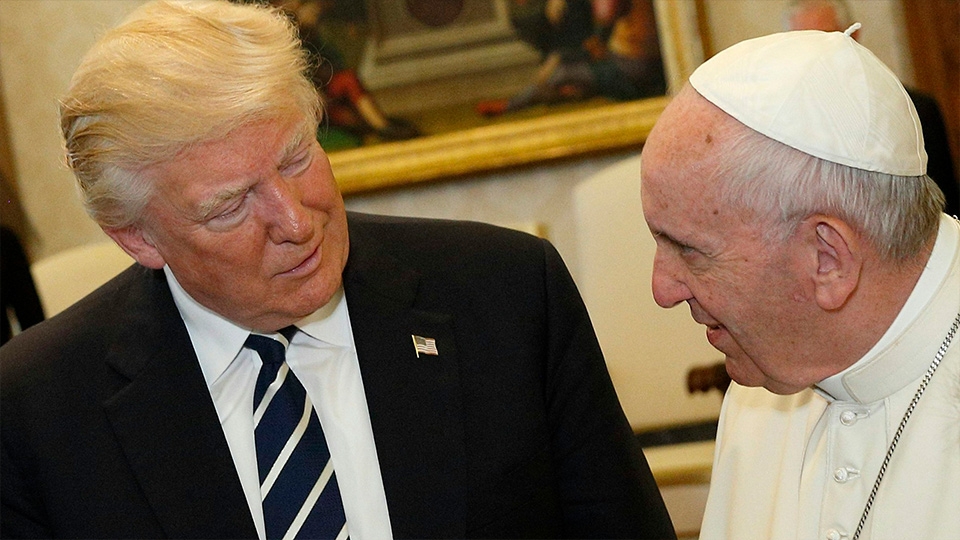

Donald Trump has appointed Brian Burch as the new ambassador to the Holy See. Founder of CatholicVote and president of the Seton Montessori School, Burch is known for his open criticism of Pope Francis’ pontificate and his strongly conservative positions. Trump’s choice has been met with mixed reactions.
The newly elected President of the United States, Donald Trump, announced on December 20, 2024, the appointment of Brian Burch as the new ambassador to the Holy See. Founder of CatholicVote and president of the Seton Montessori School, Burch is known for his open criticism of Pope Francis’ pontificate and his strongly conservative positions. Trump’s choice has been met with mixed reactions, both in the United States and within the international Catholic community.
Brian Burch is a fervent Catholic and a supporter of Tradition, but he is also the president of a school that adopts the method developed by Maria Montessori, a renowned Italian educator affiliated with the Theosophical Society. Without wanting to criticize either Burch’s faith or the political-diplomatic choice of the newly elected US president, I must admit that this detail raises a profound question in my heart: how can such a deeply rooted Catholic lead an institution inspired by a pedagogy historically linked to a society rooted in ideologies distant and even contrary to Catholic doctrine?
One of the most controversial aspects related to Brian Burch is his denunciation of alleged abuses of power by the FBI against traditionalist Catholics.
The Theosophical Society is indeed known for being founded by Madame Blavatsky, a famous medium and spiritualist of the last century and one of the most important exponents of neo-gnostic Luciferianism, making this connection a topic – in my opinion – worth exploring, perhaps with the direct interested party. My intention is not to criticize, much less to insinuate, but simply to observe.
Nevertheless, Brian Burch is a prominent figure in the American Catholic landscape. He has strongly supported conservative issues such as strengthening Latin liturgical celebrations, pro-life battles, criticism of homosexual unions, and denouncing some progressive Catholic associations for their role in facilitating illegal immigration through public funding. His vision of faith is rooted in the so-called “non-negotiable values,” an element that clearly reflects Trump’s political strategy in consolidating the support of the conservative Christian, and particularly Catholic, electoral bloc.
This appointment seems like an explicit declaration of challenge to the pontificate of Francis, a Pope who, as also highlighted by the Italian “unofficial” Vatican information platform messainlatino.it, has become a problematic figure for many – even non-conservatives – and even, I add, of “doubtful validity.” Consider, for example, the discontent that is spreading among the African clergy and episcopate, and even among the African cardinals created by the very same Pope Bergoglio. With this choice, Trump seems to want to reaffirm his opposition to a Vatican that in recent years has embraced a blatantly neo-modernist agenda, in stark contrast to the conservative positions of the designated ambassador.
One of the most controversial aspects related to Brian Burch is his denunciation of alleged abuses of power by the FBI against traditionalist Catholics. In 2023, CatholicVote filed a lawsuit against the agency and the Department of Justice, accusing them of spying on communities linked to the Latin Mass. According to Burch, the federal government – under the Biden administration – labeled some faithful as potential terrorists and “radicals,” raising questions about the misuse of Section 702 of the Foreign Intelligence Surveillance Act. These accusations have sparked a debate on the growing hostility towards religious (Catholic) values and freedom of worship.
The tensions between Brian Burch and Pope Francis are not limited to pastoral issues. The designated ambassador has criticized the Pope for his globalist approach and handling of topics such as immigration, climate change, and the economy. According to Burch, many of the policies promoted by the Pope create division rather than unity. In particular, he has denounced the collusion between the Vatican and illegal immigration, highlighting the role of Catholic Church-affiliated agencies in managing migration flows with the financial support of the American government.
It remains to be seen how these dynamics will influence the future of relations between Washington and Rome, but one thing is certain: the appointment of Brian Burch marks a turning point in the relations between two “hemispheres of the Catholic world” with radically different visions.
With this appointment, a paradoxical scenario looms for relations between the United States and the Vatican. On one hand, the Trump administration appears uncompromising on non-negotiable values, perhaps even more so than the Pope. On the other hand, these tensions could lead to an unprecedented diplomatic conflict. This situation could redefine the role of the Vatican not only in relation to the United States but in a broader global context.
Modernity has seen a profound change in the relationship between civil power and the Church. If in the Middle Ages and up to the early modern period it was the Church that guided temporal power, offering a moral and transcendent vision to political choices, with the end of Church’s temporal power (1870) and the neo-modernist assault of the post-Vatican II Council, this dynamic has been reversed. Today, it is the civil power, dominated by secular ideologies and transient mentalities, that too often influences certain thoughts and much of the Church’s action. Never in its history has the Church been so permeable to “human traditions” and so timid in reaffirming the eternal Truth in the face of the world’s errors.
Trump’s landslide victory against Kamala Harris, an authentic symbol of anti-Christian progressivism, could mark a turning point, or rather the transition from one political generation to another, not only in the United States of America. Trump, loved by some and hated by others, has catalyzed the support of millions of Americans, including 56% of Catholics. His appeal found particular resonance among Catholics also because they were attracted by his defense of traditional values, the protection of life from conception, and his opposition to progressive policies on issues such as abortion and gender identity.
Although it cannot be said that Trump perfectly embodies the ideal of a political leader oriented towards a transcendent moral order, his agenda nonetheless represents a bulwark against the spread of “wokism” and rampant social disintegration. American Catholics, especially the more conservative and traditionalist ones, see in his leadership an opportunity to consolidate a new political-spiritual consensus.
It remains to be seen how these dynamics will influence the future of relations between Washington and Rome, but one thing is certain: the appointment of Brian Burch marks a turning point in the relations between two “hemispheres of the Catholic world” with radically different visions.