In his recent article for Tradition & Sanity, Dr. Peter Kwasniewski reflected on an essay by a German cleric who writes under the name Vigilius, “The Performative Contradiction of the Society of St. Pius X.” Despite what one might surmise from Vigilius’s title, he actually supports the SSPX’s consecrations of bishops without Rome’s approval — his criticism of the SSPX instead concerns a set of ideas that Dr. Kwasniewski has helped bring to light in recent years: those related to hyperpapalism, or an exaggerated view of the papacy. For purposes of the present article, the nuances and credibility of Vigilius’s argument are not especially important; rather, Vigilius’s essay and Dr. Kwasniewski’s response to it are valuable in introducing the concept that many Catholics have a view of the papacy that is not only wrong but also offensive to God.
The Church is going to destroy herself by obeying revolutionary principles brought inside the Church by the authorities of the Church.
To get a sense of this exaggerated view of the papacy, we can look not to the words of heretics but of St. Pius X. Vigilius cited the following passage from St. Pius X’s 1912 address to priests of the Apostolic Union:
“So if one loves the Pope, one does not argue about what he commands or demands, or how far obedience should go, or in which matters one should obey; if one loves the Pope . . . one does not question his orders . . . ; one does not limit the sphere in which he can and must exercise his authority; one does not place the authority of other persons before that of the Pope, however learned they may be . . . He who is holy cannot deviate from the Pope.”
Of course, we ought to interpret this in the best possible light, and we can be relatively certain that St. Pius X had no intention of altering Catholic teaching on the papacy. At the same time, though, it is easy to understand how these words could be understood to set up a potential conflict between God’s immutable truth and the authority of the pope. After all, even if we were to assume (erroneously) that the pope could never diverge from God’s truth, sensible Catholics would have to realize that if such a circumstance were to occur, we must side with God’s truth. Otherwise, we would be putting a creature over God.
Dr. Kwasniewski responded to this quotation from St. Pius X by pointing out that even saintly popes can be wrong in their private opinions:
“In regard to St. Pius X’s saying ‘there can be no holiness where there is disagreement with the pope,’ Jean Madiran has an instructive comment in his obituary of Fr. Roger-Thomas Calmel, O.P.: ‘Fr. Calmel energetically rejected this proposition. The authority in question did not shake his certainty. St. Pius X is St. Pius X, he venerated him with his whole heart, but it was a question here of a private opinion that was incorrect. The history of the Church shows us canonised saints who disagreed with popes. . . . Fr. Calmel appealed to theology—and to common sense.’ Madiran also says that his journal Itinéraires was guilty of papalist exaggeration in the 1950s and that among his collaborators only Calmel and Louis Salleron resisted it.”
So, Fr. Calmel venerated St. Pius X but thought the pope’s words from above were incorrect. Even more relevant for the present analysis is the notion that there was indeed a movement in Catholic thinking prior to Vatican II that involved an exaggerated view of the papacy.
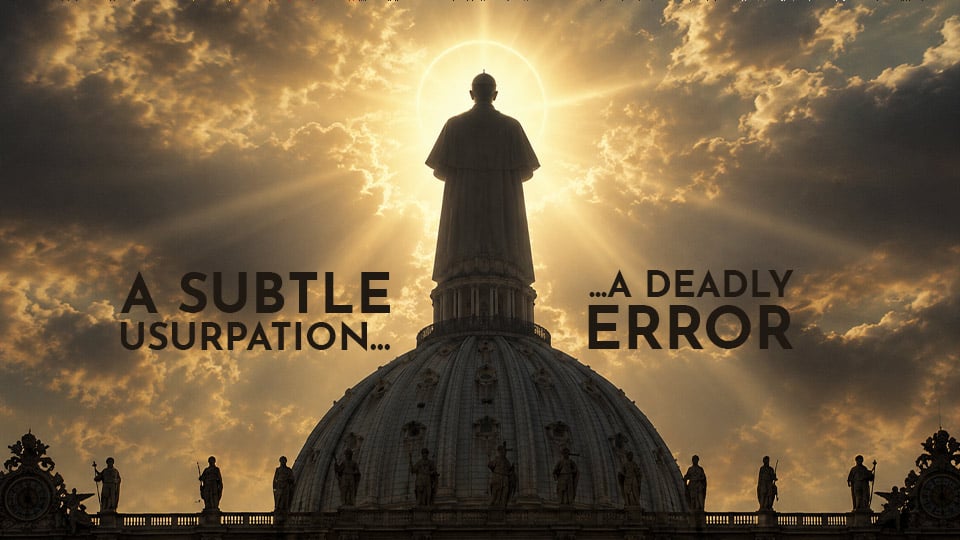
Hyperpapalism subtly shifts Catholicism from being God-centered to being pope-centered.
At first glance, this exaggerated sense of the papacy may not seem especially dangerous in normal times, when the Catholic Church firmly resists heterodoxy. However, we can see that there is a true difference between the following two formulations of why we would adhere to the Catholic Faith:
- I believe all of the truths of the Catholic Faith because they have been revealed by God, Who can neither deceive nor be deceived.
- I believe all of the truths of the Catholic Faith because they are safeguarded by the pope, whom we must follow if we wish to save our souls.
In normal times, either formulation will lead Catholics to believe the same set of Catholic truths. And yet the latter formulation could nonetheless detract from the honor due to God if souls were to lose sight of the facts that (a) God’s truth cannot change, even if the pope were to say they could, and (b) the only reason why we would follow the pope would be so that he could help lead us to God’s truth. All else being equal, the exaggerated sense of the papacy in the 1950s would likely have tended to cause some Catholics to think of their religion as more pope-centered than God-centered.
When we couple this exaggerated sense of the papacy with the errors of Modernism and Liberalism that were still threatening the Church in the 1950s, we can see that the stage was set for the crisis that we have seen develop since Vatican II. As Archbishop Marcel Lefebvre recounted in his Open Letter to Confused Catholics, much of the damage was already done before John XXIII opened the Council:
“My personal experience never ceases to amaze me. These bishops, for the most part, were fellow students with me in Rome, trained in the same manner. And then, all of a sudden, I found myself alone. But I have invented nothing new; I was carrying on. Cardinal Garrone even said to me one day: ‘They deceived us at the French Seminary in Rome.’ Deceived us in what? Had he not himself taught the children of his catechism class thousands of times, before the Council, the Act of Faith: ‘My God, I firmly believe all the truths Thou hast revealed and that Thy Church doth teach, because Thou canst neither deceive nor be deceived’? How have all these bishops been able to metamorphose themselves in this manner? I can see only one explanation: they were always in France and they let themselves become gradually infected. In Africa I was protected. I came back the year of the Council, when the harm had already been done. Vatican II only opened the gates which were holding back the devastating flood. In no time at all, even before the end of the fourth session, it was catastrophic. Everything, almost, was to be swept away; prayer first of all.”
As with most other evils in our lives, the initial offense against God can be relatively subtle but tremendously impactful. Thus, the fact that many bishops had become somewhat comfortable with these errors prior to the Council was already inviting disaster, even if most Catholics had little idea that serious problems were on the horizon.
God has permitted this crisis to expose Modernism, Liberalism, and hyperpapalism for what they truly are: anti-Catholic errors.
God could have caused John XXIII to eradicate all of these errors, but we know that He instead permitted these theological disorders to persist. As a result, the words of Fr. Joseph Schryvers from The Gift of Oneself seem especially apt as we look back today on the state of the Church on the eve of Vatican II:
“But every disorder brings its own chastisement, and the chastisement means the restoration of outraged order.”
The disorders among Catholics prior to the Council included an indifference to the errors of Modernism, Liberalism, and what Dr. Kwasniewski refers to as hyperpapalism. Each of these disorders not only threatens Catholics but also offends God. And so, following the wisdom of Fr. Schryvers, we can say that the resulting crisis has been the chastisement that will eventually lead to the restoration of outraged order, unless God intervenes directly to restore order.

For perhaps the best synopsis of the disorder and the chastisement, we can look to how Bishop Tissier de Mallerais described Archbishop Lefebvre’s assessment:
“In fact ‘the masterstroke of Satan has been to trick the Church through obedience into disobeying her Tradition.’ The Church was going to destroy herself by obeying revolutionary principles brought inside the Church by the authorities of the Church. From 1968 onwards, did not Paul VI himself speak publicly of the ‘auto-demolition of the Church’? On June 29, 1972, he admitted: ‘Through some crack, the smoke of Satan has entered the temple of God . . . Satan . . . has come to spoil and wither the fruits of the Council.’ Paul did not want to see where the crack was. Marcel saw it and denounced it: it lay in the break with Tradition. Already, however, the Archbishop felt that his foresight would get him condemned: ‘Satan has played a masterstroke: those who keep the Faith are condemned by those who should defend and propagate it!’” (from the Bishop Bernard Tissier de Mallerais biography of Archbishop Lefebvre, p. 468)
The chastisement manifests itself through the harms associated with the abandonment of Tradition as well as the anxiety associated with having to choose between obedience and Tradition. By choosing Tradition, we place God above blind obedience, and rectify the disorders that caused the crisis; by rejecting Tradition, we choose obedience over God, and perpetuate the disorders that caused the crisis.
The masterstroke of Satan was to trick the Church through obedience into disobeying Tradition.
With this crucial reality about honoring God in mind, the proper response all along has been the one that Archbishop Lefebvre set forth in his 1974 Declaration:
“This Reformation, born of Liberalism and Modernism, is poisoned through and through; it derives from heresy and ends in heresy, even if all its acts are not formally heretical. It is therefore impossible for any conscientious and faithful Catholic to espouse this Reformation or to submit to it in any way whatsoever. The only attitude of faithfulness to the Church and Catholic doctrine, in view of our salvation, is a categorical refusal to accept this Reformation. That is why, without any spirit of rebellion, bitterness or resentment, we pursue our work of forming priests, with the timeless Magisterium as our guide. We are persuaded that we can render no greater service to the Holy Catholic Church, to the Sovereign Pontiff and to posterity.”
To those who disagree with Archbishop Lefebvre, these words sound like nothing more than disobedience to Rome. But the reality is that these words reflect a choice of God over authority at a time in which authority no longer follows God. For those who see matters as Archbishop Lefebvre and the SSPX do, the alternative is to choose authority over God, which would be an accursed choice.
One may ask why the SSPX’s position has not resulted in a restoration of order if it is truly the proper response to the crisis. Although it would be sufficient to note that we do not dictate timing with God, the current circumstances associated with episcopal consecrations show us a picture that has never been clearer: the SSPX follows and defends God’s truth, while the proponents of the Vatican II revolution (represented by Leo XIV and Tucho) oppose God’s truth. Thus, by permitting the crisis to unfold as it has, God has made it unmistakably clear that choosing authority over Tradition has been a formula for diabolical disorientation. Modernism, Liberalism, and hyperpapalism have been shown to be anti-Catholic and therefore anti-God. So although order is not yet restored, we have reached a point at which the disorder has been revealed for what it is, which is an all-important step in the restoration.
Whereas Modernism, Liberalism, and hyperpapalism were palatable for many otherwise serious Catholics during the reigns of John Paul II and Benedict XVI, they lost their savor with Francis and now Leo. Reasonable Catholics could be confused about which sides were which in 1988, when John Paul II excommunicated the SSPX bishops; but today there is no such ambiguity. Beyond merely testifying to the reasonableness of the SSPX’s actions, this reality calls for us to recognize that Archbishop Lefebvre was correct in his opposition to the Vatican II revolution. God is giving us this opportunity to choose Him and Catholic truth over wayward authority and blasphemies — it seems that now is the time to choose wisely, because we do not know how much longer He will be mocked. Immaculate Heart of Mary, pray for us!