
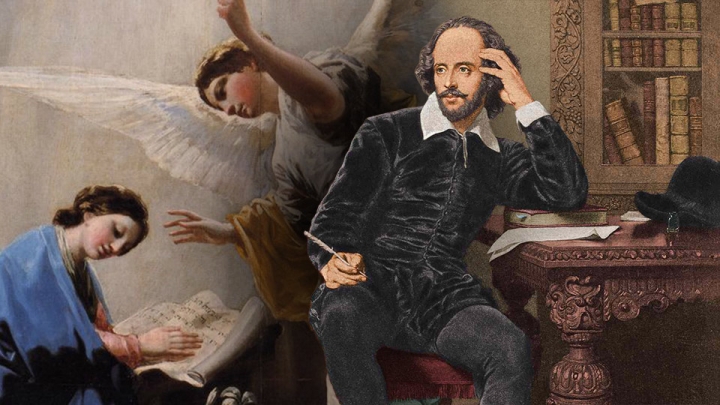

About twenty years after my godfather, the late Dr. David Allen White, and I had stumbled upon the key to understanding the devout Catholic allegory within Shakespeare’s The Winter’s Tale, I had a slight doubt about our study: if Shakespeare was truly Catholic, why didn’t he include the Blessed Virgin Mary in his allegory? As I had detailed in an early version of A Tale Told Softy: Shakespeare’s The Winter’s Tale and Hidden Catholic England, Shakespeare had effectively incorporated every other meaningful aspect of the Faith in his play, so the omission of a definite role for Our Lady seemed anomalous. As with so many other lines of Catholic inquiry about The Winter’s Tale, though, pondering the question eventually yielded a glimpse of Shakespeare’s ingenious solution: through his portrayal of Perdita’s character as “Flora,” Shakespeare left us an extraordinarily elaborate and devout homage to the Blessed Virgin Mary, which even those who have never read the play can see below.
One cannot fully grasp Shakespeare’s homage to the Blessed Virgin Mary without considering the connection between Perdita and her role as Flora. However, even without identifying this connection, the late Fr. Peter Milward had persuasively argued that Perdita resembled the Blessed Virgin Mary in his Shakespeare the Papist:
“[I]n the Chorus of Time at the beginning of Act IV we are introduced to the maiden Perdita as ‘now grown in grace equal with wondering’ (IV 1.24), just as in Pericles we were introduced to Marina in the Chorus of Gower. Next, we are shown her offering flowers, notably those signifying ‘grace and remembrance,’ to the noble visitors at the sheep-shearing feast (IV iii.76). Later, Leontes welcomes her and Florizel, on their arrival in Sicilia, as ‘a gracious couple,’ even before he recognizes her as his long-lost daughter. Even without the word ‘grace,’ the supernatural reality is implied time and again — once when Florizel denies that the gods ever transformed themselves for a rarer ‘piece of beauty’ (IV. iii.32), again when his father Polixenes comments, ‘Nothing she does or seems/ but smacks of something greater than herself’ (IV. iii.157), and yet again when the Gentleman describes her to Leontes as ‘the most peerless piece of earth’ and the ‘rarest of all women’ (V i.94, 112) — as if recalling the words of Elizabeth to Mary in Luke i.42, ‘Blessed art those among women.’” (pp. 262-263)
Especially with this last observation, Fr. Milward clearly identified an apparent connection between Perdita and the Blessed Virgin Mary. However, the difficulty in seeing anything more than an interesting echo of Our Lady’s virtues in Perdita is that many of her actions and mannerisms in the play — as virtuous as they are — cannot appropriately be applied to the Blessed Virgin Mary. If, as it seems, Shakespeare was a devout Catholic, surely he might have hesitated to represent Our Lady as anything less than absolutely perfect.
When we recall that Shakespeare was arguably the greatest-ever master of the English language, we can realize how nonsensical it would be to imagine that Shakespeare did not intend for these connections to link Perdita to the Blessed Virgin Mary through Flora.
Perhaps because he truly had this pious desire to portray Our Lady without the slightest blemish, Shakespeare allowed Perdita to have a secondary identity in the play, much like a child might temporarily take on a new identity during an All Saints Day celebration. As we can see from the first lines of the play from Perdita, she is also “Flora”:
FLORIZEL
These your usual weeds to each part of you
Do give a life — no shepherdess, but Flora
Peering in April’s front. This your sheepshearing
Is a meeting of the petty gods,
And you the queen on’t.
PERDITA
Sir, my gracious lord,
To chide at your extremes it not becomes me.
O, pardon, that I name them! Your high self,
The gracious mark o’ th’ land, you have obscured
With a swain’s wearing, and me, poor lowly maid,
Most goddesslike pranked up.
(IV.4.1-10)
In the literal meaning of the play, we can see that both Perdita and Florizel are in costume, with Perdita assuming the role of Flora. By allowing Perdita to play Flora — whose name fittingly suggests flower, which ties to Mary, the “Mystical Rose” — Shakespeare overcame the difficulty of having an imperfect character represent the Blessed Virgin Mary. Through this dramatic mechanism, we can apply everything about Perdita that resembles Our Lady to Flora, without having to concern ourselves about the fact that certain aspects of Perdita’s character are incompatible with Mary.
Thus, in the ten lines above from Florizel and Perdita, we can apply to Flora at least three similarities to Our Lady:
- Florizel calls her Flora, connecting her by name to a common description of the Blessed Virgin Mary.
- Florizel also suggests that Flora is the queen of a “meeting of the petty gods” — Shakespeare obviously could not have called Perdita the “queen of heaven and earth,” but this is about as close as one could get to that using secular language.
- Flora responds to this praise in much the same way that Mary responded to the message of Gabriel — even though she is dressed up to be “goddesslike,” she calls herself a “poor lowly maid.”
Already with these few connections we can sense how much Shakespeare must have delighted to honor the Blessed Virgin Mary in this hidden but definite manner. Additionally, although Shakespeare may well have intended more hidden connections between Perdita/Flora and Mary, here are some of the most prominent:
Innocence: Although all babies are born innocent of actual sins, only the Blessed Virgin Mary was ever innocent of all sin, including original sin, from the moment of conception. As such, calling a baby innocent is either completely superfluous — in the sense that all babies are free from actual sin — or something profoundly unique that would apply most especially to the Blessed Virgin Mary (and, to a lesser extent, St. John the Baptist, who was purified in the womb). Thus, when Perdita’s mother calls the newborn “innocent” (II.2:29), we have a strong hint of her connection to Our Lady.
Grace: As Fr. Milward described above, Perdita is associated with grace, just as Mary is “full of grace.”
Purity: We cannot think about the Blessed Virgin Mary without observing her perfect purity. Perdita’s purity also shines throughout the play, as we can see from the way in which Florizel refers to his love for Perdita as “chaste” (IV.4.33). Moreover, Perdita warns that another character (Autolycus) must not use “scurrilous words” in her presence (IV.4.213) And, as Clare Asquith astutely observed in her Shadowplay: The Hidden and Coded Politics of William Shakespeare, Perdita’s purity extended even to the religious debates of the day: “In a charming pastoral debate at the centre of the play, the chaste heroine Perdita pointedly prefers the pure stock of country flowers to the ‘grafted’ varieties proposed by her more sophisticated visitors. The language of the debate comes straight from the theological argument of the day, in which the grafted, hybrid, spotted state religion was denounced by both Catholics and Puritans.”
Humility: Much like Our Lady (the handmaid of the Lord) was perfectly humble despite being the Mother of God, Perdita shows her humility on several occasions, including by calling herself a “poor lowly maid” (IV.4.9).
Obedience to the Father’s Will: The Blessed Virgin Mary’s “Fiat” was a perfect expression of obedience to her Heavenly Father’s will. Shakespeare has Perdita echo Our Lady’s obedience as she accepts the honor of hosting the sheep-shearing gathering: “it is my father’s will I should take on me/ The hostess-ship o’ th’ day” (IV.4.71-72). There is no dramatic purpose for this declaration other than as a demonstration of Perdita’s humility, so it clearly connects her to Our Lady within the Catholic allegory.
Sorrows: Catholics honor the sorrows, or dolors, of Mary. So too, Shakespeare has a Gentleman describe Perdita’s sorrows as follows: “ . . . from one sign of dolor to another, she did, with an ‘Alas!’ I would fain say, bleed tears for I am sure my heart wept blood” (V.2.88-91). This recalls the words of the Stabat Mater: “Is there one who would not weep,/ Whelm’d in miseries so deep,/ Christ’s dear mother to behold?”
Intercession: With every Hail Mary, we pray for the Blessed Virgin Mary, the Mediatrix of All Graces, to intercede for us. Similarly, Shakespeare had Paulina direct Perdita to intercede with the “resurrected” Hermione at the end of the play: “Please you to interpose, fair madam. Kneel,/ And pray your mother’s blessing” (V.3.120-121). Hermione does not speak in the final scene until after this intercession from Perdita.
Perfections: In his Mother of God: Mary in Scripture and Tradition, Fr. Cyril Papali wrote that Mary “is the only creature of whom it could be said that every one of her actions was so perfect that from her part it could not have been more perfect.” (p. 29) Florizel offers similar praise for Perdita: “Each your doing,/ So singular in each particular,/ Crowns what you are doing in the present deeds,/ That all your acts are queens” (IV.4.143-146).
Worthiness of Devotion: Fr. Papali also related the words of Richard Victorinus about Mary: “Unless I believed in thy Son whom Paul has preached to me, I should now have fallen prostrate at thy feet adoring thee as the very Godhead . . .” (p. 12). Camillo (who represents Camillo Borghese, Pope Paul V in the allegory) echoed this sentiment in praising Perdita: “I should leave grazing, were I of your flock,/ And only live by gazing” (IV.4.109-110). Along the same lines, a Servant in Act V describes Perdita as follows: “This is a creature/ Would she begin a sect, might quench the zeal/ Of all professors else, make proselytes/ Of who she but bid follow” (V.1.106-112). In the literal reading of the play, this devotion to Perdita is so excessive as to be nonsensical, and yet it makes perfect sense in light of the words above from Richard Victorinus.
Rosary: One of the most fascinating, albeit less certain, connections between Our Lady and Perdita arises through Perdita’s naming of the following categories of flowers and herbs in Act IV: rosemary, rue, carnations, streaked gillyvors, hot lavender, mints, savory, marjoram, marigold, daffodils, violets, pale primroses, bold oxlips, the crown-imperial, and “lilies of all kinds,/ The flower-de-luce being one.” Although one can quibble over whether there are fifteen or sixteen flowers and herbs named, it is certainly reasonable to put the number at fifteen by seeing that Perdita intends the flower-de-luce as simply an example of the category of lilies (which happens to have a well-known connection to Mary). As such, the connection between Perdita’s fifteen flowers and the fifteen mysteries of the Rosary seems at least possible.
“Peering in April’s Front.” In the opening lines of Act IV, Florizel says that Perdita is Flora, “peering in April’s front.” Although the allegorical meaning of this is indefinite, it does resonate with a famous fifteenth century poem about Our Lady, “I syng of a mayden”: “I sing of a maiden/ That is matchless,/ King of all kings/ For her son she chose./ He came as still/ Where his mother was/ As dew in April/ That falls on the grass./ He came as still/ To his mother’s bower/ As dew in April/ That falls on the flower./ He came as still/ Where his mother lay/ As dew in April/ That falls on the spray./ Mother and maiden/ There was never, ever one but she;/ Well may such a lady/ God’s mother be.” This connection is also bolstered when Shakespeare has Polixenes address Flora as “gentle maiden” during their discussion about the flowers in her garden (IV.4.85).
Pentecost. Finally, we know that the Holy Ghost appeared to the Blessed Virgin Mary and the Apostles at Pentecost, which is also known as Whitsunday. Fittingly, Perdita likens her role as Flora to “Whitsun pastorals”: “Come, take your flowers./ Methinks I play as I have seen them do/ In Whitsun pastorals. Sure this robe of mine/ Does change my disposition” (IV.4.132-135). Given that the only female figure who featured prominently at the first Pentecost was the Blessed Virgin Mary, Perdita’s reference to “changing her disposition” to play a role associated with the feast day is another connection to Our Lady.
It is almost as though God guided Shakespeare so that his devout allegory would remain hidden while necessary but eventually come to light, leading many English souls to return to the religion that St. Edmund Campion spoke of when he was condemned to death.
Returning to the analogy of a child portraying a saint at an All Saints Day celebration, any three or four of these qualities would have sufficed for us to guess that Perdita’s Flora persona represents the Blessed Virgin Mary. By including over a dozen connections between Flora and Our Lady, Shakespeare made it so abundantly clear that it is almost impossible to deny once we see it.
When we recall that Shakespeare was arguably the greatest-ever master of the English language, we can realize how nonsensical it would be to imagine that Shakespeare did not intend for these connections to link Perdita to the Blessed Virgin Mary through Flora. Given that this association of Perdita with Our Lady is meaningful only within the context of the Catholic allegory, we can scarcely avoid the conclusion that Shakespeare’s elaborate homage to the Blessed Virgin Mary strongly suggests that he was a devout Catholic. And, further, when we recall that those in Shakespeare’s England would have been punished for openly exhibiting Catholic devotion to Mary, one could make a reasonable argument that the way in which Shakespeare developed Perdita to pay homage to Our Lady is one of the most remarkable accomplishments in the English language.
From a Catholic perspective, there is even something almost miraculous about Shakespeare’s devout Catholic allegory. Living under the anti-Catholic persecution of King James I, he could not have openly favored the Catholic religion. And yet the Catholic allegory within The Winter’s Tale is so complete that, in many ways, it makes far more sense than the literal meaning of the play. It is almost as though God guided Shakespeare so that his devout allegory would remain hidden while necessary but eventually come to light, leading many English souls to return to the religion that St. Edmund Campion spoke of when he was condemned to death:
“In condemning us you condemn all your own ancestors — all the ancient priests, bishops and kings — all that was once the glory of England, the island of the saints, and the most devoted child of the See of Peter.” (quoted in Evelyn Waugh’s Saint Edmund Campion: Priest & Martyr, p. 205)
Through the intercession of Our Lady, Mediatrix of All Graces, may God grant England the grace to rediscover the most precious treasure of the Catholic Faith so that it may once again become the “island of the saints.” Our Lady of Walsingham, pray for us! St. Edmund Campion, pray for us!