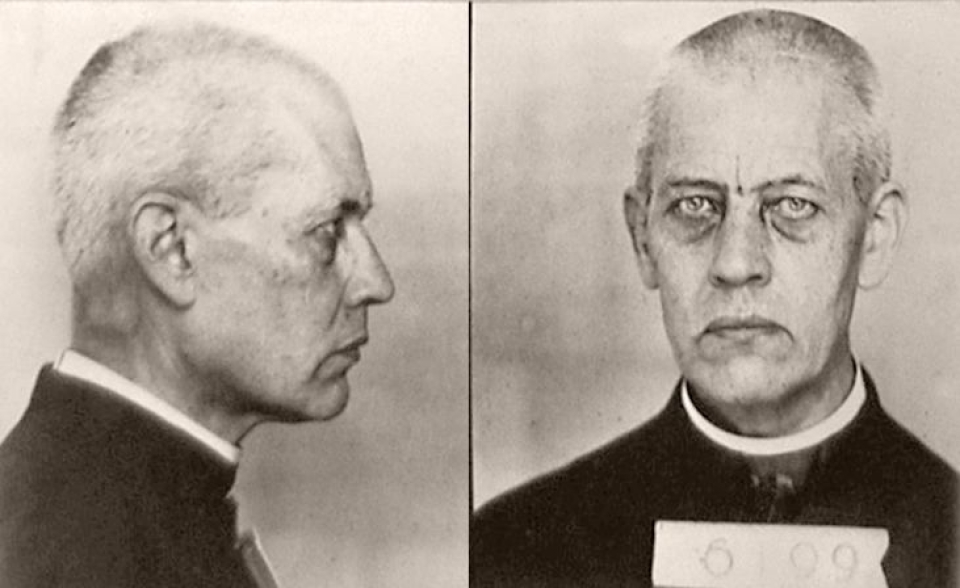

Considered, like all other Catholic hierarchs, a formidable adversary of the Communist Party and Marxist-Leninist ideology, Bishop Anton Durcovici was arrested on June 26, 1949, near Popești-Leordeni, while on his way to a community where he was to administer the sacrament of Confirmation. His main “guilt” was being a Catholic Thomist intellectual who had fought against the party’s materialist ideology.
Formed according to the intellectual rigor scholastic thought, Bishop Anton Durcovici demonstrated, through the testimony of his own life and, especially, through his martyrdom, that true philosophy (vera philosophia) is synonymous with Christian holiness. Why do I emphasize this? Because it is impossible to be an authentic philosopher without being perpetually and intensely driven by that “love of the truth” (caritatem veritatis) that Saint Paul speaks of in the Second Epistle to the Thessalonians (2:10). This love, in the case of authentic Christians, involves recognizing both the truth of the existence of the ecclesiastical hierarchy and the truth of the existence of a visible head of this hierarchy, the Holy Father—the Pope. During the communist persecution, Catholic bishops in Romania sometimes paid the ultimate price, giving their lives for their faith in the eminent role––established by God Himself––and value of the pontifical office.
The origin of this historical fact, proven by the life and death of the bishop to whom I have dedicated my little article, Anton Durcovici (beatified in 2014), is found in the principled demand of Thomistic philosophy—the knowledge of the Truth—which fulfills the deepest aspiration of the human being, created in the image and likeness of God:
“All men by nature desire to know the truth; they also have a natural desire to avoid error and to refute it when the opportunity arises” —Saint Thomas Aquinas, De unitate intellectus contra Averroistas (On the Uniqueness of the Intellect Against Averroists).[i]
By continuously knowing and deepening the revealed truth, the young Durcovici—born on May 17, 1888, in Altenburg, Austria—serves as a model of piety and devotion to the “sacred science” founded on faith in the divinity of our Lord Jesus Christ. After completing his secondary studies, where he was noted for his intelligence, Anton was admitted to the minor seminary in Bucharest, thus beginning his sacerdotal preparation. His merits earned him the admiration of Archbishop Raymund Netzhammer, the Catholic Archbishop of Bucharest at the time, who sent him to continue his studies in Rome.
First taken to the infamous prison Jilava, tortured in various ways by his tormentors, he ended his earthly existence on December 10, 1951, in an unhealthy cell in the prison at Sighetu Marmației.
There, on November 4, 1906, he began his studies in scholastic philosophy at the “Saint Thomas Aquinas” Philosophical Academy (also known as the Angelicum). After brilliantly completing his philosophy studies, he dedicated himself to theology “with tireless diligence and constant hard work,” as noted by his biographer––Florian Müller. At the age of just 22, he completed his studies at the “Propaganda Fide” College, after which, with a Vatican dispensation from the canonical age for ordination, he was ordained on September 24, 1910.
Although it may sound excessively laudatory, the tone of the biographer Müller is not at all exaggerated in comparison to the real qualities demonstrated by Father Durcovici:
“Dr. Anton Durcovici returned to his diocese in August 1911, adorned with two doctorates and a license in canon law, burning with piety, full of the Holy Spirit, rich in knowledge.”
His entire existence represented a meticulous preparation for an apostolic end. It must be noted that by submitting to a “foreign power”—namely, the authority of the Holy Father, the Pope—all Catholic hierarchs were regarded in the countries behind the Iron Curtain as enemies of “the people” and, naturally, of the Communist party. Specifically, what the communist dictatorial power wanted was the creation of a national Catholic Church, hostile to the Pope. (The same strategy was used by the new power in France after the Revolution of 1789 to create a national Church that would not recognize the authority of the Pope.) Faced with such a diabolical plan, all twelve Catholic hierarchs stood in solidarity, refusing to collaborate with the dictatorship. Thus, without exception, all Catholic bishops—both of the Byzantine rite and of the Latin rite—were arrested between 1948 and 1951.
The first targets of communist persecution were the Greek-Catholic bishops: Valeriu Traian Frențiu (1875–1952; beatified in 2019), Vasile Aftenie (1899–1950; beatified in 2019), Ioan Suciu (1907–1953; beatified in 2019), Tit Liviu Chinezu (1904–1955; beatified in 2019), Ioan Bălan (1880–1959; beatified in 2019), Alexandru Rusu (1884–1963; beatified in 2019), and Iuliu Hossu (1885–1970; the latter was made a Cardinal in pectore by Pope Paul VI in 1969; beatified in 2019).
The Roman-Catholic bishops were not spared either. With over one million faithful in the period following World War II, the Roman-Catholic Church in Romania had one archbishop and four bishops. Archbishop Alexandru Theodor Cisar (1880–1954) was arrested and kept under house arrest by the communists until his death under suspicious circumstances. Áron Márton (1896–1980), Bishop of Alba Iulia, survived a detention regime between 1949 and 1955. He was the longest-living survivor of communist persecution. Bishop Augustin Pacha (1870–1954) of Timișoara was arrested later, in 1951. Sentenced to 18 years in prison, he went blind in 1954. Due to his deteriorating health (he was suffering from cancer), he was placed under house arrest in Timișoara, where he died in November 1954.
Thrown into a mass grave whose location is no longer known, the bishop, a lover of scholastic philosophy, demonstrated through the very testimony of his life that when the love of truth is not darkened by petty human passions, it can elevate philosophy to the rarefied altitude of martyrdom in the service of the supreme end of sacred science: God.
The Bishop of Satu Mare, János Scheffler (1887–1952), endured the harshest repression. Arrested as early as 1949 and first kept under house arrest, he was later imprisoned in Sighet, where he died from torture in 1952. He was beatified in 2011. Finally, the last of the Roman-Catholic bishops, the Bishop of Iași, Anton Durcovici (1888–1951), suffered a martyr’s death, just like Bishop Scheffler.
Considered, like all other Catholic hierarchs, a formidable adversary of the Communist Party and Marxist-Leninist ideology, Bishop Anton Durcovici was arrested on June 26, 1949, near Popești-Leordeni, while on his way to a community where he was to administer the sacrament of Confirmation. His main “guilt” was being a Catholic Thomist intellectual who had fought against the party’s materialist ideology. In Bucharest (the capital of Romania) during the interwar period, he became famous among intellectuals for his public Thomistic philosophy lectures and conferences. Obviously, an intellectual with such a profile, and at the same time a hierarch of the Catholic Church, could not be ignored by the communists.
First taken to the infamous prison Jilava, tortured in various ways by his tormentors, he ended his earthly existence on December 10, 1951, in an unhealthy cell in the prison at Sighetu Marmației. Thrown into a mass grave whose location is no longer known, the bishop, a lover of scholastic philosophy, demonstrated through the very testimony of his life that when the love of truth is not darkened by petty human passions, it can elevate philosophy to the rarefied altitude of martyrdom in the service of the supreme end of sacred science: God.
Beatus Antonius Durcovici, ora pro nobis!
[i] The full text can be read online here: https://isidore.co/aquinas/english/DeUnitateIntellectus.htm [Accessed: 09 June 2025].
