

The Bishop of Rome is not just another bishop; he is the visible source of hierarchical communion, and his liturgy must reflect this truth. Until the signs once again manifest the reality they signify, the faithful will continue to experience the disorientation of a Church that seems intent on hiding itself. But light is not meant to be concealed—it is meant to be exposed, proclaimed, and celebrated.
The liturgy, by its very nature, is never a neutral set of gestures but a sacred, ordered, and revelatory language. Therefore, papal liturgy is not merely a Eucharistic celebration but the most eloquent public act through which the Church expresses its faith in the uniqueness of the Petrine munus. The Mass marking the beginning of the Petrine Ministry (May 18, 2025) and the one for the installation on the Roman Cathedra (May 25, 2025) of Pope Leo XIV were meant to be the visible embodiment of this uniqueness. Unfortunately, this did not happen in a satisfactory manner, though the blame does not lie with the Pontiff but rather with those currently responsible for papal ceremonies.
The common thread linking Annibale Bugnini, Piero Marini, and Diego Ravelli is the gradual suppression of all liturgical elements of the papal chapel that highlighted the exceptional—indeed, unique—nature of the Roman Pontificate. Bugnini, the architect of the post-conciliar liturgical reform, sought to design a more “pastoral” liturgical order, which inevitably became less symbolic. Marini, his disciple and the master of ceremonies for John Paul II, pursued an agenda aimed at “simplifying” the papal rite, omitting and modifying traditional elements under the pretext of cultural adaptation and ecumenical dialogue. Ravelli, trained in the same school, is today its consistent executor.
This reformist trajectory has led not only to a liturgy impoverished in its symbolic elements but also to a perceived transformation of the very identity of the Papacy. The paradoxical outcome is that today’s papal liturgy now mirrors episcopal liturgy, whereas once the reverse was true—the archetype has yielded to its imitation.
During the Mass inaugurating the Petrine Ministry in St. Peter’s Basilica, the Pope appeared surrounded by an unprecedented “sobriety” for such an event. No visible papal throne. No strong symbols of Petrine authority. No gestures conveying the superiority of the Bishop of Rome as the visible principle of unity and universal jurisdiction. The symbols that once manifested the supremacy of the Roman Pontiff over other bishops have either been removed or rendered imperceptible.
And let it be clear that these are not mere trifles or details for the overly meticulous. The liturgy, or lex orandi, must reflect the lex credendi—that is, the deposit and order of doctrine to be believed. When liturgical elements are removed, the groundwork is unwittingly laid for the elimination of the doctrinal elements they are meant to signify.
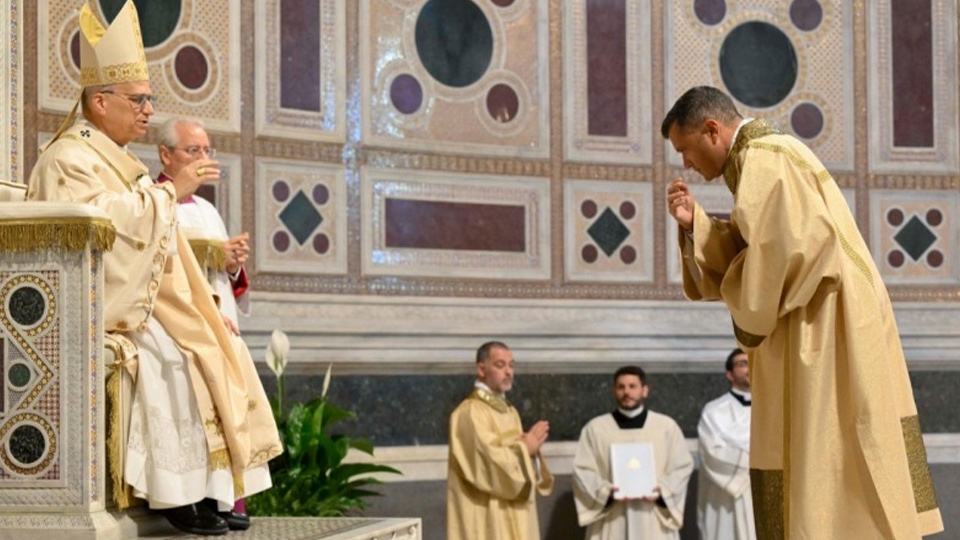
At St. John Lateran, the Cathedral of the Bishop of Rome, the papal homily was delivered standing. Yet, tradition dictates that in this very setting, the Pontiff teaches from the Cathedra, seated, to emphasize that he does not teach as a private individual or merely as a bishop, but as the successor of Peter, the prince of all the apostles. The refusal to use the throne—or the improper use of the Cathedra—signals a shift in the public perception of the Papacy: no longer as the universal teacher, but as a bishop among bishops.
The failure to grasp the symbolic significance of the Roman Cathedra is, in fact, perhaps the most concerning indication. As some commentators have rightly pointed out, delivering the homily standing rather than seated visibly denies the Pope’s authority to teach the entire world ex cathedra, as the primary custodian of the munus docendi received from Christ.
The Chair of Peter is not a symbol of personal power but of doctrinal authority, and the obedience of the faithful is directed not to the Pope as an individual man, but to the supreme ministry he exercises.
Equally emblematic was the absence of the tunicella (or dalmatica), the liturgical vestment proper to the deacon. When worn by the Pope or a bishop, it signifies the fullness of sacred orders and the charity of priestly service. Its exclusion, which was already irregular under John Paul II, has now become systematic. Guido Marini attempted to restore the proper use of certain symbols during Benedict XVI’s pontificate, but Diego Ravelli has continued along the path of their eclipse.
Another missing element is the fanon, a double circular mozzetta made of ultra-fine silk woven with parallel stripes of gold and amaranth. It symbolizes faith as an impenetrable shield against the enemy’s darts, with Peter as its guarantor—the one who “confirms”. Additionally, the gold and amaranth colors represent the two Churches, the West and the East, inseparably united in the figure of the Roman Pontiff.
A similar discussion applies to the arrangement of the altar, starting with the cross. Benedict XVI repositioned the cross at the center of the altar, reaffirming the principle of versus Deum as the orientation of worship. Now, the cross has once again been removed or placed in a marginal position, as if to suggest that the protagonist of the liturgy is no longer the Lord, but the assembly—or, perhaps worse, the celebrant, regardless of his authority as Pope or bishop.
Another noteworthy aspect of papal furnishings is the absence of the traditional seven candles. This is a highly significant pontifical symbol, deeply rooted in Tradition and Scripture. Its origin traces back to the Book of Revelation, which describes a majestic and solemn “cosmic liturgy.” The number seven, a biblical symbol of totality and perfection, represents the Church in its fullness through the “seven angels”: on one hand, the Church Militant, with the seven bishops of Asia Minor mentioned in Revelation 1:20; on the other, the Church Triumphant, recalling the seven archangels and finding a precedent in the Old Testament with the menorah of the Temple, the seven-branched candelabrum (cf. Exodus 25:31-40).
According to the ancient adage Ubi Petrus, ibi Ecclesia (“where Peter is, there is the Church”), the presence of the Pope carries with it the entirety of the Church. Originally, the arrangement of seven candlesticks on the altar was an exclusive prerogative of the Pontiff, a tradition that, over time, was extended to bishops as well.
The Roman Pontificate is not merely an administrative function; theologically, it is the visible principle of unity in faith and jurisdiction. This reality is manifested in the liturgy, which is never mere ornamentation but the sacramental visibility of the Church’s mystery.
According to the General Instruction of the Roman Missal (cf. 117), there should always be seven candles when the diocesan bishop celebrates Mass—and, until proven otherwise, the Pope is the Bishop of Rome.
In Catholic Tradition, papal liturgy is both the origin and the standard for the Roman Rite. Today, however, we witness a reversal: papal liturgy conforms to local practices (often the result of so-called “creativity” rather than Tradition), abandoning its normative character. This is a dangerous inversion—if what is original takes shape from what is derivative, the very principle of order collapses.
This is not about aesthetic nostalgia but ecclesiological substance. The Roman Pontificate is not merely an administrative function; theologically, it is the visible principle of unity in faith and jurisdiction. This reality is manifested in the liturgy, which is never mere ornamentation but the sacramental visibility of the Church’s mystery.
One single gesture, among many others that were questionable, stood out for its positive significance. During the Mass of installation on the Roman Cathedra, Leo XIV wore a planeta previously used by John Paul II and Benedict XVI. This vestment, adorned with floral motifs and golden stars, bears on the chest the image of the fisherman receiving the keys to the Kingdom. On the back, it features the coat of arms of John Paul II—a symbol of continuity, which, at least in its external form, sought to recall the identity of the Papacy as a Petrine service and guardian of the deposit of faith.
However, the value of a vestment cannot compensate for the overall absence of the most significant symbols.
It is no coincidence that the representatives of the Catholic and schismatic Eastern Churches present at the celebrations appeared bewildered, even bored. Accustomed to solemn, hieratic liturgies rich in symbolism and beauty, they found themselves before a bland, standardized, and impoverished liturgy. The Roman Rite has lost that sense of majesty and sacredness that once made it revered even beyond Western borders—and even among Catholics.
Paradoxically, just days earlier, Pope Leo XIV had told participants at the Jubilee of Eastern Churches (May 14, 2025) that “it is important to rediscover, even in Christian Western traditions, the sense of God’s primacy”.
During his first homily at the Mass pro Ecclesia (May 9, 2025), the Pope had declared: “[We must] disappear so that Christ remains, make ourselves small so that He may be known and glorified”.
But how can Christ be made present if the symbols that reveal Him are systematically removed? Humility is not the annihilation of identity but obedience to the received form. And that form, in the Roman liturgy, is theological even before it is aesthetic.
An intelligent faith demands coherence between what is believed and what is shown. The absence of strong symbols, the suppression of signs of papal jurisdiction, and the assimilation of the Roman Rite into the episcopal liturgy constitute not only a loss of decorum but an alteration of doctrine. Liturgy is not a pastoral showcase—it is dogma made gesture.
This is why it is unacceptable for the Pope to be reduced to a mere presider over the assembly. The Bishop of Rome is not just another bishop; he is the visible source of hierarchical communion, and his liturgy must reflect this truth. Until the signs once again manifest the reality they signify, the faithful will continue to experience the disorientation of a Church that seems intent on hiding itself. But light is not meant to be concealed—it is meant to be exposed, proclaimed, and celebrated.