

We are in a completely abnormal situation: we do not “see” any of the spiritual beings—the angels—that Scripture tells us are far more numerous than we could imagine. Neither the good ones nor the evil ones. Spiritual beings are not directly accessible to our knowledge. But even more troubling is the fact that we do not see God.
I will begin by making a very simple observation about our eyes and vision. Let’s suppose that sand—or dust—gets under our eyelids. Even a single grain of sand can severely impair our visual perception. The same goes for dust. It becomes absolutely necessary to wash our eyes thoroughly in order to regain clear sight. Once, a tiny shard of ice got into my eye. Fortunately, it had no serious consequences, but it was incredibly painful. A tiny piece of frozen water, no more than one-twentieth of a millimeter, nearly completely obstructed my vision. Only after repeated rinses with lukewarm water was I able to see again.
Besides such unpleasant physical experiences, ophthalmologists can tell us how many visual distortions are the result of diseases. Depending on the underlying cause (covering refractive, retinal, optic nerve, and neurological causes), there are between 12 and 15 major conditions. That’s not a small number. So, both physical minuscule bodies and medical conditions can seriously affect our vision.
Another experience of distorted vision results from a change in the surrounding environment. If we submerge our heads under water, we can keep our eyes open. But without protective goggles like those divers wear, what we see will be far inferior to normal vision: blotches of color and varying brightness. Nothing clearly defined. A change in environment results in a complete alteration of our visual capacity. Now let’s note an important detail: although our eyes and their components remain intact, disease or physical anomaly distorts our sight. The eyes (with all their constituent parts) remain, but perception—i.e., vision—is altered. Sometimes things become so serious that we arrive at the most terrible condition: blindness.
In our current condition, the “visual apparatus” needed to perceive the unseen world is sick. Through numerous examples, parables, and real or imagined situations, Scripture tells us even more: it tells us that we are blind. We have simply lost the ability to see the world of “the unseen.”
As for our placement in this world, we can immediately see that we are in a completely abnormal situation: we do not “see” any of the spiritual beings—the angels—that Scripture tells us are far more numerous than we could imagine. Neither the good ones nor the evil ones. Spiritual beings are not directly accessible to our knowledge. But even more troubling is the fact that we do not see God.
Although revealed theological teaching tells us that He is an absolute, perfect, infinite, omnipresent, and omnipotent spiritual being, most Christians never see Him in this passing life. Naturally, anyone might ask: if this is so, and God is omnipresent, how is it that we do not see Him? The short answer, inspired by my opening remarks about our bodily vision, is this: in our current condition, the “visual apparatus” needed to perceive the unseen world is sick. Or, if you prefer a more technical term, it is “malfunctioning.” We have it, but it is dysfunctional. Through numerous examples, parables, and real or imagined situations, Scripture tells us even more: it tells us that we are blind. We have simply lost the ability to see the world of “the unseen.” Explaining this requires many clarifications.
If we limit ourselves to the desire to regain the ability to see the unseen world, we can do without a complicated explanation of how the spiritual blindness mentioned above came about. It is enough to do what the blind man Bartimaeus did: to cry out with all our strength, “Jesus, Son of David, have mercy on me!” (Mark 10: 47). There is no better solution for regaining spiritual sight than persevering prayer.
On the other hand, we must take seriously the warnings of the great saints and mystics, like the Apostle Paul, who tells us that in this fallen world “we see now through a glass in a dark manner” (1 Corinthians 13: 12). In other words, in this life, we do not have direct access to knowledge of the unseen world. That is precisely why we need the supernatural gift of faith: to believe in what we do not see. In Paradise, after the end of this fallen world, we will no longer need faith: the unseen will no longer be believed but directly seen.
We are in this world like the blind, able to find our way only by shadows and the light of faith in our hearts—as much as we have of it. We move through the obscure night like phantoms, unable to see and truly move.
According to the great mystical Doctor, Saint John of the Cross, we are in this world like the blind, able to find our way only by shadows and the light of faith in our hearts—as much as we have of it. We move through the obscure night like phantoms, unable to see and truly move (like the cripple at the pool of Bethesda who had no one to help him into the healing waters). This, spiritually speaking, is our present condition: blind, crippled, and on top of that full of the leprosy of sin. Though shocking and repulsive, this is the most accurate description of the fallen human soul. Absolutely all the illnesses and infirmities in the New Testament describe, allegorically and symbolically, the condition of post-lapsarian man. And likely, among all of them, none is graver than blindness.
In a TV show featuring his remarkable presence, the Argentine poet Jorge Luis Borges spoke about his progressive blindness, which ended in total loss of vision. This terrible event occurred when he was 55 years old, in 1954. His sorrowful words were devastating. With a resigned calm that could not hide his bitterness, this genius of 20th-century literature spoke of his desire to die: his blindness was so heavy that he would have preferred death over a life without the “revelations” granted by eyes able to see. Reflecting on Borges’ words, how much more should we suffer and long to see the world beyond—and its glorious King, God?
Clearly, if we accept that we are seriously ill, it wouldn’t hurt to try to understand why and how we got this way. Sometimes, solidarity among the sick and the little comfort they can offer each other comes from discussing their own illnesses. It’s not much, but it’s something.
Since my conversion in 1993, nothing has preoccupied me more than original sin and its consequences. The opening of the bodily eyes (Genesis 3: 7) necessarily involved the closing of the eye of the mind, which, through contemplation, once had direct access to the unseen world (although, as all the Saints and Doctors of the Church teach, Adam and Eve did not yet have access to the beatific vision). I will now speak further about this opening/closing of the eyes. To do so, I will use an extraordinary metaphor suggested to me by an adventure film—National Treasure (2004).
The “fall” brought with it a serious alteration of the human faculties of knowledge. Just as with diseased eyes, although the functions of the optical apparatus are still there, their proper functioning is deeply disturbed by sin.
I’ve always loved books and movies about treasure. From early childhood to this day, I read voraciously any story or account involving the discovery of a treasure. Our Lord Jesus Christ Himself used symbols and metaphors related to precious stones and treasures in His parables. So here we have a fascinating and profound subject!
The mentioned film caught my attention precisely because of my favorite theme. Whether pirates are involved or not, treasure discovery always involves a map, right? National Treasure, however, introduced an artifice designed to capture the audience’s attention and amplify their curiosity: the treasure map is invisible.
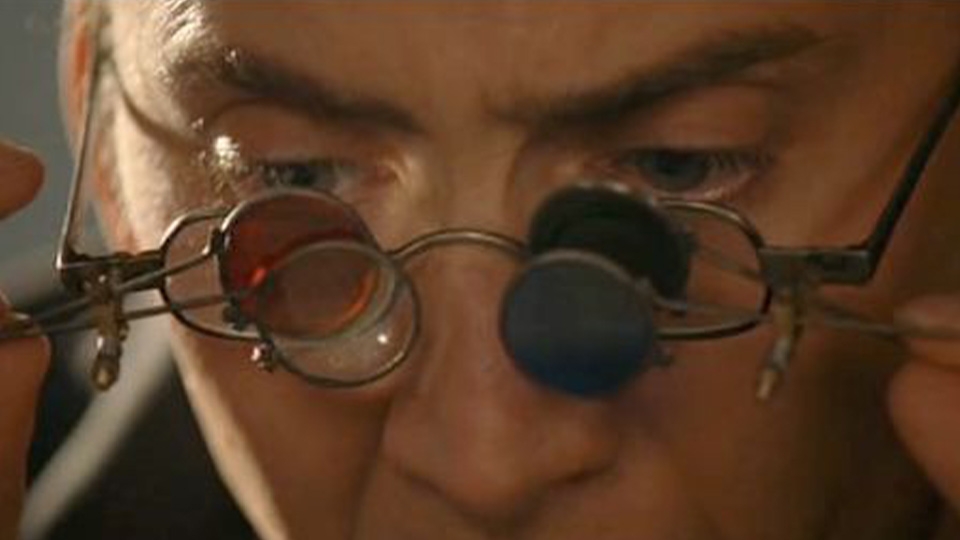
Drawn with special ink, it cannot be seen until it is treated with certain substances. That’s all? No. What fascinated me comes next: after the map becomes at least somewhat visible (following a thermo-chemical treatment), one more thing is needed to decipher it. An artifact—a pair of glasses fitted with several colored lenses that can be combined in different ways.
Now comes the truly brilliant key: the essential clues encrypted in the map drawing only become visible when the lenses are combined correctly. Otherwise, although something can be seen, the decisive clues indicating the treasure’s location remain hidden. The ingenuity of this solution cannot be emphasized enough. Let’s recap.
Someone has “hidden” a map using two methods of concealment. First, it was drawn with ink that, once dried (or treated with a specific ingredient), became invisible. To make it visible again, the ink must be treated thermo-chemically. Now, though visible to the naked eye, certain clues remain invisible. They are revealed only when the map is viewed through glasses with multiple layers of colored lenses—the correct combination of colors, determined by lens order, is what makes all the hidden elements visible. Let us now return to the matter of the unseen world’s invisibility.
If the eyes of the body allow us to know the visible, sensory world, then the “eye” of the soul—the mind, the intellect—is what can contemplate the unseen world in which angels and saints dwell in the eternal glory of the Holy Trinity.
On the one hand, the entire Christian Tradition unanimously testifies that what Adam and Eve lost through original sin was the divine grace with which they were endowed from the beginning. In other words, they lost all the qualities that this grace—through its supernatural power—had added to their human nature. So the first thing lost in Paradise was this supernatural element, which granted the first humans exceptional faculties. Indirectly, mystical theology books teach us this by telling us that authentic ecstatic experiences—like those of Saint Teresa of Avila—are the result of extraordinary divine graces. Thus, mystical-contemplative knowledge is the result of graces God gives to chosen souls.
On the other hand, however, the “fall” brought with it a serious alteration of the human faculties of knowledge. Just as with diseased eyes, although the functions of the optical apparatus are still there, their proper functioning is deeply disturbed by sin. Beyond the loss of the light of supernatural graces, our faculty of knowledge has suffered a double disturbance. On one hand, the eyes themselves are affected by disease, but on the other hand, the environment in which we look has been so altered that “the world of visible things” distorts our perception, just as water distorts our vision when we open our eyes underwater.
The metaphor of the correct combination of lens colors—the only one that allows the clues on the treasure map to be seen—precisely indicates this alteration, corruption, and disorder in the functioning of the cognitive powers of our minds. For, to conclude this essay, I remind you that if the eyes of the body allow us to know the visible, sensory world, then the “eye” of the soul—the mind, the intellect—is what can contemplate the unseen world in which angels and saints dwell in the eternal glory of the Holy Trinity.
