
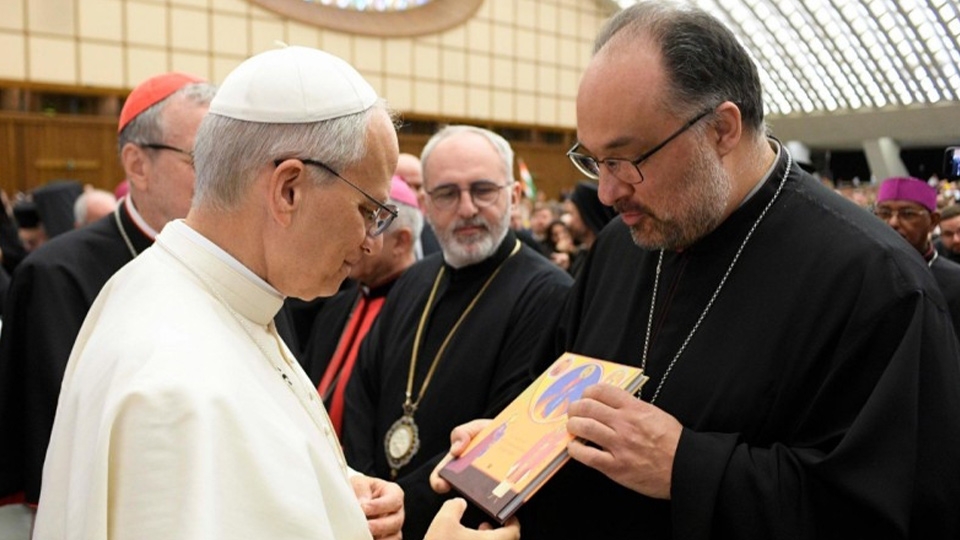

On May 14 Pope Leo XIV met with representatives of the Eastern Catholic churches. In his speech to the assembly he spoke of the beauty and variety of the Eastern Rites, prompting many traditionalists to hope that he might provide the same papal balance to the question of the Latin Mass. “Indeed,” he said, “Pope Leo XIII made a heartfelt appeal that the ‘legitimate variety of Eastern liturgy and discipline… may redound to the great honor and benefit of the Church’ (Orientalium Dignitas). His desire remains ever timely.”
To the consternation of Zionists everywhere, Pope Leo XIV also insisted on the need for the true peace of Christ in war-torn regions, specifically in the Holy Land and the Middle East. “I thank God for those Christians – Eastern and Latin alike – who, above all in the Middle East, persevere and remain in their homelands, resisting the temptation to abandon them,” he said. “Christians must be given the opportunity, and not just in words, to remain in their native lands with all the rights needed for a secure existence.”
The relevant sections are below:
Pope Leo XIV: “I would also like to mention Pope Leo XIII, the first Pope to devote a specific document to the dignity of your Churches, inspired above all by the fact that, in his words, “the work of human redemption began in the East” (cf. Apostolic Letter Orientalium Dignitas, 30 November 1894). Truly, you have “a unique and privileged role as the original setting where the Church was born” (SAINT JOHN PAUL II, Orientale Lumen, 5). It is significant that several of your liturgies – which you are now solemnly celebrating in Rome in accordance with your various traditions – continue to use the language of the Lord Jesus. Indeed, Pope Leo XIII made a heartfelt appeal that the “legitimate variety of Eastern liturgy and discipline… may redound to the great honor and benefit of the Church” (Orientalium Dignitas). His desire remains ever timely. In our own day too, many of our Eastern brothers and sisters, including some of you, have been forced to flee their homelands because of war and persecution, instability and poverty, and risk losing not only their native lands, but also, when they reach the West, their religious identity. As a result, with the passing of generations, the priceless heritage of the Eastern Churches is being lost.
The Church needs you. The contribution that the Christian East can offer us today is immense! We have great need to recover the sense of mystery that remains alive in your liturgies, liturgies that engage the human person in his or her entirety, that sing of the beauty of salvation and evoke a sense of wonder at how God’s majesty embraces our human frailty! It is likewise important to rediscover, especially in the Christian West, a sense of the primacy of God, the importance of mystagogy and the values so typical of Eastern spirituality: constant intercession, penance, fasting, and weeping for one’s own sins and for those of all humanity (penthos)! It is vital, then, that you preserve your traditions without attenuating them, for the sake perhaps of practicality or convenience, lest they be corrupted by the mentality of consumerism and utilitarianism.
Your traditions of spirituality, ancient yet ever new, are medicinal. In them, the drama of human misery is combined with wonder at God’s mercy, so that our sinfulness does not lead to despair, but opens us to accepting the gracious gift of becoming creatures who are healed, divinized and raised to the heights of heaven. For this, we ought to give endless praise and thanks to the Lord. Together, we can pray with Saint Ephrem the Syrian and say to the Lord Jesus: “Glory to you, who laid your cross as a bridge over death… Glory to you who clothed yourself in the body of mortal man, and made it the source of life for all mortals” (Homily on our Lord, 9). We must ask, then, for the grace to see the certainty of Easter in every trial of life and not to lose heart, remembering, as another great Eastern Father wrote, that “the greatest sin is not to believe in the power of the Resurrection” (SAINT ISAAC OF NINEVEH, Sermones ascetici, I, 5).
From the Holy Land to Ukraine, from Lebanon to Syria, from the Middle East to Tigray and the Caucasus, how much violence do we see! Rising up from this horror, from the slaughter of so many young people, which ought to provoke outrage because lives are being sacrificed in the name of military conquest, there resounds an appeal: the appeal not so much of the Pope, but of Christ himself, who repeats: “Peace be with you!” (Jn 20:19, 21, 26). And he adds: “Peace I leave you; my peace I give to you. I do not give it to you as the world gives it” (Jn 14:27). Christ’s peace is not the sepulchral silence that reigns after conflict; it is not the fruit of oppression, but rather a gift that is meant for all, a gift that brings new life. Let us pray for this peace, which is reconciliation, forgiveness, and the courage to turn the page and start anew.
For my part, I will make every effort so that this peace may prevail. The Holy See is always ready to help bring enemies together, face to face, to talk to one another, so that peoples everywhere may once more find hope and recover the dignity they deserve, the dignity of peace. The peoples of our world desire peace, and to their leaders I appeal with all my heart: Let us meet, let us talk, let us negotiate! War is never inevitable. Weapons can and must be silenced, for they do not resolve problems but only increase them. Those who make history are the peacemakers, not those who sow seeds of suffering. Our neighbours are not first our enemies, but our fellow human beings; not criminals to be hated, but other men and women with whom we can speak. Let us reject the Manichean notions so typical of that mindset of violence that divides the world into those who are good and those who are evil.
The Church will never tire of repeating: let weapons be silenced. I would like to thank God for all those who, in silence, prayer and self-sacrifice, are sowing seeds of peace. I thank God for those Christians – Eastern and Latin alike – who, above all in the Middle East, persevere and remain in their homelands, resisting the temptation to abandon them. Christians must be given the opportunity, and not just in words, to remain in their native lands with all the rights needed for a secure existence. Please, let us strive for this!”
Read the full address here.
