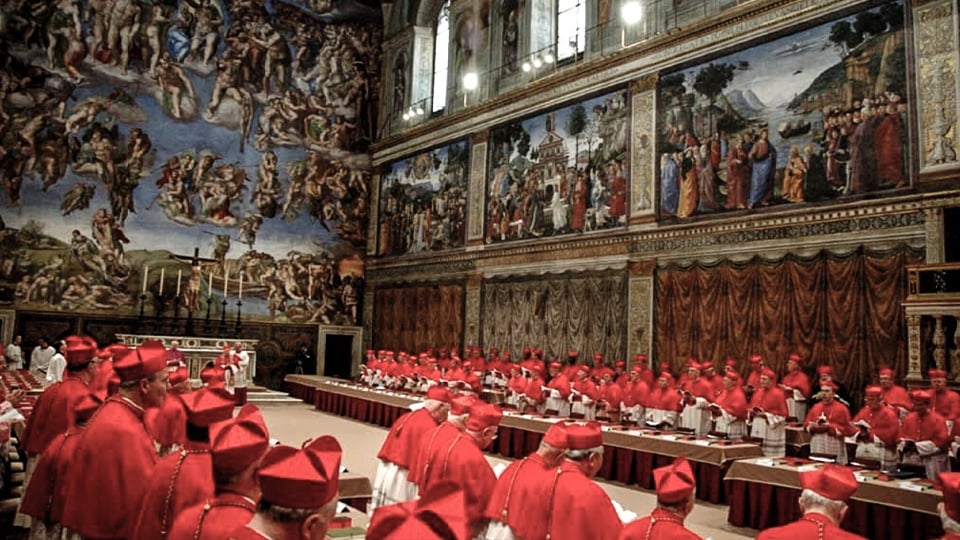

Eminences, you know that this situation in which the hierarchy of the Church persecutes Traditional Catholics would be comical were it not so tragic. Please elect a shepherd for all Catholics, including those who humbly wish to follow the only Gospel that St. Paul would recognize as Christian.
Your Eminences: As you know, Traditional Catholics around the world are offering their prayers and sacrifices so that you will elect a pope who can truly follow God’s will in guiding the Catholic Church in these tumultuous times. As Cardinal Baldassare Reina said in his homily during the third day of Novendiales Masses for Pope Francis, you are tasked with finding a true shepherd who will proclaim the Gospel:
“To seek a shepherd today means above all to seek a guide who knows how to manage the fear of loss in the face of the demands of the Gospel. To seek a shepherd who bears the gaze of Jesus — the epiphany of God’s humanity in a world marked by inhumanity. To seek a shepherd who confirms that we must walk together, integrating ministries and charisms: We are the people of God, constituted to proclaim the Gospel.”
While many members of the College of Cardinals may disagree with Traditional Catholics on some aspects of proclaiming the Gospel, we are all called to abide by the teaching of St. Paul, who assured us that the Gospel cannot mutate over time to become something that conflicts with what it once was:
“But though we, or an angel from heaven, preach a gospel to you besides that which we have preached to you, let him be anathema. As we said before, so now I say again: If any one preach to you a gospel, besides that which you have received, let him be anathema. For do I now persuade men, or God? Or do I seek to please men? If I yet pleased men, I should not be the servant of Christ.” (Galatians 1:8-10)
Surely St. Paul must have known how vital it is to always preach the same Gospel, otherwise he would not put such great emphasis on the point. It is interesting that he suggested that the likely cause for preaching a different Gospel would be a desire to please men rather than God. And, indeed, throughout the Church’s history we have seen that most attempts to preach a new Gospel have stemmed from attempts to please men rather than God.
At its core, Traditional Catholicism is nothing other than the set of Catholic beliefs and practices animated by the desire to remain faithful to these insights from St. Paul, which have been confirmed by the Church’s saints and revered theologians for two thousand years.
St. Paul also taught us that the wisdom of God and the wisdom of the world will always be in conflict:
“For Christ sent me not to baptize, but to preach the gospel: not in wisdom of speech, lest the cross of Christ should be made void. For the word of the cross, to them indeed that perish, is foolishness; but to them that are saved, that is, to us, it is the power of God. For it is written: I will destroy the wisdom of the wise, and the prudence of the prudent I will reject. Where is the wise? Where is the scribe? Where is the disputer of this world? Hath not God made foolish the wisdom of this world? For seeing that in the wisdom of God the world, by wisdom, knew not God, it pleased God, by the foolishness of our preaching, to save them that believe. For both the Jews require signs, and the Greeks seek after wisdom: But we preach Christ crucified, unto the Jews indeed a stumblingblock, and unto the Gentiles foolishness: But unto them that are called, both Jews and Greeks, Christ the power of God, and the wisdom of God. For the foolishness of God is wiser than men; and the weakness of God is stronger than men.” (1 Corinthians 1:17-25)
As St. Paul wrote, those who follow the wisdom of God — which is anathema to the world — will be saved; those who follow the wisdom of the world — which is anathema to Christians — will perish. So those who seek to adhere to the unadulterated Gospel will appear foolish to the world, but we know with absolute certainty that this is the way of salvation.
At its core, Traditional Catholicism is nothing other than the set of Catholic beliefs and practices animated by the desire to remain faithful to these insights from St. Paul, which have been confirmed by the Church’s saints and revered theologians for two thousand years. These beliefs and practices often come into conflict with many of the ideas and inclinations involved with the implementation of Vatican II, which is why Francis referred to Traditional Catholics as rigid and backward. Somewhat ironically, though, Traditional Catholics generally tend to be far more likely than our detractors to believe certain key passages of the Vatican II documents, such as:
- “Therefore the Apostles, handing on what they themselves had received, warn the faithful to hold fast to the traditions which they have learned either by word of mouth or by letter (see 2 Thess. 2:15), and to fight in defense of the faith handed on once and for all (see Jude 1:3).” (from the Council’s Dogmatic Constitution on Divine Revelation, Dei Verbum)
- “Therefore those men cannot be saved, who though aware that God, through Jesus Christ founded the Church as something necessary, still do not wish to enter into it, or to persevere in it. Therefore though God in ways known to Himself can lead those inculpably ignorant of the Gospel to find that faith without which it is impossible to please Him (Heb. 11:6), yet a necessity lies upon the Church (1 Cor. 9:16), and at the same time a sacred duty, to preach the Gospel. And hence missionary activity today as always retains its power and necessity.” (from the Council’s Decree on the Missionary Activity of the Church, Ad Gentes)
- “All the Church’s children should remember that their exalted status is to be attributed not to their own merits but to the special grace of Christ. If they fail moreover to respond to that grace in thought, word and deed, not only shall they not be saved but they will be the more severely judged.” (from the Council’s Dogmatic Constitution on the Church, Lumen Gentium)
- “Religious freedom, in turn, which men demand as necessary to fulfill their duty to worship God, has to do with immunity from coercion in civil society. Therefore [the Council] leaves untouched traditional Catholic doctrine on the moral duty of men and societies toward the true religion and toward the one Church of Christ.” (from the Council’s Declaration on Religious Freedom, Dignitatis Humanae)
- “While helping the world and receiving many benefits from it, the Church has a single intention: that God’s kingdom may come, and that the salvation of the whole human race may come to pass. . . . For God’s Word, by whom all things were made, was Himself made flesh so that as perfect man He might save all men and sum up all things in Himself. The Lord is the goal of human history, the focal point of the longings of history and of civilization, the center of the human race, the joy of every heart and the answer to all its yearnings. He it is Whom the Father raised from the dead, lifted on high and stationed at His right hand, making Him judge of the living and the dead. Enlivened and united in His Spirit, we journey toward the consummation of human history, one which fully accords with the counsel of God’s love: ‘To reestablish all things in Christ, both those in the heavens and those on the earth’ (Eph. 11:10). The Lord Himself speaks: ‘Behold I come quickly! And my reward is with me, to render to each one according to his works. I am the Alpha and the Omega, the first and the last, the beginning and the end (Rev. 22:12-13).’” (from the Council’s Pastoral Constitution on the Church in the Modern World, Gaudium et Spes)
Many of those who denounce Traditional Catholics for “rejecting Vatican II” would not agree with the true meaning of these key passages were they to read them. And yet we who believe the letter and spirit of these passages are often persecuted for not following what the Council taught.
Anyone familiar with the Synod on Synodality will recognize that Benedict XVI was criticizing its key features: “There were those who sought the decentralization of the Church, power for the bishops and then, through the expression ‘People of God,’ power for the people, the laity.” Traditional Catholics agree with Benedict XVI in criticizing these features of the Synodal Church.
Another irony that may hit closer to home for some members of the College of Cardinals comes from Pope Benedict XVI’s farewell address to the clergy of Rome, in which he decried the reality that the “Council of the media” — which he said “created so many disasters, so many problems, so much suffering” — involved a power struggle between different trends in the Church:
“I would now like to add yet a third point: there was the Council of the Fathers – the real Council – but there was also the Council of the media. It was almost a Council apart, and the world perceived the Council through the latter, through the media. Thus, the Council that reached the people with immediate effect was that of the media, not that of the Fathers. And while the Council of the Fathers was conducted within the faith – it was a Council of faith seeking intellectus, seeking to understand itself and seeking to understand the signs of God at that time, seeking to respond to the challenge of God at that time and to find in the word of God a word for today and tomorrow – while all the Council, as I said, moved within the faith, as fides quaerens intellectum, the Council of the journalists, naturally, was not conducted within the faith, but within the categories of today’s media, namely apart from faith, with a different hermeneutic.
It was a political hermeneutic: for the media, the Council was a political struggle, a power struggle between different trends in the Church. It was obvious that the media would take the side of those who seemed to them more closely allied with their world. There were those who sought the decentralization of the Church, power for the bishops and then, through the expression ‘People of God,’ power for the people, the laity. There was this threefold question: the power of the Pope, which was then transferred to the power of the bishops and the power of all – popular sovereignty. Naturally, for them, this was the part to be approved, to be promulgated, to be favoured. So too with the liturgy: there was no interest in liturgy as an act of faith, but as something where comprehensible things are done, a matter of community activity, something profane. And we know that there was a tendency, not without a certain historical basis, to say: sacrality is a pagan thing, perhaps also a thing of the Old Testament. In the New Testament it matters only that Christ died outside: that is, outside the gates, in the profane world. Sacrality must therefore be abolished, and profanity now spreads to worship: worship is no longer worship, but a community act, with communal participation: participation understood as activity. These translations, trivializations of the idea of the Council, were virulent in the process of putting the liturgical reform into practice; they were born from a vision of the Council detached from its proper key, that of faith.”
Anyone familiar with the Synod on Synodality will recognize that Benedict XVI was criticizing its key features: “There were those who sought the decentralization of the Church, power for the bishops and then, through the expression ‘People of God,’ power for the people, the laity.” Traditional Catholics agree with Benedict XVI in criticizing these features of the Synodal Church.
So this Final Document grants to Protestants who detest the Catholic Church something which many of the Final Document’s authors routinely deny to Traditional Catholics: a voice in safeguarding the true Gospel message that St. Paul assured us could never change.
A final irony to consider is from the Final Document of the October 2024 session of the Synod, speaking of the sensus fidei of all baptized people:
“Through Baptism ‘the holy People of God has a share, too, in the prophetic role of Christ, when it renders Him a living witness, especially through a life of faith and charity” (LG 12). The anointing by the Holy Spirit received at Baptism (cf. 1 Jn 2.20. 27) enables all believers to possess an instinct for the truth of the Gospel. We refer to this as the sensus fidei. This consists in a certain connaturality with divine realities, based on the fact that, in the Holy Spirit, the baptised become ‘sharers in the divine nature’ (DV 2). This participation enables the capacity for the faithful to grasp intuitively that which is in conformity with the truth of Revelation in the communion of the whole Church. This is the reason why the Church is certain that the holy People of God cannot err in matters of belief. . . .The sensus fidei aims at reaching a consensus of the faithful (consensus fidelium), which constitutes ‘a sure criterion for determining whether a particular doctrine or practice belongs to the apostolic faith’ (ITC, Sensus fidei in the life of the Church, 2014, 3).” (Paragraph 22)
“All Christians participate in the sensus fidei through baptism. Therefore, as well as constituting the basis of synodality baptism is also the foundation of ecumenism.” (Paragraph 23)
Eminences, you know that this is a true innovation, one which the great theologians would have rejected without the slightest hesitation: non-Catholics obviously do not participate in the Sensus Fidei of the Catholic Church. So this Final Document grants to Protestants who detest the Catholic Church something which many of the Final Document’s authors routinely deny to Traditional Catholics: a voice in safeguarding the true Gospel message that St. Paul assured us could never change.
Eminences, you know that this situation in which the hierarchy of the Church persecutes Traditional Catholics would be comical were it not so tragic. Please elect a shepherd for all Catholics, including those who humbly wish to follow the only Gospel that St. Paul would recognize as Christian. Immaculate Heart of Mary, pray for us!
Latest at RTV — The Pope & the Conclave: Can the Church Survive Francis II?