
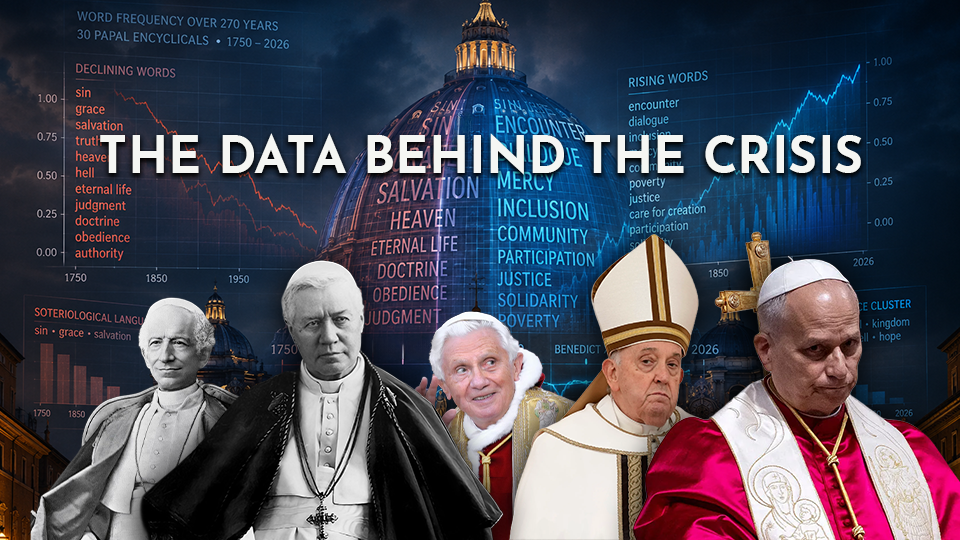

The Statistical Case for the Crisis in the Church
‘When tenderness is detached from the source of tenderness, its logical outcome is terror.‘
FLANNERY O’CONNOR wrote that in 1961. Robert Morrison’s May 1 article in these pages recovered her warning for the current moment, and the recovery is timely. When truth and tenderness, both good in themselves, are separated, each becomes something it was never meant to be. The Group 9 May 5 Final Report from the Synod on Synodality offers a perfect example of how language shapes new ideas. Those new ideas are not necessarily Catholic ones, but substituting the traditional ideas for new ones under the guise of the old, familiar Catholic words.
Both O’Connor and Morrison diagnosed what happened, but one of the questions that remain is about ‘how’. The corpus data I assembled confirms the diagnosis empirically, and opens a window to see how the new ideas traveled all the way to the top of the Church, often through the words of people who would never consciously reject the faith.
For the first time, corpus analysis claims to measure a centuries-long shift in the Church’s theological vocabulary.
This article would not be the first to name formation networks as the vehicle of such new ideas. One could point at Liberation theology, how Libertatis Nuntius offered a stern warning, which was ignored by its proponents such as Father Gustavo Gutiérrez, who went on to teach theology at the University of Notre Dame. They, side by side with the many materialist professors in Western universities, shaped the next generation of priests, religious and lay people, especially those interested in activist or mission work. As these driven people ventured out and reached positions of authority in the Church, parishes, NGOs, charities, schools, and so on, whole new generations were educated with a specific worldview.
Some went on to lead groups such as Pax Christi, others, such as Cardinal Turkson, became head of the Pontifical Council for Justice and Peace, and others still, such as Fr. John Dear, became peace activists. When Cardinal Turkson held the 2016 peace conference at the Vatican, people from Pax Christi and John Dear spoke, rejecting not just war by itself, but the whole Just War doctrine. Their final statement became the foundation for Pope Francis’ 2017 Peace Message, including, as John Dear gloated, “our main points, even some of our exact language.” And suddenly non-Catholic ideas made it to papal statements, now cited as foundational, and the cycle is complete.
This does not require any conspiracy to make that happen, just the slow change in schools, then in organizations, which then seeps into the Church as highly respectable activists, missionaries, and aid workers.
I mentioned a corpus data analysis at the opening of this article. Looking at 30 encyclicals, from 6 historical periods (from 1750 to Francis), using 11 thematic word clusters and normalized word frequency, it shows how the vocabulary used by the Church changed over time, supporting the claim that a materialist anthropology quietly entered, substituting the traditional Catholic moral and theological discourse. The link to the article with the full study is here.
Words like sin, grace, salvation, truth, and heaven have steadily declined, while pastoral and social language has steadily risen.
This was a preliminary study, using normalized word counts of a selection of teaching documents, and not a full semantic analysis over all available documents. The results were surprising in their detail.
Three of those findings bear on the present moment. First, we can see a soteriological collapse, where words such as sin, grace, and salvation are, under Francis, at their lowest point in 270 years, lower even than pre-1850. Instead of talking about what humans are to be saved from, how such salvation is received, there is a shift towards more structural economic words, such as poverty and economy, at the cost of words such as property, labor and capital. Which brings us to the point where in 2026 Cardinal Fernandez can talk about “the experience of an encounter that constitutes the foundation of everything.”
That line, criticized harshly when the document came out, was openly cited from Benedict XVI. Very subtly, however, Benedict’s understanding of that encounter was a meeting with the Logos Himself, as key to truth not just about God but about who we are as sinners in need of salvation. Under Fernandez, the same word becomes a pastoral alternative to doctrine, which is now treated as hindrance to salvation rather than the foundation thereof.
Next, it is very interesting to see what happens to words such as love and hope. Love rises continuously, peaks under Benedict, and remains elevated under Francis, but the problem lies elsewhere: truth declines. In a move that mirrors O’Connor’s stark words on tenderness uncoupled from Christ and truth, Caritas in Veritate warned of charity without truth becoming sentimentality. The data, making O’Connor’s diagnosis measurable, shows this is happening in the period after Benedict XVI.
At the same time, under Francis the ‘transcendence’ cluster, with the words hope, eternal, kingdom, heaven, resurrection, and hell, scores the very lowest. Hope reaches the second lowest level, while all other words almost disappear. Love without truth is as dangerous as a hope without an eternal focus.
Looking at 30 encyclicals spanning 270 years, the vocabulary used by the Church changed in measurable ways, quietly edging out the traditional Catholic moral and theological discourse.
Lastly, we can see a boundary collapse in the word frequencies. Even before Vatican II we see terms such as error, heresy, condemnation, and judgment decline strongly after 1850, matching the current state where a final report from the Synod on Synodality openly signals that it replaced ‘controversial issues’ with ‘emerging issues.’ The vocabulary substitution is no longer beneath the surface; it is being proposed as method.
At the same time, the use of the word Church declines to its lowest level, while words such as authority, doctrine, and obedience collapse completely. Now ‘Church’ stands alone, stripped of its authority-defining companions, becoming more of a community than a teaching office.
It is worth pointing out that this shift often went hand in hand with a growing ambiguity, now dropped on the shoulders of the laity to resolve. Every new document, with its shift in vocabulary and underlying anthropology, could still be read and perfectly understood in light of tradition, even if that is becoming increasingly difficult.
That is what the data shows us. Let’s take a step back now, and look at Matthew 13, which gives us the parable of the sower. Jesus likens us to seeds, some falling on or near the road, some on shallow ground, some among thorns, and some on good, fertile soil, and describes what happens after we receive the Word. Importantly, each seed received that word with joy! Most showed actual growth, shooting up! I always loved -and hated- this parable, which is much harder than its surface reading would suggest.
This parable must be read dynamically, not statically. The seed can be transplanted; the soil itself can be tilled; the believer is not merely acted upon by conditions but also acts within and upon them. Personal conversion and the slow work of changing the soil are not alternatives but a single labor.
Pope Benedict XVI stands out as a measurable exception—reuniting truth, love, and transcendence in a way unique within the modern period.
Looking at those seeds that showed growth, those who fell on shallow soil can be likened to those who embraced the faith, and see themselves as Catholics, affirming God. Yet the soil they grow in is shallow so they have no roots, as Christ said, and when pressure comes they cannot hold. Read against the modern condition, the rootlessness is philosophical: they lack the framework needed to hold what Catholic teaching requires. Meanwhile, those who grew up among thorns, who also affirm God and remain ostensibly Catholic, are those in whom a competing worldview has taken root alongside the faith, a worldview that progressively strangles the shoot before it can bear fruit, often without the believer noticing.
This is important, and it maps cleanly on the situation modern thinking has created. Very quietly, the nominalist ideas underpinning a lot of enlightenment ideas, later growing into Marxism and Modernism, trained many people, even good Catholics, that every sign only held one and only one signified. Such an innocent looking poison of the mind! This is the root of the problem where people think in ‘either/or’, and can no longer hold multiple realities, at different levels, at the same time, in the very traditional Catholic ‘both/and.’
Where Catholic teaching gave rise to both Fr. Ryan, looking at the immediate needs of the poor, and also to Cardinal O’Connell, looking at the wider picture, long term, the either/or framework demands to pick one: Ryan OR O’Connell. Love OR truth. Mercy OR justice. Mystery OR scientific fact. Nature OR grace.
Notice also how O’Connor’s “tenderness detached from the source of tenderness” is indeed the love-only failure mode, but the inverse holds the truth-only failure mode, or ‘being right alone is not enough, as without love…’.
Amidst the many injustices of the world, many became like Fr. Ryan and worked to alleviate the many immediate needs of those suffering, a position that was very susceptible to ideological capture and this substitution of framework and vocabulary.
The Synodal documents are not anomalies, but the surfacing of a substitution that has been measurable in the Church’s own language for the last sixty years.
Both the shallow soil and thorny soil seeds are Catholics, or see themselves as such, and both try to reconcile Catholic morality and teaching with either what the world offers, or what their own competing worldview demands. What is needed is not just a fuller conversion (don’t we all need that, every day again?) nor even more or better theology or doctrine. Instead, a philosophical recalibration is required, which is somehow an even harder proposition.
This is where pope Benedict XVI comes back into the spotlight. His documents form a measurably distinct profile in the corpus, with the highest transcendence score, with truth and love firmly bound together, and the pastoral vocabulary present but controlled. He took the modern pastoral language, but firmly anchored it in tradition, demonstrating that the realist both/and can still be inhabited in the present: pastoral engagement at full depth without surrender.
To show that a different way: Benedict XVI gave a famous address to the Roman Curia in December 2005 in which he distinguished two interpretations of Vatican II: the “hermeneutic of discontinuity and rupture” and the “hermeneutic of reform in continuity.” Benedict identified the hermeneutic of rupture as the principal source of the post-conciliar crisis, and he argued, repeatedly across his papacy, that the only legitimate reading of Vatican II was the reading that situated it within the continuous tradition. This was the central interpretive task of his pontificate, building on the attempts of St. John Paul II to stabilize the changes happening after Vatican II.
The final reports from the Synod on Synodality show something different, however. They worry about tenderness, dialogue, encounter, (social and environmental) justice, but are averse of the harsh language of sin, conversion, doctrine, obedience, and sacrifice. Not in continuity with tradition, but hiding behind the words of tradition, smuggling in a philosophical framework that is not compatible with the faith. Few see it, because our whole world has seemingly embraced that framework, even when rejecting its worst excesses such as communism or atheism in seemingly ‘neutral’ positions. Yet the root of those materialist views is pervasively present, everywhere.
As such, those synodal documents are no anomalies, but represent the surfacing of a substitution that is measurable in the Church’s own language for the last sixty years (with very notable counters, as well), but now stated openly as method. There is nothing new, there, as the Church has weathered similar storms before (ask Athanasius or Nicholas). Then, and now, naming the substitution is the precondition for resisting it. Naming the philosophical on-ramp (namely the loss of being able to hold ‘both/and’ which makes the substitution possible) is the precondition for understanding why even faithful Catholics transmit what they would reject if they saw it clearly. That window of recalibration and conversion is not infinite. Pope Benedict XVI, however, showed that recovery is available, recognizing that for most the seed was indeed received with joy, which he grounded back in hope, truth and love: tradition is waiting.