
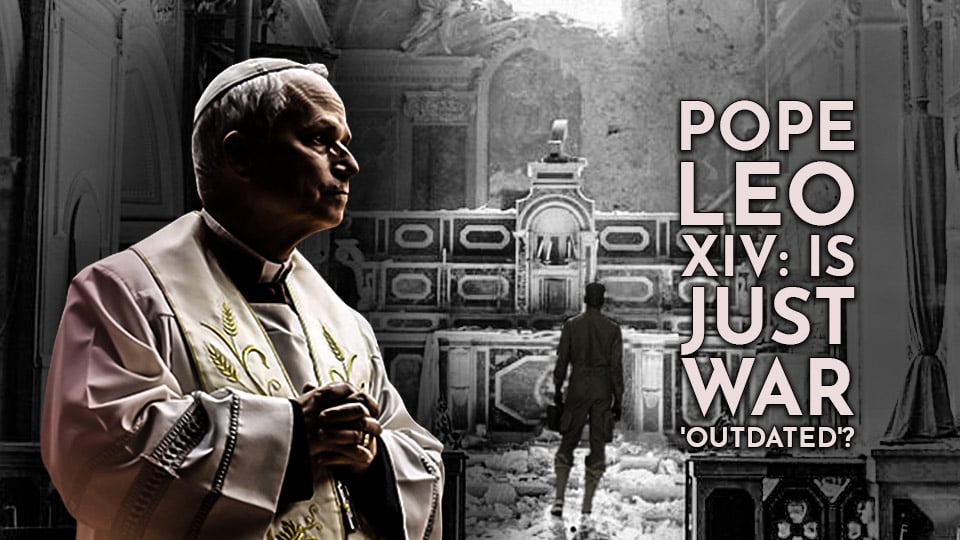

Just War Theory is abused and misunderstood, but not outdated…
Legitimate Self Defense
A nation has the right to defend itself and its people. This principle is codified in Article 51 of the UN Charter, and as Catholics we observe this as one of the principles of the just war laid out by Saint Thomas Aquinas in the 13th century. The other conditions under which a nation may go to war are that the conflict must come as a last resort, it must be declared by competent authority, and there must be a reasonable chance of success. The correct conduct of the war requires that proportionality be exercised and injury or death of noncombatants must be avoided. We can find these principles described in the Catechism of the Catholic Church, starting at #2307.
In his first encyclical, Magnifica Humanitas, Pope Leo appears to be relegating this decision-making process to the dust bin by declaring that the Just War theory is now outdated. As Catholics who take the Church seriously, we are bound to give the Pope’s words our serious consideration. This pronouncement, however, is not infallible, and the circumstances that have led him to address modern warfare it in this manner and arrive at this conclusion should be examined.
It is dangerous for the entire world when Church leaders replace precise Catholic doctrine with empty platitudes.
The exact words, from the encyclical are as follows:
“Today, more than ever, without prejudice to the right to self-defense in the strictest sense, it is important to reaffirm that the “just war” theory, which has all too often been used to justify any kind of war, is now outdated.”
This is followed by a footnote referencing the October 2020 encyclical Fratelli Tutti, by his predecessor, Pope Francis, who says something entirely different in the referenced text:
“In recent decades, every single war has been ostensibly ‘justified.’ The Catechism of the Catholic Church speaks of the possibility of legitimate defense by means of military force, which involves demonstrating that certain ‘rigorous conditions of moral legitimacy’ have been met. Yet it is easy to fall into an overly broad interpretation of this potential right. In this way, some would also wrongly justify even ‘preventive’ attacks or acts of war that can hardly avoid entailing ‘evils and disorders graver than the evil to be eliminated.’”
In other words, Francis is stating that in recent decades it has become commonplace for nations to go to war while falling short of meeting the rigorous conditions of moral legitimacy to do so. In this, he is, unfortunately, correct; it has become commonplace. But these two popes are saying two different things. Francis is saying that we’re falling short of meeting the moral legitimacy for just war. Leo is saying that he’s “reaffirming” that the just war theory is now outdated, according to his predecessor, and he’s attempting to support this assertion by taking a quote from Francis that in no way supports it.
Pope Leo goes on:
Humanity possesses far more effective and capable tools for promoting human life and resolving conflicts, such as dialogue, diplomacy and forgiveness.
Dialogue and diplomacy are excellent tools for resolving conflicts among people of good will, and in particular among Catholics. These tools should be used to resolve issues with the SSPX, for example. It would be good for those who preach dialogue and diplomacy to put these tools for resolving conflict into practice, but for now we will focus on armed conflict.
When confronted with someone who believes that your nation, your Faith, or your way of life should cease to exist and who is willing to use armed force to that end, dialogue and diplomacy may or may not be effective, and if they are not, we have a right to defend ourselves. The Church should be there with Her timeless wisdom to guide mankind, at least those who are willing to listen, on how to participate in armed conflict in a way that minimizes harm.
He continues:
The use of force, violence and weapons reflects a relational poverty that always has disastrous consequences for civilian populations.
This is correct, but what would be even more disastrous for a civilian population would be to fail to defend themselves when confronted by an enemy that believes that they should cease to exist. The just war theory is there to guide the effort, in order to avoid unnecessary violence or the national suicide that would result from failure to act in legitimate self-defense.
The problem is not the Just War theory itself, but the abandonment of the traditional Catholic framework that once guided its application.
Iran: A Thoroughly Vatican II Quagmire
St. Thomas Aquinas came long before Vatican II, and for that reason alone his thinking no longer applies in the minds of many contemporary Catholics who seem to believe that the Catholic Church was born in the 1960s. Herein lies the problem with having created the mirage of a new church, having a new liturgy and new theology, and forbidding old practices and ways of thinking. Now, after several decades of “Springtime,” those leading the Church lack the intellectual tools to make sound arguments for the constraint of military activities. Leo XIV and a number of bishops, archbishops and cardinals have complained that the war in Iran is not a just war, but many of them do so using the weak and unconvincing language of Vatican II instead of the clear and precise language of St. Thomas. They are justifiably horrified by war, but they seem to have no understanding of the subject and can only provide empty platitudes about dialogue, diplomacy and forgiveness. They are incapable of guiding the dangerous world that we live in. They seem to have no experts to turn to for advice who are statesmen and senior military officers and who are also serious Catholics who understand the teaching regarding the justified use of military force. Perhaps there’s a link between the fact that such people are few and far between and the fact that in recent decades tradition-minded Catholics have been forced from polite society and discouraged altogether from serving in the military [1]. Most Catholics either abandoned their Faith or accepted a new world view, and a form of worship that goes with it, that seems to shift the emphasis of everything from God to man.

When we speak of the “just war,” in whose eyes are we hopeful that it will appear “just?” To ask the question a different way, “whose judgement do we fear?” To contemporary man, this justification is only necessary for public consumption. The just war criteria are to be used as talking points. If you can successfully convince the right voting block that your cause is just by presenting good arguments, hiding certain evidence, and building a solid narrative, then that makes it justified. As traditional Catholics, however, we understand that it is God’s judgement, not Man’s, that we fear. We do not labor through the points of the just war theory in order to convince our fellow humans, but rather to pursue the campaign with a free conscience. We understand that if we are guilty of violating these strict criteria, (and they are rightfully strict) then we will suffer eternal consequences. Therefore, if we see that people around us are attempting to make excuses for wars that cannot be justified and falling short of meeting the rigorous conditions for moral legitimacy, we do not simply throw our hands up in the air and decide that the just war theory is “outdated.” That is not even an option. It would be wrong to claim that this timeless intellectual treasure given to us by St. Thomas Aquinas is somehow outdated simply because it is being widely disregarded or abused. Instead, the abuses of it should be addressed and we should double down on efforts to ensure that its principles are interpreted and understood in an honest manner.
Given several decades of marginalization of those who take the traditional teachings of the Church seriously, it is no surprise that the just war theory is misused by those in our military and the national command authority. This latest quagmire in Iran provides a timely example of how those involved in the decision-making process use the criteria to justify their actions to a human audience with no regard for the eternal consequences. Upon closer examination, this war effort has been a failure on every single point of the just war doctrine.
Dialogue and diplomacy are excellent tools among people of good will—but they are insufficient when confronting those committed to your destruction.
Last Resort
Our bombing of Iran, which began on Saturday, February 28, was not a last resort. In fact, we were in the middle of a round of negotiations. Late in the day on February 27 Oman’s Foreign Minister Badr Al Busaidi, who was mediating the negotiations between the US and Iran, said: “I am confident, and in my assessment of the way the talks are going, I think there is, really I can see that the peace deal is within our reach. … if we just allow diplomacy the space it needs to get there. Because I don’t think any alternative to diplomacy is going to solve this problem.” [2] Negotiations were due to continue after the weekend, but instead we began bombing Iran a few hours later. How can one claim that this was a last resort if we began dropping bombs in the middle of negotiations? By the admission of our Secretary of State, Marco Rubio, we had to attack Iran because Israel was about to do so, and therefore it was necessary for us to participate in order to avoid the destruction of our bases in the region…many of which were destroyed in the aftermath anyway. Follow the twisted logic.
Furthermore, we had done the same thing a few months earlier. Operation “Midnight Hammer” was commenced in the middle of a round of negotiations. Apparently we use negotiations to lull other nations into a sense of security so that we can bomb them. The long-term consequences of this dishonorable behavior are yet to be seen.
Just Cause
A nation has a right to defend itself from an immediate threat. The leaders who make the call to go to war must be doing so to protect the innocent and vulnerable, and they have the obligation to conduct war with the ultimate aim of ensuring a lasting peace. What was the immediate threat here? If Iran has been chanting “death to America” for the past 40 years, then how can we suddenly claim that the threat is imminent, urgent, and immediate? Here we will be reminded that we do not have access to the highly-classified information that the National Command Authority has. True, we do not have such access. But clearly, there was no nuclear weapons program, so this recent attack against Iran did not save us from one. It is also important to point out that in October 2003, Supreme Leader Ali Khamenei issued an oral Fatwa forbidding the production and use of WMD in any form. A Fatwa is somewhat similar in scope and application to what we call an encyclical. [3]
For those who will argue that we cannot trust the Iranians, Fatwa or not, then, by the President’s own words, the facilities were buried under rubble in 2025 and our satellites have been watching it since then. The Director of National Intelligence at the time, Tulsi Gabbard, confirmed this. It was therefore physically impossible for Iran to have been two weeks away from building a nuclear bomb, which was the claim that some were using to justify this action.
The Church should be there with her timeless wisdom to guide mankind, not surrender centuries of moral teaching to modern confusion.
Proportionality
In order for a war to be a just war, proportionality must be exercised. The military force that is applied must be proportional to the offence that is being addressed. Our war efforts in Iran fail on this point as well. There was nothing in the situation that existed in Iran prior to February 28 that would justify the assassination of a foreign leader; in fact, doing so was a barbaric act unbecoming of our nation. Within the West, the assassination of foreign leaders has been prohibited since the Treaty of Westphalia in 1648. The Duke Center for Firearms and Law points out that the “…prohibition on targeting sovereign leaders has been so robust that only ten leaders have been assassinated by a foreign state between 1875 and 2004.” [4]
Nevertheless, during the initial strikes on Iran February 28, 2026, a coordinated U.S.–Israeli strike killed Iranian Supreme Leader Ayatollah Ali Khamenei in Tehran. This act was completely out of proportion to the threat that we supposedly faced. To make matters worse, in taking out the Ayatollah (along with a few family members) we removed the cleric who had issued the Fatwa in which the development of nuclear weapons was forbidden
Declaration by Competent Authority
In order for a war to be a just war, it must be declared by competent authority. The use of military force must fall under the laws governing the nation, which in our case requires that the War Powers Act are invoked. A rogue general (or president) should not initiate a conflict, but that is exactly what is happening in this case. Our president, who fought his way into the office he now holds with the promise of “no more stupid wars in the Middle East,” chose to follow the advice of those pressuring him into getting us involved in the conflict. Shortly after the operation began, Congress, which has the power to declare war under our Constitution, actually voted against resolutions that would have required the Trump administration to seek congressional approval for military action as required by the War Powers Act. In other words, they voted in favor of not fulfilling their responsibilities. [5] A few months later, as support for the effort slipped and the political landscape began to shift, a majority passed a measure requiring the President to remove U.S. Armed forces from hostilities in Iran. [6] This change of heart has been a result of hearing from constituents, but it reveals a flaw in the way the just war theory is understood among those making decisions. The decision to go to war against Iran was never about doing what is right in the eyes of God, it was about satisfying some human demand for conflict. That conflict became too costly and the decision-makers began backpeddeling.
Avoid Injury or Death of Noncombatants
Injury or death of noncombatants must be avoided at all costs if engagement in armed conflict is to be justified, and on this point we failed miserably. How did we end up targeting a girls’ school during the initial strike? Somehow we targeted the Shajareh Tayyebeh Elementary School in Minab, resulting in the deaths of over 150 civilians, including more than 120 school girls. [7] Our targeting is better than this. Was AI used for targeting? Were we given this particular target by some nefarious Middle-East “ally” intent on ensuring that we would strike a target whose impact would ensure that the emotions of the Iranians were enflamed, so as to make our backing out of the war difficult? Was it just incompetence? Whatever the reason, the damage caused by this targeting failure will last for generations. As Catholics we understand that if the targeting of a girls’ school was deliberate, the consequences of this barbaric act will be eternal.
The decision to go to war should never be about satisfying human demands for conflict, but about acting rightly before God.
Reasonable Chance of Success
It’s not entirely clear what our military objective was. According to some it was to end a nuclear program that didn’t even exist. Such a military campaign would be doomed to failure since it’s being carried out against a mirage. According to others it was a change of regime. Our National Command Authority seems to have believed that by killing a few key people in leadership positions we would be able to create an uprising that would cause an Iranian version of Thomas Jefferson to rise to power. Not only did this not happen, it unified the highly diverse factions in Iran against the US and Israel. Iran is a nation of 90 million people, and it’s half the size of USA with terrain like the Rocky Mountains, so a ground invasion on our part is not an option. Closing off the Strait of Hormuz was always an option for Iran. That can be done as easily as placing mines, using drones, and placing small artillery nearby on the banks of the Strait of Hormuz. There is little we can do to reopen the Strait of Hormuz, which was open prior to hostilities, other than to meet the Iranian demands.
Quagmire Extraction Strategy
We know that the Israelis have disproportionate influence over the decisions made by our National Command Authority. This disproportionate influence comes from political donations and lobbying that, in effect, renders us a colony of Israel. Our military personnel and hardware and other resources are used to carry out their foreign policy with little regard for the actual interests of the US. We also know that the Israelis have zero interest in what Saint Thomas had to say about a just war. Nevertheless, it is all too easy to blame Israel for dragging us into conflicts in the Middle East. While we continue fighting their war against Iran on their behalf, they are taking portions of Lebanon as a part of their “Greater Israel” project. All of this is our fault for turning over our sovereignty to them. The solution is to simply reassert our sovereignty, recognize the Christian heritage of the vast majority of our country, and act on Christian principles. What has made Western Civilization superior over the centuries is precisely the fact that our laws have been based on Christian doctrine. That includes the just war criteria coming from St. Thomas, instead of “an eye for an eye” which is the law of the Middle East. The solution is NOT to abandon the guiding principles of the just war. In their mad dash to run away from the preconciliar liturgy and doctrine, our Church leadership is giving license to abandon the moral high ground.
In order to get out of this quagmire, it would be good to start by recognizing that it is at least partly a result of the postconciliar rejection of traditional Catholic thinking. Those who think like Catholics have been marginalized, and they are generally few and far between among the decision makers on decisions of strategic and national importance. Everything that came before “The Great Council” (1962-1965) has ceased to have any relevance in contemporary society thanks to the recent popes, with the exception of Pope Benedict, and the vast majority of the bishops of the past 50 years. Western Civilization is that civilization that grew out of traditional Western Christianity, which very few people practice today. Those few who do practice traditional Western Christianity have been marginalized for the past few decades. When the timeless prayers that had been at the heart of Western Civilization for 1500 years were suppressed, it was inevitable that the churches would empty and Christianity would slowly fade into the background and cease to be a moral force.
There are two general paths forward at this point. One would be for the Pope and the bishops to continue to complain about unjust wars and use words such as “dialogue,” “diplomacy” and “forgiveness” as they fade into irrelevance. This is dangerous to the entire world. The other way forward, and the only way out of the quagmire, is for Pope Leo and the bishops to lift the ridiculous restrictions on the preconciliar liturgy and the doctrine and ways of thinking that go with it. The traditional Catholicism that they’re trying to purge from the Church includes a proper and serious understanding of the just war theory. Perhaps it would be good for the Pope and the bishops to exercise some of the dialogue, diplomacy and forgiveness that they are preaching, and recognize that those who retain an attachment to the traditional ways of being Catholic just might have something to offer.
______________
[1] This assertion is made on my own personal experience, which is carefully documented and demonstrated in “Rites and Wrongs”, Os Justi Press: https://osjustipress.com/products/rites-and-wrongs-sonnier?_pos=1&_sid=6aabf38dd&_ss=r
[2] https://www.cbsnews.com/news/full-transcript-omani-foreign-minister-badr-albusaidi/
[3] https://www.washingtoninstitute.org/uploads/Documents/pubs/PolicyFocus115.pdf
[4] https://firearmslaw.duke.edu/2020/08/assassinating-sovereigns-and-american-foreign-policy
[5] The Senate voted on March 4, 2026, rejecting a war powers resolution in a 53-47 vote that would have required the Trump administration to seek congressional approval for military action. The House voted on March 5, 2026, rejecting a similar war powers measure.
[6] On May 19, 2026, the Senate voted 50-47 to advance a war powers resolution (185) aimed at forcing President Donald Trump to end military hostilities against Iran unless he receives explicit congressional authorization. On June 3, 2026 the U.S. House of Representatives passed House Concurrent Resolution 86 by a vote of 215 to 208.